


Burning incense can make a home feel peaceful, familiar, and welcoming. For many people, it is part of meditation, prayer, relaxation, or cultural tradition. But incense is also a combustion source. The smoke contains fine particles and gaseous compounds, so how to ventilate a room when burning incense matters just as much as where you place the incense itself.
The goal is not to eliminate every trace of fragrance. It is to prevent smoke from building up indoors.
The U.S. Environmental Protection Agency (EPA) identifies source control, ventilation, and filtration as three complementary ways to improve indoor air quality. EPA also specifically advises that proper ventilation should be available when burning candles and incense indoors.
This guide explains the practical steps that can help reduce incense smoke indoors while keeping fire safety in mind.
How to Ventilate a Room When Burning Incense
The simplest answer is to create a path for fresh outdoor air to enter while smoky indoor air leaves.
Think of the room as having an air-flow route:
Fresh outdoor air → room → incense smoke → exhaust opening → outdoors
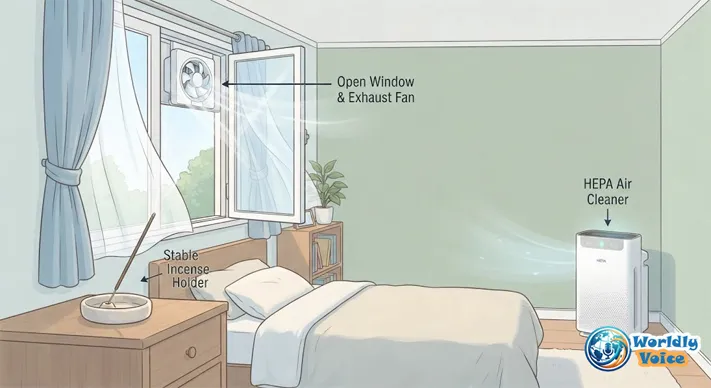
For most homes, a practical setup includes:
- Open a suitable window or exterior opening.
- Open a second window or door when conditions allow cross-ventilation.
- Use a bathroom or kitchen exhaust fan if it vents outdoors.
- Keep the incense away from strong drafts.
- Burn only a small amount at a time.
- Avoid sitting directly in the smoke plume.
- Continue ventilation after extinguishing the incense.
- Use a properly sized portable air cleaner when additional particle removal is needed.
A fan that merely moves air around the room is not the same as ventilation. For incense smoke ventilation, the important question is where the air goes. If smoky air simply circulates back toward you, the smoke has not actually been removed.
EPA guidance similarly recommends bringing outdoor air indoors and using exhaust fans that discharge outdoors to help remove indoor pollutants.
1. Start Ventilation Before Lighting the Incense
Do not wait until the room is visibly smoky.
Open the appropriate window or establish an exhaust route before lighting the stick, cone, coil, or resin. This gives combustion products somewhere to go from the beginning.
For example, in a small bedroom with one window, opening the window slightly and keeping the bedroom door open may provide better air exchange than closing everything and trying to remove the smoke afterward.
If outdoor air is heavily polluted, however, opening windows may not always be the best choice. Outdoor pollution can enter through open windows and doors, so ventilation decisions should consider the air outside as well as inside.
2. Create Cross-Ventilation When Possible
Cross-ventilation works by creating openings on different sides of a room or building.
A window can provide incoming air while another opening allows indoor air to leave. The exact airflow depends on wind direction, temperature differences, building design, and the position of the openings.
Avoid placing incense directly between two strong airflow paths. A powerful draft can scatter ash, disturb the burning material, or push smoke toward another person.
The aim is controlled air exchange, not maximum wind.
3. Use an Outdoor-Venting Exhaust Fan
An exhaust fan that actually discharges outdoors can be particularly useful.
A bathroom fan or kitchen exhaust system may help remove polluted indoor air when it is correctly installed and operating effectively. EPA notes that local exhaust fans that vent outdoors can directly remove contaminants from the room.
A ceiling fan, pedestal fan, or ordinary circulating fan is different. It may improve mixing but does not necessarily remove pollutants from the home.
Why Indoor Air Quality Matters When Burning Incense
Incense smoke is more than fragrance.
Combustion can produce fine particulate matter, volatile organic compounds, and other combustion-related substances. Fine particles known as PM2.5 are particularly important because they are small enough to remain airborne and penetrate deep into the respiratory system.
Research also shows that incense products do not all produce identical emissions.
A 2024 study conducted in a California residence by researchers associated with the University of California, Berkeley and Lawrence Berkeley National Laboratory found that burned incense produced organic PM2.5, with emission factors ranging from 7 to 31 mg per gram of incense burned. The researchers also found that incense-generated particles interacted with some semivolatile compounds already present indoors.
Another residential study involving 32 homes in Hanoi, Vietnam, found that PM2.5 increased substantially during incense-burning events. The average concentration during an event was approximately 201 µg/m³, with a one-minute peak of approximately 826 µg/m³. The study found that incense burning increased indoor PM2.5 concentrations after other factors were considered.
These figures should not be interpreted as the exposure produced by every incense stick in every home. Room volume, ventilation, incense composition, burn time, and the amount burned all matter.
The broader consensus is clearer: incense smoke is an indoor source of particulate pollution, and reducing exposure is sensible.
indoor air quality burning incense
Best Way to Ventilate Smoke From Incense
The best way to ventilate smoke from incense is to combine source reduction with directional ventilation.
That means producing less smoke in the first place, then giving the remaining smoke a route outdoors.
A practical smoke-removal routine
Step 1: Extinguish the incense.
Do not continue generating smoke while trying to clear the room.
Step 2: Open suitable exterior openings.
Use windows or doors that allow outdoor air to enter and polluted indoor air to escape.
Step 3: Turn on an exhaust fan that vents outdoors.
This can help establish directional airflow.
Step 4: Create an airflow path.
A second window or open door can provide replacement air.
Step 5: Run an appropriate air cleaner.
A portable HEPA-equipped unit can help remove airborne particles.
Step 6: Keep ventilating after visible smoke disappears.
A room can look clear while fine particles remain suspended or have deposited on surfaces.
Research on incense emissions has found that particle and organic-compound concentrations change after combustion stops and that ventilation and deposition affect removal.
How to Clear Incense Smoke From a Room
If you walk into a room and immediately notice a smoky haze, start with the source.
Do not try to solve a continuing emission problem with filtration alone. Extinguishing the incense is the first step.
Then use outdoor ventilation where conditions permit. If a portable air cleaner is available, position it where it can process room air without being blocked by furniture.
Avoid placing the purifier directly beside the incense. The objective is to clean the room air rather than create a strong airflow that changes how the incense burns.
Does a HEPA Air Purifier Remove Incense Smoke?
Yes, a suitable HEPA air cleaner can help remove the fine particles produced by combustion.
EPA explains that a HEPA filter is a mechanical filter that can theoretically remove at least 99.97% of particles at 0.3 microns under specified test conditions.
But the filter percentage alone does not tell you how quickly a room will become cleaner.
Airflow matters.
A purifier with a higher clean air delivery rate, or CADR, can process more air. EPA recommends selecting a portable air cleaner with a CADR appropriate for the size of the room.
A July 2026 study specifically examining incense smoke found that a tested dual-HEPA air cleaner reduced PM2.5 mass by approximately 81% and particle number concentrations by approximately 78% under controlled residential-room conditions. The researchers emphasized the importance of effective CADR and filter configuration.
That does not mean every air purifier will produce an 81% reduction. Results depend on the unit, room size, airflow, placement, operating speed, and filter condition.
What should you look for in an air purifier?
| Feature | What it does | Why it matters for incense |
|---|---|---|
| HEPA/mechanical filtration | Captures airborne particles | Useful for PM2.5 |
| High smoke CADR | Processes more air | Helps clean a room faster |
| Activated carbon | Adsorbs some gases and odors | May help with odor and certain gaseous pollutants |
| Appropriate room rating | Matches purifier capacity to room size | Prevents undersizing |
| Clean filters | Maintains airflow and filtration | Dirty filters can reduce performance |
EPA notes that activated carbon can help remove gases, although there is no widely used gas-removal rating system comparable to particle CADR. The amount and quality of carbon also matter.
An air purifier for incense smoke should therefore be viewed as a supplement, not a license to burn continuously in a sealed room.
Safely Burning Incense in a Closed Room
The phrase safely burning incense in a closed room needs an important qualification.
A completely sealed room is not the preferred setting for a smoke-producing product. Closing the room may preserve fragrance, but it also allows combustion products to accumulate.
If a room has no practical outdoor ventilation, consider using incense somewhere with better airflow or choosing a non-combustion fragrance alternative.
If incense must be used in a relatively enclosed space, reduce exposure by:
- Burning less incense.
- Choosing shorter sessions.
- Using one stick or cone instead of several.
- Keeping people away from the smoke plume.
- Using an appropriately sized air cleaner.
- Ventilating whenever practical.
- Extinguishing the incense as soon as the desired session ends.
- Never leaving burning incense unattended.
People who develop coughing, throat irritation, eye irritation, headache, wheezing, or other symptoms should stop exposure and move to cleaner air. Anyone with recurring or concerning symptoms should discuss them with a healthcare professional.
Extra caution is appropriate around young children and people who are particularly sensitive to airborne irritants.
How Long Should You Ventilate After Burning Incense?
There is no universal number of minutes that guarantees a room is completely free of incense-related pollutants.
Clearance depends on:
- Room size
- Amount of incense burned
- Burn duration
- Ventilation rate
- Outdoor conditions
- Exhaust-fan performance
- Air-cleaner CADR
- Filter condition
A practical approach is to continue ventilation until the room no longer feels smoky and the odor has substantially diminished. If you use a PM2.5 monitor, watching the reading return toward the room’s usual baseline can provide additional information.
A monitor should not be placed directly beside the incense or immediately in front of an open window because those locations can distort measurements. EPA recommends keeping low-cost monitors away from pollutant sources and strong drafts.
For people interested in broader household air management, related practices such as How to Clean Baseboard Heaters can also reduce accumulated household dust, while Beginner Composting Tips and How to Start a Zero-Waste Lifestyle on a Budget can support broader low-waste home habits.
Should You Use a Fan When Burning Incense?
Yes, but direction matters.
A circulating fan can spread incense smoke through the room. An exhaust fan that moves indoor air outdoors is generally more useful for incense smoke removal.
Avoid placing a powerful fan directly beside the burning incense. Excessive airflow may:
- Scatter ash.
- Cause uneven burning.
- Push smoke toward occupants.
- Increase the chance of tipping a lightweight holder.
The objective is controlled air exchange.
Where Should You Place Incense?
Use a dedicated, stable, heat-resistant incense holder on a firm surface.
Keep burning incense away from:
- Curtains
- Bedding
- Books and paper
- Clothing
- Furniture
- Dry plants
- Children
- Pets
- Other combustible materials
Never balance an incense stick on an unstable object simply because it is convenient.
Fire safety matters as much as air quality. The U.S. Fire Administration (USFA) recommends working smoke alarms in bedrooms, outside sleeping areas, and on every level of the home.
Should You Burn Incense in a Bedroom?
A bedroom is often a poor location for routine incense burning because it may be small and contains bedding and other combustible materials.
If incense is used there, burn it only while awake and present. Extinguish it before leaving the room or going to sleep, then ventilate the space.
Can Incense Set Off a Smoke Alarm?
Yes. Incense releases airborne particles and can activate a smoke alarm depending on the quantity of smoke and the alarm’s location.
Never disable, cover, remove, or disconnect a smoke alarm to prevent nuisance alarms. Fire protection should not be sacrificed for incense use.
The Safest Incense-Burning Routine
Before burning
- Choose a stable, heat-resistant holder.
- Remove combustible materials from the immediate area.
- Establish outdoor ventilation when practical.
- Turn on an outdoor-venting exhaust fan if available.
- Keep children and pets away.
- Make sure smoke alarms remain operational.
During burning
- Use a small amount.
- Maintain gentle airflow.
- Avoid sitting directly in the smoke.
- Avoid multiple sticks in a small room.
- Monitor the burning incense continuously.
- Never burn it while sleeping or leaving home.
After burning
- Extinguish the incense completely.
- Continue ventilation.
- Run a HEPA air cleaner if available.
- Avoid unnecessarily disturbing accumulated ash.
- Allow the room to return toward its normal air-quality conditions.
Reduce, Ventilate, Filter, Monitor
For indoor air quality and incense, a simple four-part strategy works well:
Reduce: Burn less incense, use fewer sources, and shorten sessions.
Ventilate: Bring in cleaner outdoor air and exhaust smoky air outdoors when conditions allow.
Filter: Use a properly sized portable air cleaner with high-efficiency particle filtration when additional particle removal is needed.
Monitor: A PM2.5 monitor can help you understand how strongly incense affects your particular room.
This framework closely matches EPA’s broader approach to indoor air quality: source control, improved ventilation, and supplemental filtration or air cleaning.
Common Mistakes to Avoid
Burning incense in a sealed room: This allows pollutants to accumulate.
Using only a circulating fan: Moving smoke around is not the same as exhausting it outdoors.
Assuming a HEPA purifier makes unlimited burning safe: Filtration is a supplement to source control and ventilation.
Burning several sticks for more fragrance: More combustion generally means more smoke.
Sitting directly in the smoke: Avoid deliberately inhaling the plume.
Leaving incense unattended: Smoldering incense is a fire hazard.
Burning incense while sleeping: Always extinguish it first.
Disabling a smoke alarm: Never compromise fire protection.
Assuming natural means pollution-free: Natural materials still produce combustion pollutants when burned.
Is Incense Smoke the Same as Cigarette Smoke?
A simple one-to-one comparison is misleading.
Both involve combustion and can generate fine particles, but their chemical composition, exposure patterns, quantities, frequency, and circumstances differ. Research does show that incense burning can contribute substantially to indoor particulate pollution, but the health implications of a particular exposure depend on dose, duration, ventilation, and individual susceptibility.
The responsible conclusion is neither that occasional incense use is automatically equivalent to smoking nor that incense smoke is harmless.
It is an indoor pollution source worth controlling.
FAQs
What is the best way to ventilate a room when burning incense?
Create a path for outdoor air to enter and smoky indoor air to leave. A window combined with a second opening or an outdoor-venting exhaust fan is generally more useful than a fan that only recirculates air.
Does a HEPA purifier remove incense smoke?
A HEPA purifier can remove fine airborne particles from incense smoke. Performance depends on CADR, room size, placement, operating speed, and filter condition. It does not replace source control or ventilation.
How can I clear incense smoke from a room quickly?
Extinguish the incense first. Then open suitable outdoor openings, use an exhaust fan that vents outdoors, establish cross-flow when possible, and operate an appropriately sized air cleaner.
Is it safe to burn incense in a closed room?
A completely sealed room is not the preferred environment for burning incense. If ventilation is poor, reduce or avoid combustion and consider using incense outdoors or choosing a non-combustion fragrance option.
Should I burn incense in my bedroom?
It is better to use incense in a well-ventilated area while you are awake and present. Never leave incense burning while sleeping or away from the room.
How long should I ventilate after burning incense?
There is no universal time. Continue ventilation until visible smoke and strong smoky odor have substantially cleared. A PM2.5 monitor can provide additional information about whether particle levels have returned toward baseline.
Final Takeaway
The answer to how to ventilate a room when burning incense is not simply “open a window.” The real goal is to prevent smoke from accumulating.
Start by reducing the amount burned. Establish a route for cleaner outdoor air to enter and smoky air to leave. Use an exhaust fan that vents outdoors when available. Add a properly sized HEPA air cleaner when ventilation alone is insufficient.
For the best way to ventilate smoke from incense, think in terms of directional airflow rather than simply moving air around the room.
For indoor air quality burning incense, remember that incense is a combustion source capable of producing PM2.5 and other pollutants. Research in residential settings has documented measurable particulate emissions, while a 2026 controlled study found substantial particle reductions from a high-performing dual-HEPA air cleaner.
And when considering safely burning incense in a closed room, the safest approach is not to deliberately trap combustion smoke indoors. Keep sessions limited, ventilate when outdoor conditions permit, use safe holders, protect smoke alarms, and never leave burning incense unattended.
This article is intended for general educational purposes and does not replace individualized medical advice. If incense exposure repeatedly causes breathing problems or other concerning symptoms, seek advice from a qualified healthcare professional.
