


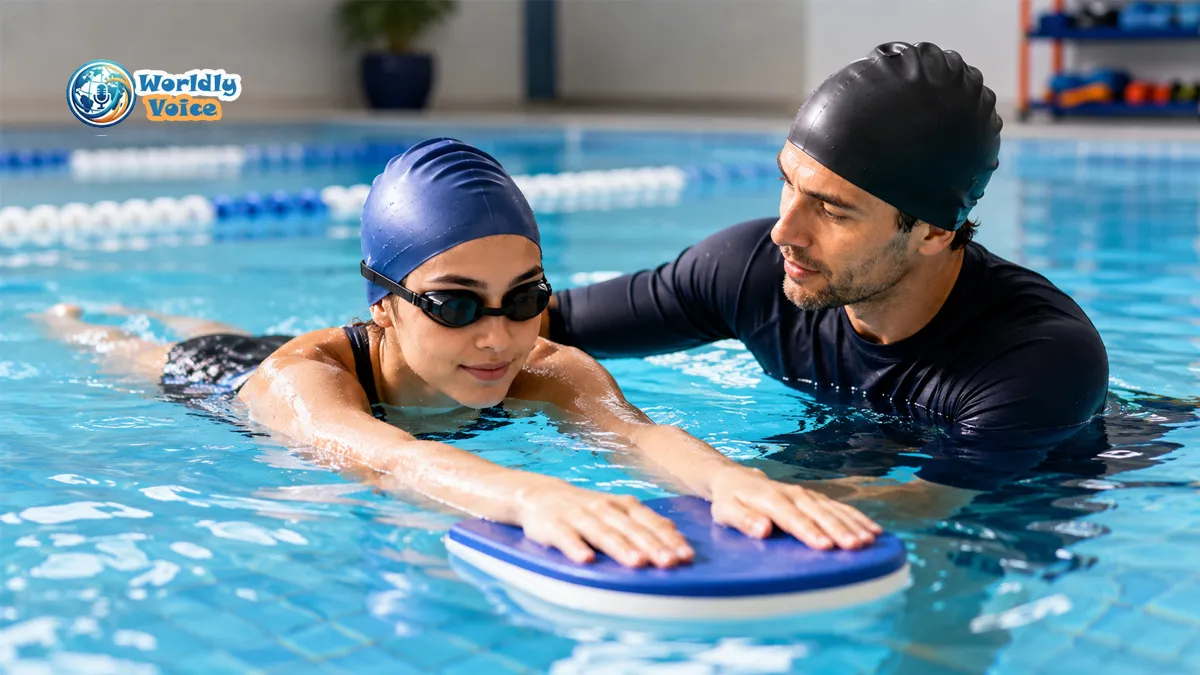
Learning how to swim does not begin with trying to cross an entire pool. For someone with little or no experience, the first goal is to become comfortable and safe in the water. Breathing, floating, body position, kicking and simple coordination all come before swimming longer distances.
The process is gradual, and that is perfectly normal. Adults who feel nervous around water can learn, too. A patient approach allows you to build one skill at a time instead of trying to master everything simultaneously.
The Centers for Disease Control and Prevention (CDC) recommends learning basic swimming and water-safety skills and notes that formal swimming lessons can reduce drowning risk. Swimming ability, however, is only one part of staying safe around water.
Start With Water Safety
Before practicing any swimming technique, establish a safe environment. A beginner should never practice alone, particularly while learning to float, submerge the face or move away from the pool wall.
For early practice:
- Choose a supervised swimming pool rather than open water.
- Stay in an area where you can stand comfortably.
- Know where the shallow and deep sections are.
- Practice with a qualified instructor, lifeguard or appropriately experienced swimming partner nearby.
- Avoid progressing into deeper water simply because you can manage a skill in shallow water.
- If you are teaching a child, provide close and constant supervision.
Drowning can happen quickly and quietly. The CDC also stresses that swimming lessons do not remove the need for supervision, particularly for children.
For a beginner, water safety is not a separate subject from learning to swim. It is part of the skill itself.
Step 1: Get Comfortable in the Water
If water makes you nervous, do not begin by forcing yourself to swim. Start with simple water confidence exercises.
Stand in shallow water and become accustomed to the sensation around your legs. Walk slowly through the pool, wet your arms and shoulders, and splash a little water onto your face.
Then progress gradually:
- Put your chin into the water.
- Put your mouth underwater briefly.
- Put your nose underwater.
- Submerge your face for a few seconds.
- Exhale gently while your face is underwater.
- Return to a comfortable standing position.
There is no prize for progressing quickly. If putting your face underwater makes you panic, return to an easier step and repeat it until it feels manageable.
The purpose of this stage is to teach your body that water can be controlled and predictable. That foundation makes later breathing and floating exercises much easier.
Step 2: Learn How to Breathe While Swimming
Breathing is one of the biggest challenges for people learning to swim because the normal breathing pattern changes as soon as your face enters the water.
The basic principle is simple:
Above the water: inhale.
Underwater: exhale slowly.
Try this beginner exercise in shallow water:
- Take a normal breath while standing.
- Put your mouth and nose into the water.
- Slowly blow bubbles.
- Lift your face out of the water.
- Breathe in normally.
- Repeat several times.
Avoid trying to hold your breath for as long as possible. Swimming requires controlled breathing rather than prolonged breath-holding.
As you become comfortable, submerge your whole face and practice steady exhalation. Later, when learning freestyle, you can coordinate breathing with body rotation instead of lifting your entire head.
Lifting the head too much can disturb body alignment. Harvard Health recommends keeping the head in an appropriate position and focusing on efficient, streamlined form rather than simply trying to move faster.
Step 3: Learn How to Float on Your Back
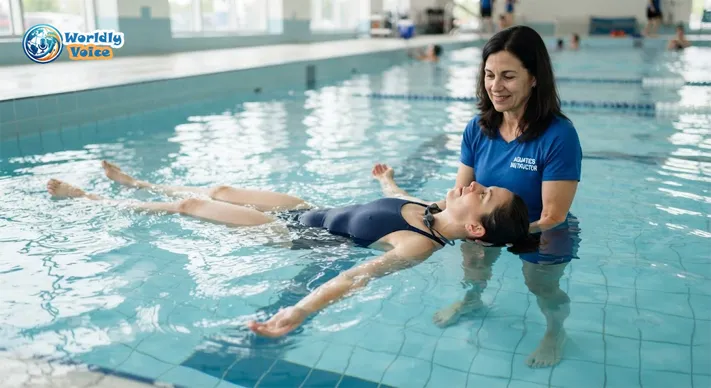
Learning how to float on your back in water is one of the most useful early skills because it introduces the feeling of supporting yourself at the surface.
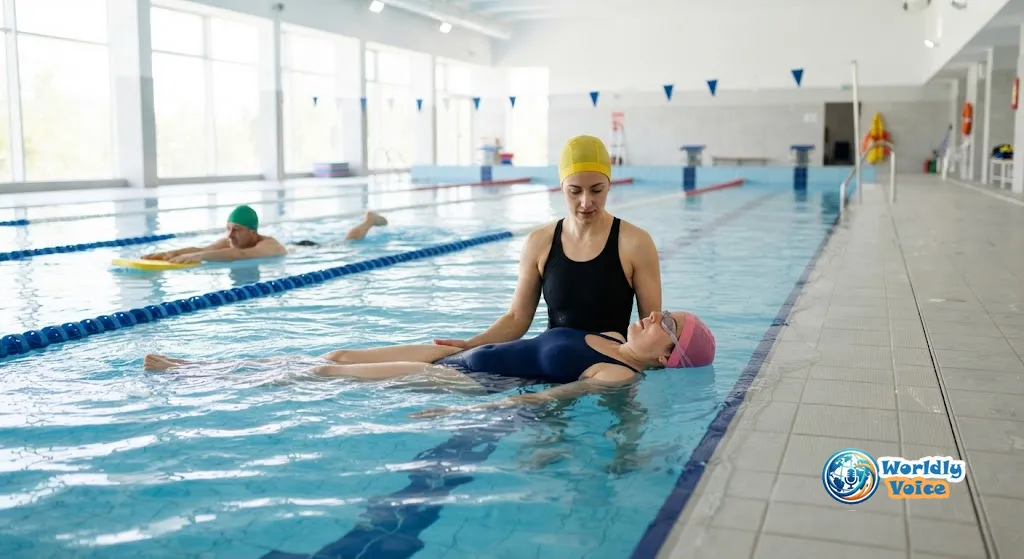
Practice with a qualified instructor or trusted swimming partner nearby and remain in an appropriate area of the pool.
A basic progression is:
- Stand in shallow water.
- Bend your knees slightly.
- Lean backward gradually.
- Let your shoulders and head enter the water.
- Allow your ears to become submerged.
- Look upward rather than trying to lift your head.
- Extend your arms and legs comfortably.
- Relax your neck and shoulders.
- Breathe calmly.
- Allow your hips to move toward the surface.
Many beginners assume they need to kick constantly to avoid sinking. Often, the bigger problem is unnecessary tension or poor body position. Trying to sit upright, lifting the head or stiffening the neck can make floating more difficult.
The objective is not to force the body to remain perfectly flat. It is to find a relaxed position in which the water supports much of your body.
Common floating problems include:
- lifting the head;
- tightening the neck;
- bending the knees excessively;
- trying to sit upright;
- becoming rigid because of fear;
- holding the breath.
If you become uncomfortable, return to standing rather than struggling to remain afloat.
Step 4: Practice Front Floating and Gliding
Once back floating becomes comfortable, try a simple front float.
Hold the pool wall, take a breath and place your face into the water. Extend your body behind you and gently push away from the wall. Glide for a short distance, then bring your feet underneath you and stand.
This exercise teaches body position before you have to think about complicated arm and leg movements.
Think about maintaining a relatively long line from your head through your shoulders, hips and legs. A streamlined position reduces unnecessary resistance.
Harvard Health similarly recommends concentrating on body position and streamlined movement rather than making larger movements simply to generate speed.
Do not worry about how far you glide. A controlled two-second glide is more useful for a beginner than an uncontrolled attempt to travel several meters.
Step 5: Learn the Flutter Kick
The flutter kick provides basic propulsion and becomes particularly useful when learning freestyle swimming for beginners.
Hold the pool wall or use suitable instructional equipment under supervision. Keep your legs relatively long and make small alternating movements from the hips.
Focus on:
- relatively relaxed ankles;
- small, steady kicks;
- avoiding excessive knee bending;
- maintaining a comfortable body position;
- producing controlled movement rather than huge splashes.
A common beginner mistake is assuming that kicking harder automatically makes swimming easier. It usually does not. Large, frantic kicks can consume energy without providing efficient forward movement.
The goal at this stage is rhythm.
Step 6: Add Basic Arm Movements
After practicing floating and kicking separately, introduce simple arm movements.
Breaking the skill into parts reduces the mental workload. Instead of thinking about breathing, kicking, arm recovery and body position at exactly the same moment, you first learn what each component feels like.
Arm movements provide propulsion and help maintain rhythm and balance. Practice them slowly and focus on controlled movement.
Eventually, swimming becomes a coordinated sequence rather than several unrelated actions.
Step 7: Learn Basic Swimming Strokes for Beginners
Once you are comfortable putting your face in the water, floating, gliding and kicking, you can begin learning the basic swimming strokes for beginners.
There is no requirement to learn every competitive stroke immediately. Freestyle/front crawl, breaststroke and basic backstroke provide useful foundations.
Freestyle or Front Crawl
Freestyle generally combines:
- a horizontal body position;
- alternating arm movements;
- a flutter kick;
- controlled underwater exhalation;
- turning the head and body appropriately to breathe.
The important point for a beginner is coordination. Do not attempt to swim a long distance immediately. Practice short sections and pause when technique starts to fall apart.
Keeping your body streamlined and avoiding unnecessary head movement can make the stroke more efficient.
Breaststroke
Breaststroke has a different rhythm and can be easier for some beginners to understand because the movement has a noticeable sequence:
Pull → breathe → kick → glide
The glide provides a short moment to regain balance and prepare for the next cycle.
Backstroke
Backstroke is a natural progression after becoming comfortable floating on your back. It generally combines alternating arm movements with a flutter kick while keeping the face above the water.
Because breathing does not require turning the face into the water, some beginners find the breathing aspect less intimidating.
What About Butterfly?
Butterfly is best left for later. It requires considerably more coordination, timing and strength than the basic skills a new swimmer needs. Learning it is not necessary for someone whose immediate goal is becoming comfortable and competent in the water.
Overcoming Fear of Water: A Beginner’s Swimming Guide
Fear should not be treated as something you simply need to “get over.” For a nervous swimmer, confidence is usually built through repeated experiences that remain within a manageable level of difficulty.
A useful progression is:
Level 1: Stand in shallow water.
Level 2: Walk through the pool.
Level 3: Put your face underwater briefly.
Level 4: Blow bubbles underwater.
Level 5: Hold the wall and kick.
Level 6: Practice assisted floating.
Level 7: Float independently.
Level 8: Glide a short distance.
Level 9: Combine kicking and arm movements.
Level 10: Swim a short distance under appropriate supervision.
You do not need to complete all ten levels in one session.
If a particular exercise causes panic, step back to an easier exercise. Progress is more useful when it builds confidence rather than reinforcing fear.
For adults learning to swim, patient beginner swimming lessons can be especially helpful because an instructor can adjust the progression instead of expecting everyone to learn at the same pace.
Common Beginner Swimming Mistakes
Even motivated beginners can make swimming harder than it needs to be.
Trying to swim too far too soon
Short, controlled distances allow you to maintain technique. Increase distance gradually.
Holding your breath
Practice gentle underwater exhalation instead. Breathing should eventually become part of your swimming rhythm.
Lifting your head
On front strokes, excessive head lifting can disturb alignment. Practice keeping the head in a comfortable neutral position.
Kicking too hard
Powerful splashing is not the same as efficient propulsion. Aim for a controlled kick.
Becoming stiff
Tension often makes floating and movement more difficult. Relax the shoulders, neck and ankles as much as possible.
Focusing on speed
For beginners, technique matters more than speed. Harvard Health recommends developing form before pushing for faster swimming.
Learning alone
A person who cannot swim confidently should not use solo practice as a substitute for proper supervision or instruction.
Moving into deep water too quickly
Depth should increase only when the swimmer has developed the skills and confidence appropriate for that environment.
Swimming Tips for Absolute Beginners
These swimming tips for absolute beginners can make practice more productive:
- Start in shallow, controlled water.
- Take lessons from a qualified instructor when possible.
- Practice breathing separately from full swimming.
- Learn to float before attempting long distances.
- Keep your body relaxed.
- Use small, controlled kicks.
- Practice one new skill at a time.
- Take breaks before you become exhausted.
- Increase distance gradually.
- Focus on technique instead of speed.
- Repeat skills that still feel uncomfortable.
- Treat water safety as part of swimming ability.
The CDC recommends basic swimming and water-safety skills training and emphasizes that lessons do not replace other protective measures such as supervision and appropriate life-jacket use when applicable.
A Simple Beginner Swimming Practice Routine
You do not need an exhausting workout to make progress. Early sessions should focus on skill quality.
As your skills improve, gradually introduce front floating, back floating, gliding, kicking, arm movements and short swimming attempts.
There is no reliable rule saying that every person will learn to swim after a fixed number of sessions. The better approach is to measure progress by skills rather than by the calendar.
How Long Does It Take to Learn How to Swim?
There is no universal timetable.
Someone who already enjoys being in water may progress relatively quickly, while someone with a strong fear of water may need considerably more time.
Progress can depend on:
- previous water experience;
- comfort level;
- frequency of practice;
- quality of instruction;
- ability to float;
- breathing coordination;
- physical fitness;
- age and individual learning pace.
A more useful goal than “learn to swim in X days” is to become progressively safer, more comfortable and more technically capable.
How to Know You’re Ready to Progress
A beginner can use practical milestones rather than comparing their progress with someone else.
Before moving to a more difficult skill, you should be increasingly comfortable with things such as:
- entering shallow water;
- putting your face underwater;
- exhaling underwater;
- floating with assistance;
- floating independently when appropriately supervised;
- returning to a standing position;
- gliding a short distance;
- kicking while holding the wall;
- coordinating basic arm and leg movements;
- swimming a short distance without panic.
These are learning milestones, not a substitute for formal water-competency assessment.
Swimming Safety Beyond the Pool
Learning to swim in a pool does not make someone immune to drowning.
Natural water introduces hazards that may not exist in a controlled pool environment, including currents, waves, cold water, sudden depth changes, poor visibility and underwater obstacles. The CDC recommends understanding the conditions and safety of natural bodies of water before entering them.
Do not assume that being able to swim a certain distance in a pool means you can safely handle a lake, river or ocean.
For boating and other situations where it is appropriate, use a properly fitted life jacket. Avoid alcohol around swimming and boating because it can impair judgment, coordination and balance.
Children require particularly careful supervision. Even children who have completed swimming lessons still need close and constant supervision around water.
Frequently Asked Questions
What is the easiest way to learn how to swim?
Start with water comfort, breathing, floating and basic kicking. Once those skills feel controlled, combine them gradually into a swimming stroke. Formal instruction is particularly useful for beginners who are inexperienced or nervous.
Can adults learn how to swim?
Yes. Adults can learn swimming skills through progressive practice and appropriate instruction. Being nervous around water does not mean you cannot learn.
How long does it take to learn how to swim?
There is no standard timeframe. Your progress depends on previous water experience, confidence, practice frequency, physical ability and the quality of instruction.
How do you float on your back in water?
Lean backward gradually, allow your head and ears to enter the water, look upward, extend your arms and legs comfortably, and breathe calmly. Practice with appropriate supervision.
Why do I sink when I try to float?
Tension, lifting the head, trying to sit upright and holding the breath can interfere with a comfortable floating position. Relaxation and body position are important parts of learning to float.
What swimming stroke should a beginner learn first?
Freestyle/front crawl and breaststroke are common foundational choices, while backstroke can be a natural progression after learning to float comfortably on the back. An instructor can recommend the most suitable starting point for an individual learner.
Conclusion
Learning how to swim is a progression, not a single skill. Start by becoming comfortable in shallow water, then work on breathing, floating, gliding and kicking. Once those foundations are reliable, introduce arm movements and gradually combine them into a basic stroke.
For nervous beginners, especially adults, there is no benefit in rushing. Confidence grows when each new challenge is manageable and practiced under safe conditions.
Most importantly, swimming ability and water safety should develop together. A confident swimmer still needs to respect the environment, understand the limitations of their skills and use appropriate safety measures. If you are starting from zero, a qualified instructor and a controlled pool environment are among the safest ways to begin.
