


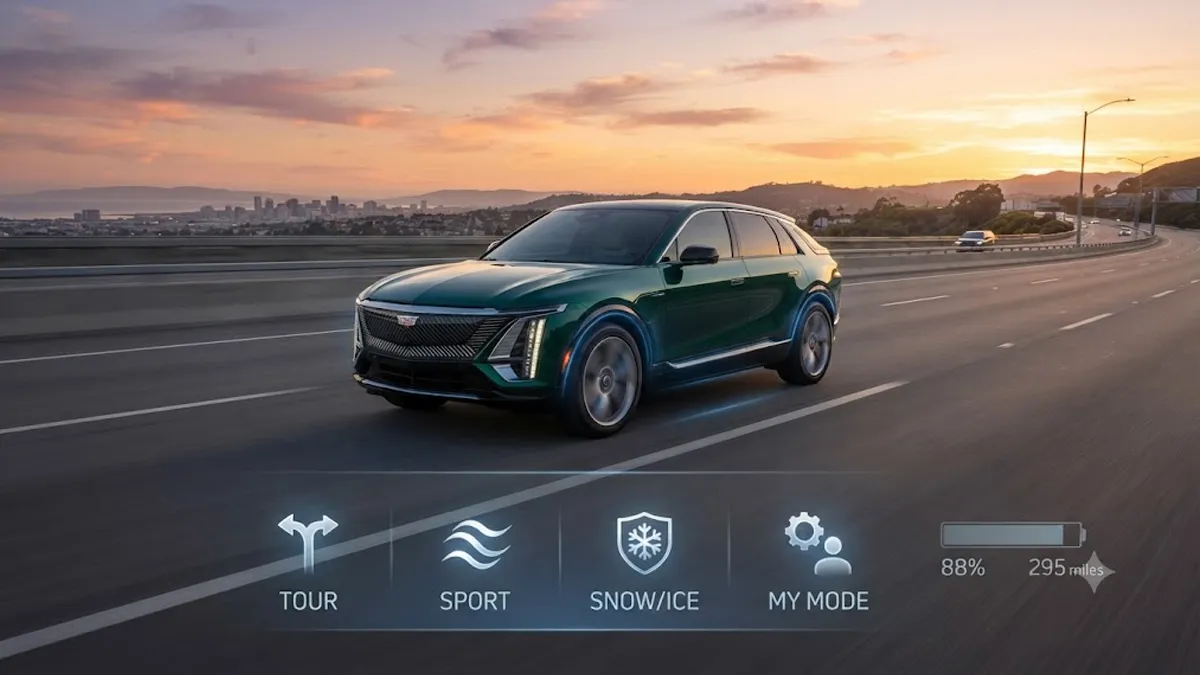
Do the driving modes in Cadillac Lyriq offer different ranges or battery usages? Yes, Tour and Sport can influence real-world energy consumption, but they do not change the physical size of the battery or create separate official EPA range ratings.
Picture this. You are driving your Cadillac Lyriq in Tour Mode with a comfortable accelerator response and a stable range estimate on the dashboard. You switch to Sport Mode before joining a motorway. The Lyriq suddenly feels more alert. Acceleration arrives faster, steering feels more connected, and the vehicle responds to smaller pedal movements.
That sharper response can encourage you to draw more power from the battery. However, selecting Sport Mode does not automatically remove a fixed number of miles from your available range.
After comparing Cadillac’s current driving-mode descriptions, range specifications, and owner guidance, I did not find an official claim that Sport Mode always reduces range by a specific percentage. The more accurate conclusion is that Tour makes economical driving easier, while Sport makes performance easier to access.
Cadillac currently lists an EPA-estimated range of up to 326 miles for the 2026 rear-wheel-drive Lyriq and up to 319 miles for selected all-wheel-drive configurations. Those figures are linked to the vehicle configuration, not to whether the driver selects Tour or Sport.
1. Do the Driving Modes in Cadillac Lyriq Offer Different Ranges or Battery Usages?
The modes can produce different battery-use results in normal driving. They do not give the Lyriq different batteries or separate official range figures.
Think of the accelerator pedal like the volume control on a sound system. Tour Mode turns the volume up gradually. Sport Mode raises it more quickly with a smaller movement. Both settings can eventually request strong performance, but Sport makes that performance easier to reach.
This distinction explains the Cadillac Lyriq driving mode impact on battery:
- Tour encourages smoother power delivery.
- Sport provides more immediate torque response.
- Faster acceleration normally requires more energy.
- Repeated acceleration can increase overall consumption.
- Steady driving may produce a much smaller difference between the modes.
Cadillac describes Tour as the main everyday setting, calibrated for a smooth ride. Sport is designed to provide a stronger feeling of connection to the road, more immediate torque response, and improved steering at higher speeds. My Mode allows the driver to customise accelerator response, steering, braking response, and vehicle sound. You can review Cadillac’s official description of the Cadillac Lyriq driving settings.
The strongest practical answer is simple: the mode changes how the car responds, while the driver’s use of that response determines much of the final battery consumption.
2. How Cadillac Lyriq Driving Modes Work
The Lyriq’s Driver Mode Control adjusts the behaviour of several vehicle systems. Available options depend on the model, trim, drivetrain, and installed equipment.
Standard Lyriq models can include:
- Tour Mode
- Sport Mode
- Snow/Ice Mode
- My Mode
The performance-focused Lyriq-V adds features such as V-Mode and Velocity Max.
These modes may adjust accelerator-pedal calibration, steering effort, brake feel, suspension response, vehicle sound, and electric all-wheel-drive behaviour. They can make the vehicle feel calm, responsive, stable, or performance-focused without changing how much energy the battery can physically store.
A mode also should not be confused with a trim level. A Lyriq Sport is a vehicle trim with particular styling and equipment. Sport Mode is a selectable driving setting. A Lyriq Sport can still be driven in Tour Mode, while another eligible trim may also provide a Sport driving setting.
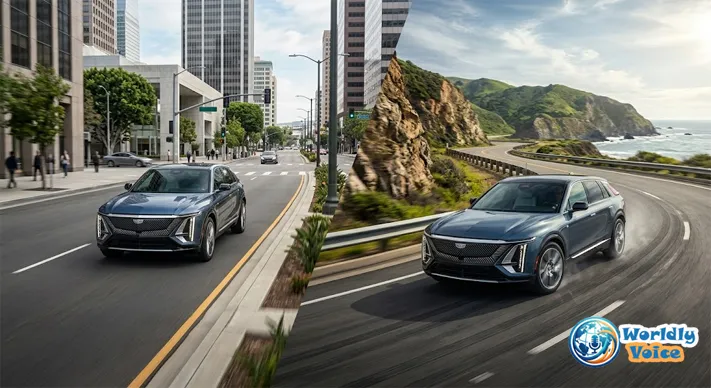
3. Cadillac Lyriq Tour vs Sport Mode
The following comparison shows the practical differences between the two primary modes.
| Feature | Tour Mode | Sport Mode |
|---|---|---|
| Main purpose | Comfortable everyday driving | More responsive performance |
| Accelerator response | Smooth and progressive | Sharper and more immediate |
| Steering feel | Balanced and relaxed | Heavier and more connected |
| Suspension behaviour | Comfort-focused where adjustable | More responsive where equipped |
| Battery consumption | Usually easier to control | May rise with stronger acceleration |
| Range behaviour | Supports predictable efficiency | Depends heavily on driving style |
| Best use | Commuting and long journeys | Overtaking and engaging roads |
How Tour Mode Affects Battery Usage
Tour is the logical default when Cadillac Lyriq Tour Mode efficiency matters more than immediate performance.
Its progressive pedal response makes it easier to pull away gently, build speed gradually, and maintain a steady pace. Those habits reduce unnecessary power demand and normally improve Cadillac Lyriq battery efficiency.
Tour does not create extra electricity. It also is not officially presented as a dedicated Eco Mode for the Lyriq. Its advantage comes from calibration. It helps the driver make smoother inputs, and smoother inputs tend to produce more predictable energy use.
I would choose Tour for:
- Daily commuting
- Long motorway journeys
- Heavy urban traffic
- Driving with limited remaining charge
- Trips where arrival range matters
- Wet conditions that require measured inputs
How Sport Mode Affects Battery Usage
Sport Mode sharpens the Lyriq’s accelerator response. The vehicle may deliver stronger torque with less pedal movement, making overtaking and quick acceleration feel more immediate.
That does not mean Sport continuously uses maximum battery power. At a constant speed on a flat road, two otherwise identical Lyriqs may consume similar amounts of energy even if one is in Tour and the other is in Sport.
The difference becomes clearer when Sport encourages:
- Faster starts
- Stronger overtaking
- Higher cruising speeds
- Frequent acceleration and braking
- More performance-focused driving
In other words, Cadillac Lyriq Sport Mode range depends less on the word “Sport” appearing on the display and more on what the driver does after selecting it.
Sportier steering should also feel firmer rather than unstable. A vibration during braking is a separate mechanical concern, which is why Why Is My Steering Wheel Shaking When I Brake? is a more relevant diagnostic topic for actual shaking or pulsation.
4. Does Sport Mode Reduce Cadillac Lyriq Range?
Sport Mode can reduce real-world range, but there is no universal Tour-versus-Sport mileage difference published by Cadillac.
I would be cautious about claims suggesting that Sport always cuts range by 10%, 15%, or a fixed number of miles. Without a controlled test using the same vehicle, route, temperature, traffic, tyres, cabin settings, and average speed, such percentages can be misleading.
Consider two practical examples.
Example one: Two drivers travel at a steady 60 mph on the same flat road. They use the same climate setting and make no aggressive inputs. One uses Tour and the other uses Sport. Their consumption difference may be relatively small.
Example two: The Sport driver repeatedly accelerates hard, travels faster, and brakes later. Battery usage can rise noticeably, even though the route is identical.
A useful formula is:
Driving-mode calibration + accelerator behaviour + speed + weather + road conditions + climate use = real-world energy consumption
The dashboard range may also change gradually. Cadillac’s owner guidance explains that the estimate considers recent driving habits, current conditions, and HVAC use. Aggressive acceleration, braking, heated or cooled seats, battery preconditioning, and performance modes may affect the displayed estimate.
This means the range display is a prediction, not a fixed promise. It learns from recent consumption.
5. What Has the Greatest Impact on Cadillac Lyriq Energy Consumption?
Driving mode matters, but it is only one part of the efficiency picture.
Speed
Higher speed can reduce Cadillac Lyriq real-world range more than switching between Tour and Sport.
As speed increases, the vehicle must push more air out of the way. Aerodynamic resistance grows rapidly, forcing the motors to use additional energy to maintain pace. The EPA also identifies high-speed driving as a major cause of lower EV range.
Acceleration
Rapid acceleration demands substantial electrical power over a short period. Sport Mode makes that power easier to request. Tour Mode makes gradual acceleration easier to manage.
Temperature and Climate Control
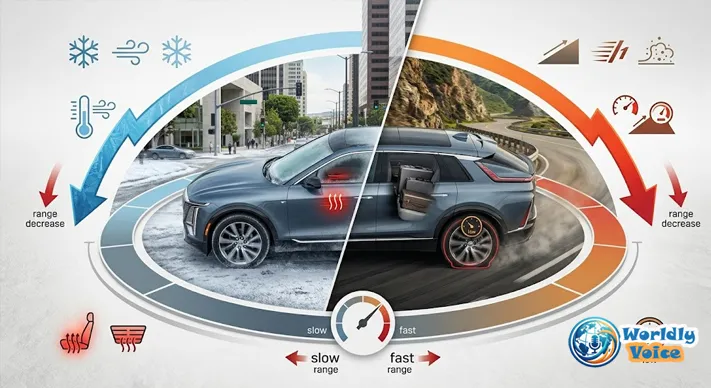
Cold batteries operate less efficiently, while cabin heating requires energy that could otherwise be used for propulsion. Hot weather and heavy air-conditioning use can also reduce range.
The EPA notes that cold weather, accessory use, and high-speed driving can significantly lower an EV’s usable range.
Tyres, Cargo, and Aerodynamics
Underinflated tyres increase rolling resistance. Heavy cargo requires more energy to move, while a roof box or external carrier increases drag.
The basic physics is similar to the principle discussed in Biggest Excavator In World: moving greater mass requires more energy. The scale is different, but the relationship still applies.
6. Cadillac Lyriq Regenerative Braking and Range
The Lyriq offers regenerative braking through One-Pedal Driving and Regen on Demand. These features turn some of the vehicle’s kinetic energy back into electricity during deceleration.
Cadillac explains that One-Pedal Driving can slow or stop the vehicle under normal conditions when the driver releases the accelerator. It can be set to Off, Normal, or High on compatible models. Its operation may be limited when the battery is extremely hot, cold, or close to full charge. Cadillac also advises against using it on slippery roads. Read the official guide to Cadillac Lyriq regenerative braking.
Regeneration improves efficiency, but it cannot recover every unit of energy used during acceleration. Some energy is always lost through tyres, aerodynamic drag, electrical resistance, and heat.
For that reason, accelerating hard and relying on regeneration to slow down is less efficient than maintaining momentum through early, smooth anticipation.
7. Snow/Ice Mode and My Mode Explained
Snow/Ice Mode
Snow/Ice Mode adjusts accelerator response to help reduce wheel spin on slippery roads. On compatible all-wheel-drive models, it may also change how power is distributed.
Winter range loss should not automatically be blamed on Snow/Ice Mode. Cold battery temperatures, cabin heating, winter tyres, snow resistance, and slower charging can have a greater influence.
My Mode
My Mode allows the driver to create a personalised combination of settings. Options may include accelerator response, steering feel, brake response, suspension behaviour, and electric vehicle sound.
For an efficiency-focused setup, I would select:
- Relaxed or Tour acceleration
- Tour steering
- Comfortable suspension
- Moderate climate settings
- Smooth regenerative braking
Cadillac does not publish a separate official range rating for My Mode. Its efficiency still depends on the selected settings and the way the vehicle is driven.
8. EV Driving Modes Efficiency and Range
The relationship between EV driving modes efficiency and range is often oversimplified.
A driving mode is not a separate energy source. It is closer to changing the sensitivity of the controls. In Sport, a smaller pedal input may request more torque. In Tour, the driver may need a deeper, more deliberate input to request the same acceleration.
The EPA’s explanation of EV driving modes efficiency and range also shows why official ratings and personal results can differ. EPA range testing uses controlled laboratory procedures and adjustments for real-world factors, while an individual journey may include hills, wind, traffic, extreme temperatures, and different cabin settings.
The consensus from Cadillac’s guidance and general EV testing principles is clear:
- Tour does not generate additional battery capacity.
- Sport does not waste maximum power every second.
- Tour makes progressive driving easier.
- Sport makes rapid acceleration easier.
- Actual efficiency depends on how the vehicle is used.
9. How to Maximize Cadillac Lyriq Range
Drivers wondering how to maximize Cadillac Lyriq range should focus on the habits that produce the largest benefits.
Use Tour for Routine Driving
Tour provides smooth accelerator calibration and is the better everyday choice for consistent Cadillac Lyriq range optimisation.
Accelerate Progressively
Build speed smoothly rather than demanding full torque from every stop. This reduces peak energy use and makes your arrival estimate more predictable.
Control Motorway Speed
A moderate, constant speed is normally more efficient than fast driving with frequent changes in pace.
Precondition While Plugged In
Heat or cool the cabin while the Lyriq remains connected to a charger. This allows more of the initial climate-control energy to come from the charging source instead of the driving battery.
Use Seat Heating Strategically
Heated or ventilated seats can make occupants comfortable without conditioning the entire cabin as aggressively.
Maintain Correct Tyre Pressure
Check pressure when the tyres are cold and follow the vehicle’s recommended values. Low pressure increases resistance and can also affect handling and tyre wear.
Remove Unnecessary Weight
Clear heavy, unused items from the cargo area. Remove roof-mounted equipment when it is not needed.
Plan Charging Before Long Trips
Use the Lyriq’s navigation and charging tools to identify suitable stops. For complex journeys involving transport hubs or unfamiliar destinations, supporting guides such as Facilities at Chongqing East Railway Station can also help with broader destination planning.
Charge Appropriately
Cadillac recommends charging to around 80% for routine daily use, while allowing a higher target when extra range is required for a longer trip. Charging to 80% can also help maintain regenerative-braking availability.
Frequently Asked Questions
Do the driving modes in Cadillac Lyriq offer different ranges or battery usages?
They can change real-world energy consumption, but they do not alter battery capacity or create separate official range ratings. Tour encourages smoother driving, while Sport can increase consumption when its sharper response is used aggressively.
Which Cadillac Lyriq mode gives the best range?
Tour is generally the strongest everyday choice for efficiency and predictable range. A customised My Mode using Relaxed or Tour acceleration may also support economical driving.
How much range does Sport Mode reduce?
Cadillac does not publish a guaranteed percentage or mileage reduction. The result depends on speed, acceleration, temperature, terrain, climate use, traffic, and driving style.
Is Sport Mode always less efficient than Tour?
Not necessarily. During identical steady-speed driving, the difference may be small. Sport becomes less efficient when it leads to harder acceleration, faster speeds, or frequent changes in pace.
Does One-Pedal Driving increase Lyriq range?
It can recover some energy during deceleration, especially in urban traffic. However, it cannot recover all the energy previously used to accelerate.
Does Snow/Ice Mode use more battery?
The mode prioritises traction. Cold weather, cabin heating, winter tyres, snow resistance, and battery temperature are usually more important causes of winter energy consumption.
Final Verdict: Should You Use Tour or Sport?
Do the driving modes in Cadillac Lyriq offer different ranges or battery usages? They can produce different real-world results, but the difference is not a fixed number programmed into the battery.
Tour and Sport draw energy from the same battery pack. Tour supports smoother accelerator inputs and more predictable Cadillac Lyriq energy consumption. Sport delivers more immediate torque and a stronger connection to the road, which may increase battery use when the driver takes advantage of that responsiveness.
My practical recommendation is straightforward. Use Tour for commuting, long journeys, and situations where range consistency matters. Select Sport when you want quicker response and more engaging handling, but watch your acceleration and speed.
The mode sets the mood. Your right foot determines much of the final range.
