


Last Updated: July 2026
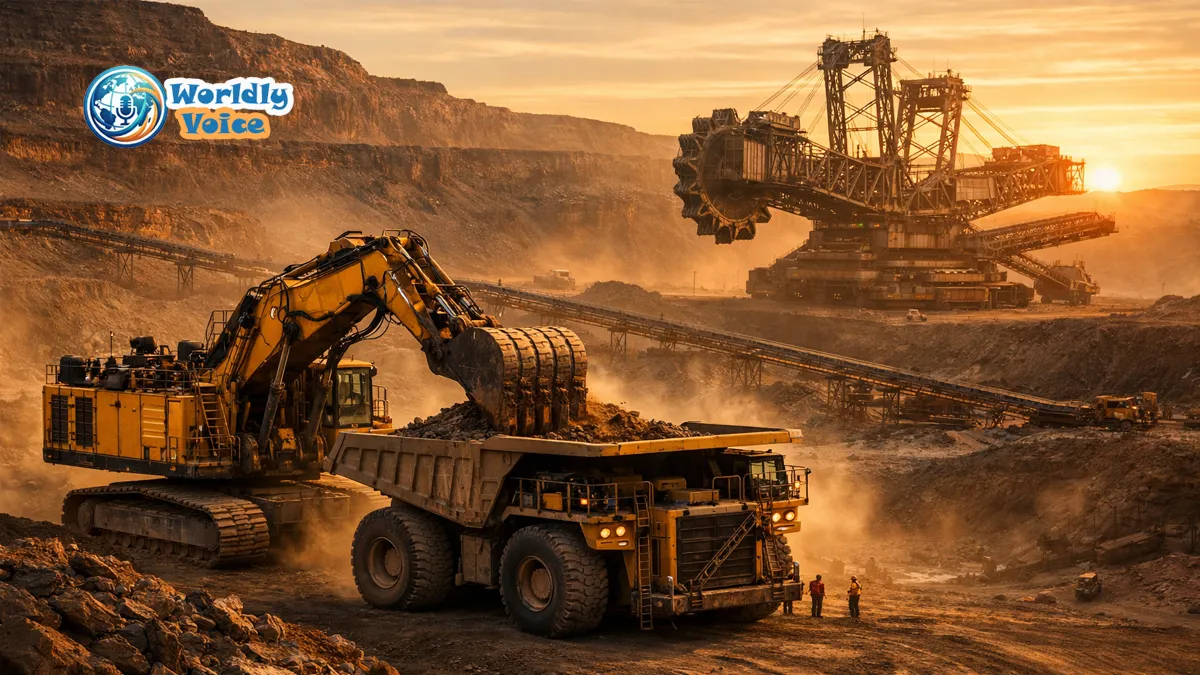
If you have ever searched for the biggest excavator in world, you probably noticed something strange: there is no single simple answer. One source points to the Caterpillar 6090 FS, a modern hydraulic mining shovel weighing about 1,000 tonnes. Another crowns Bagger 293, a 14,200-tonne bucket-wheel excavator that looks less like a machine and more like a moving steel city.
Both answers can be right.
The debate depends on what we mean by “excavator.” Are we talking about a hydraulic shovel that loads haul trucks in active mines every day? Or are we talking about the largest earth-moving equipment ever built, designed to chew through overburden continuously like an industrial factory on tracks?
In my experience reviewing mining equipment data, this is where many comparisons go wrong. They mix categories. A hydraulic shovel and a bucket-wheel excavator both dig earth, but they do it in very different ways.
Think of it like comparing a heavyweight boxer with a freight train. Both are powerful. Only one is built for rapid, repetitive strikes.
In this guide, we’ll break down the biggest machines, compare the famous Bagger 293 vs Bagger 288 scale comparison, review Caterpillar 6090 FS specifications, and settle the bucket-wheel vs hydraulic excavator debate in plain English.
For readers who enjoy practical environmental topics too, this connects surprisingly well with Beginner Composting Tips and sustainable land management, because all excavation starts with one basic question: how do humans move, manage, and reshape earth responsibly?
1. What Does “Biggest Excavator in World” Actually Mean?
The phrase biggest excavator in world sounds straightforward. But engineers, miners, and equipment manufacturers measure “biggest” in different ways.
Here are the main ways size is judged:
- Operating weight
- Bucket capacity
- Engine power
- Digging reach
- Production capacity
- Physical dimensions
- Real-world mining usefulness
For hydraulic mining excavators, operating weight and bucket capacity usually matter most. These machines dig in cycles. Scoop. Swing. Dump. Repeat. They load massive haul trucks in open-pit mines.
For bucket-wheel excavators, the scale is different. These machines remove material continuously. Instead of one giant bucket, they use a rotating wheel fitted with multiple buckets. They are often used in lignite coal mines and soft overburden removal.
That is why the biggest bucket-wheel excavator can weigh more than 14 times as much as the largest hydraulic mining shovel.
Most industry sources agree on this distinction:
- Largest hydraulic mining shovel: Caterpillar 6090 FS
- Largest bucket-wheel excavator / land vehicle: Bagger 293
- Most famous bucket-wheel giant: Bagger 288
So when people ask about the biggest excavator in world, I usually answer with a question: “Do you mean the biggest working hydraulic shovel, or the largest excavating machine ever built?”
That small distinction changes everything.
2. The Hydraulic Champion: Caterpillar 6090 FS
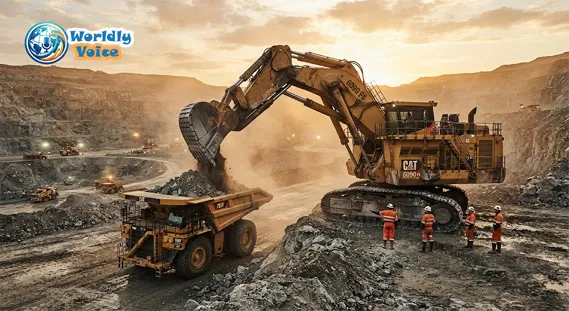
The Caterpillar 6090 FS is often described as the largest hydraulic mining shovel in current production. It is a serious machine built for serious mining operations.
When I compare modern surface mining technology, the 6090 FS stands out because it is not just large for bragging rights. It is designed to fit into high-output mining systems where every truckload matters.
The official Caterpillar 6090 FS specifications are staggering:
- Operating weight: Around 1,000 tonnes / 1,102 US tons
- Engine power: 4,500 hp / 3,360 kW
- Engines: Twin Cummins QSK60 diesel engines
- Bucket capacity: Up to 52 cubic meters
- Payload: About 93.6 tonnes
- Approximate dimensions: 13.5 m long, 9.7 m wide, 10 m high
- Hydraulic system: 8 variable-flow pumps
- Boom system: TriPower front shovel design
For technical readers, Caterpillar provides detailed product data under the anchor Caterpillar 6090 FS specifications.
One feature I find especially practical is its twin-engine redundancy. If one engine goes down, the shovel can reportedly continue operating at reduced production. In mining, that matters. Downtime is expensive. A machine that can keep working, even partially, protects production schedules.
Why Caterpillar Mining Shovel Capabilities Matter
Caterpillar mining shovel capabilities are not only about size. They are about matching the shovel to haul trucks, bench height, material type, and production targets.
A 52 m³ bucket can load ultra-class haul trucks in just a few passes. That improves cycle efficiency and reduces waiting time. In high-volume mines, small time savings can become huge financial differences over months of operation.
This is why the Caterpillar 6090 FS is a practical champion. It is not the heaviest excavating machine ever created, but it is one of the most capable hydraulic shovels in commercial mining.
If you follow AI in construction equipment or Tech Education Trends in 2026, this machine is also a great example of how mechanical power and digital monitoring are merging in heavy industry.
3. The Bucket-Wheel Titans: Bagger 293 and Bagger 288
If the Caterpillar 6090 FS is a heavyweight athlete, Bagger 293 is a moving skyscraper.
Built by TAKRAF in 1995, Bagger 293 operates in Germany’s lignite mining region. It is widely recognized as one of the heaviest land vehicles in the world. In many record discussions, it is the largest excavator ever built.
Key Bagger 293 facts:
- Weight: About 14,200 tonnes
- Height: 96 meters
- Length: 225 meters
- Bucket-wheel diameter: Around 21 meters
- Buckets: 18 buckets
- Bucket capacity: About 15 m³ each
- Daily capacity: Up to 240,000 m³ of material
That daily capacity is difficult to visualize. Imagine removing enough earth in a day to fill a large stadium bowl. That is not a normal digging machine. That is an industrial mining system with tracks.
The biggest bucket-wheel excavator category is where records become almost surreal. These machines were created for continuous overburden removal, especially in large open-cast mines where the material is relatively soft.
You can explore the record context through Guinness World Records using the anchor biggest bucket-wheel excavator.
Bagger 288: The Famous Giant
Before Bagger 293 took the spotlight, Bagger 288 was the legend.
Built by Krupp for Rheinbraun, later associated with ThyssenKrupp engineering history, Bagger 288 began operation in 1978. It weighs about 13,500 tonnes and measures roughly 220 meters long and 96 meters high.
Its fame grew even further in 2001 when it was moved approximately 22 kilometers to another mining site. That relocation required planning roads, crossing fields, and protecting infrastructure. I often point to that move as one of the best real-world examples of industrial logistics at extreme scale.
For reference, NASA once discussed the scale of large mining machines in comparison with crawler transporters, and Bagger 288 often appears in conversations about the largest moving machines on land. For added context, see Bagger 293 vs Bagger 288 scale comparison.
4. Bagger 293 vs Bagger 288 Scale Comparison
The Bagger 293 vs Bagger 288 scale comparison is close, but Bagger 293 wins by weight and slight length advantage.
Both machines are about 96 meters high. That is roughly the height of a 30-story building. Both can move enormous volumes of soil. Both are engineering landmarks.
But there are differences.
| Feature | Bagger 293 | Bagger 288 |
|---|---|---|
| Builder | TAKRAF | Krupp / ThyssenKrupp heritage |
| Year introduced | 1995 | 1978 |
| Type | Bucket-wheel excavator | Bucket-wheel excavator |
| Weight | 14,200 tonnes | 13,500 tonnes |
| Length | 225 m | 220 m |
| Height | 96 m | 96 m |
| Bucket-wheel diameter | 21 m | Approx. 21 m |
| Number of buckets | 18 | 18 |
| Daily capacity | Up to 240,000 m³ | Up to 240,000 m³ |
The main takeaway is simple: Bagger 293 is heavier, but both machines belong in the same class of massive mining machinery.
When we talk about industrial mining equipment records, Bagger 293 and Bagger 288 are not just “big excavators.” They are symbols of a specific mining era, when engineers designed machines to move entire landscapes.
5. The Largest Mining Excavators in the World: Quick Comparison
The phrase “largest mining excavators in the world” usually includes both bucket-wheel machines and hydraulic shovels. That can be useful, as long as we separate the machine types.
Here is a practical comparison:
| Machine | Type | Operating Weight | Bucket Capacity |
|---|---|---|---|
| Bagger 293 | Bucket-wheel excavator | 14,200 t | 15 m³ × 18 buckets |
| Bagger 288 | Bucket-wheel excavator | 13,500 t | Approx. 6.6 m³ × 18 buckets |
| Caterpillar 6090 FS | Hydraulic shovel | 1,000 t | 52 m³ |
| Bucyrus RH400 | Hydraulic shovel | 980 t | 50 m³ |
| Komatsu PC9000-12 | Hydraulic shovel | 896 t | 46–49 m³ |
| Hitachi EX8000-7 | Hydraulic shovel | ~839 t | 42 m³ |
| Liebherr R 9800 | Hydraulic shovel | 800 t | 42–60 m³ |
| Demag H740 OS | Hydraulic shovel | 744 t | 38 m³ |
| Komatsu PC7000-11 | Hydraulic shovel | 678–699 t | 36 m³ |
| XCMG XE7000 | Hydraulic shovel | 673 t | 30–36 m³ |
This table shows why context matters. If we only judge by weight, bucket-wheel excavators crush the competition. If we judge by modern mine loading performance, hydraulic shovels deserve their own category.
The biggest excavator in world debate is really a category debate.
6. Bucket-Wheel vs Hydraulic Excavator: The Real Difference
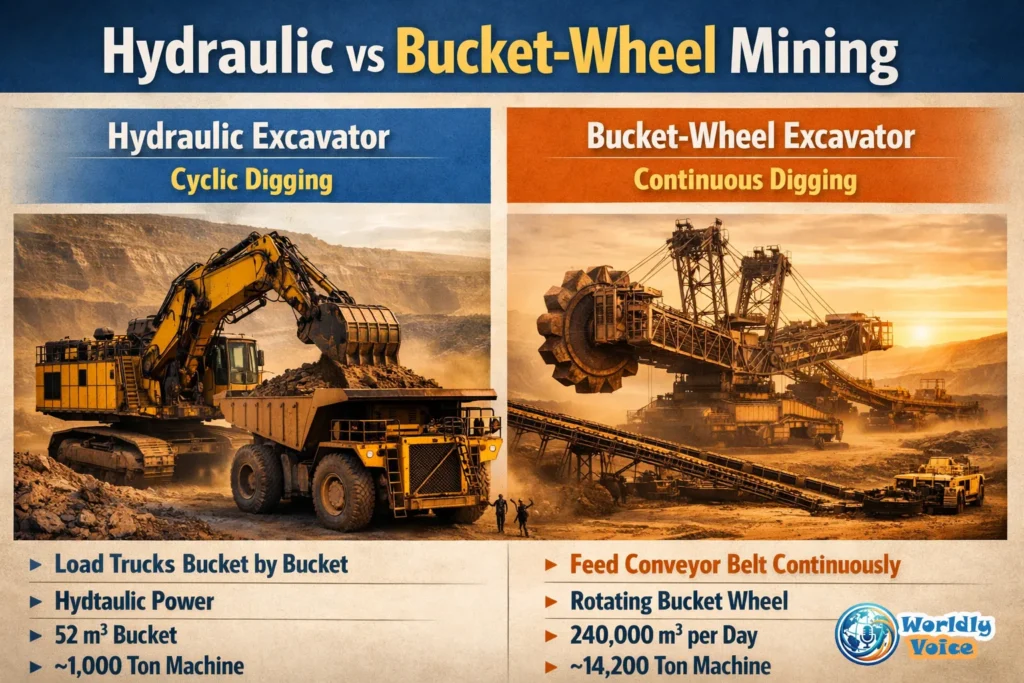
The bucket-wheel vs hydraulic excavator comparison comes down to how each machine digs.
Hydraulic Mining Excavators
Hydraulic shovels work in cycles.
They:
- Crowd the bucket into material
- Lift the loaded bucket
- Swing toward a haul truck
- Dump the material
- Return for another pass
These machines are flexible. They can work in different benches, load different truck sizes, and adapt to changing mine plans.
That is why Caterpillar, Komatsu, Liebherr, Hitachi, and XCMG keep investing in large hydraulic mining excavators.
Bucket-Wheel Excavators
Bucket-wheel excavators work continuously.
They:
- Rotate a massive wheel
- Scoop material with multiple buckets
- Transfer material onto conveyors
- Feed the mine’s material-handling system
They are less flexible than hydraulic shovels, but incredibly productive in the right environment.
In my view, the simplest explanation is this:
- A hydraulic excavator is like a giant arm with a bucket.
- A bucket-wheel excavator is like a moving factory that eats earth.
Both are excavators. But they solve different mining problems.
This distinction also connects with heavy equipment maintenance guide topics. A 1,000-tonne shovel and a 14,200-tonne bucket-wheel machine demand very different maintenance strategies, spare parts planning, and crew training.
7. Why These Machines Exist
Massive mining machinery exists because modern society consumes enormous volumes of raw materials.
Copper for wiring. Iron ore for steel. Coal and lignite in certain energy systems. Rare earth elements for electronics. Aggregates for roads. The scale of extraction is hard to grasp until you see a mine from above.
I noticed this most clearly when studying open-pit mine layouts. The machines are not oversized for drama. They are sized to match production targets.
A mine may need to move hundreds of thousands of tonnes of material per day. Smaller equipment could do the job, but it would take more machines, more operators, more fuel logistics, and more traffic inside the pit.
Large machines can improve:
- Loading efficiency
- Production consistency
- Truck matching
- Cost per tonne
- Fleet planning
- Material movement speed
But size also brings challenges:
- Higher capital cost
- Complex maintenance
- Longer downtime events
- Large spare parts inventory
- Specialized operator training
- Site-specific transport limitations
This is why the largest earth-moving equipment is usually found only in major mining operations, not ordinary construction projects.
8. Records vs Real-World Usefulness
Engineering records attract attention. I understand why. A 14,200-tonne machine is fascinating.
But mine operators do not buy equipment only to appear in record books. They buy machines to move material safely and profitably.
The Caterpillar 6090 FS, Bucyrus RH400, Komatsu PC9000, and Liebherr R 9800 represent practical production tools. They are huge, but they fit into mine fleets.
Bagger 293 and Bagger 288 represent a different logic. They are site-specific systems for continuous mining. They are not easy to relocate. They require conveyor networks, power infrastructure, and suitable geology.
That is why I separate the debate into two winners:
- Hydraulic leader: Caterpillar 6090 FS
- Bucket-wheel titan: Bagger 293
This is the fairest way to answer the biggest excavator in world question without misleading readers.
For broader context on automation, sensors, and skills, Tech Education Trends in 2026 is relevant because tomorrow’s mine operators will need digital fluency as much as mechanical knowledge.
10. What I Would Tell a First-Time Reader
If you are new to industrial mining equipment records, here is the simplest explanation.
The Caterpillar 6090 FS is the largest practical hydraulic mining excavator most people mean when discussing modern mining shovels.
Bagger 293 is the largest excavating machine when the definition includes bucket-wheel excavators.
Bagger 288 is nearly as large and more famous in popular culture, partly because of its dramatic relocation and long record-book history.
So the answer depends on the category.
That may feel less satisfying than naming one winner, but it is more accurate. And accuracy matters when discussing machines this large.
The same thinking applies to other technical topics on our site, from renewable energy for industry to Beginner Composting Tips. Definitions shape conclusions.
FAQs About the World’s Biggest Excavator
What is the biggest excavator in world?
The biggest excavator in world depends on the category. Bagger 293 is generally considered the largest bucket-wheel excavator and one of the heaviest land vehicles ever built. The Caterpillar 6090 FS is widely regarded as the largest hydraulic mining shovel.
Is Bagger 293 bigger than Bagger 288?
Yes. Bagger 293 is slightly larger and heavier. It weighs about 14,200 tonnes, while Bagger 288 weighs about 13,500 tonnes. Both stand around 96 meters tall and have similar production capacity.
What are the key Caterpillar 6090 FS specifications?
The Caterpillar 6090 FS weighs about 1,000 tonnes, uses twin Cummins QSK60 engines, produces around 4,500 hp, and can carry a bucket capacity of up to 52 m³. It is designed for high-production open-pit mining.
Why are bucket-wheel excavators so big?
Bucket-wheel excavators are built for continuous removal of soft material, especially overburden in open-cast mines. Their huge size allows them to remove massive volumes of earth while feeding conveyor systems.
Are these machines used in normal construction?
No. Machines like Bagger 293, Bagger 288, and the Caterpillar 6090 FS are used in large mining operations. Normal construction sites use much smaller excavators because they need mobility, lower cost, and easier transport.
Which companies build the largest mining excavators in the world?
Major names include Caterpillar, Komatsu, Liebherr, Hitachi, TAKRAF, XCMG, and legacy manufacturers such as Bucyrus and Demag. These brands have shaped the evolution of massive mining machinery and modern surface mining technology.
Conclusion: The Debate Has Two Winners
The world’s biggest excavator debate is not really a fight. It is a lesson in definitions.
If we are talking about hydraulic mining shovels, the Caterpillar 6090 FS is the standout. Its 1,000-tonne operating weight, 52 m³ bucket, twin engines, and proven mine-focused design make it a leader in practical production.
If we are talking about the largest excavating machine ever built, Bagger 293 takes the crown. At about 14,200 tonnes, it remains one of the heaviest land vehicles in the world and the ultimate bucket-wheel giant.
So when someone asks about the biggest excavator in world, the best answer is this:
Caterpillar 6090 FS is the biggest hydraulic mining shovel. Bagger 293 is the biggest bucket-wheel excavator and the largest excavating land machine by scale.
Both are engineering marvels. Both changed mining. And both remind us that human ambition often shows up in steel, hydraulics, tracks, and buckets large enough to swallow a room.
If this topic interests you, explore related guides like Tech Education Trends in 2026, AI in construction equipment, sustainable land management, and Beginner Composting Tips to see how technology, earth systems, and responsible resource use connect.
References
- Caterpillar Inc. — Caterpillar 6090 FS specifications
- Guinness World Records — biggest bucket-wheel excavator
- Mining Technology — Bagger 293 vs Bagger 288 scale comparison
