


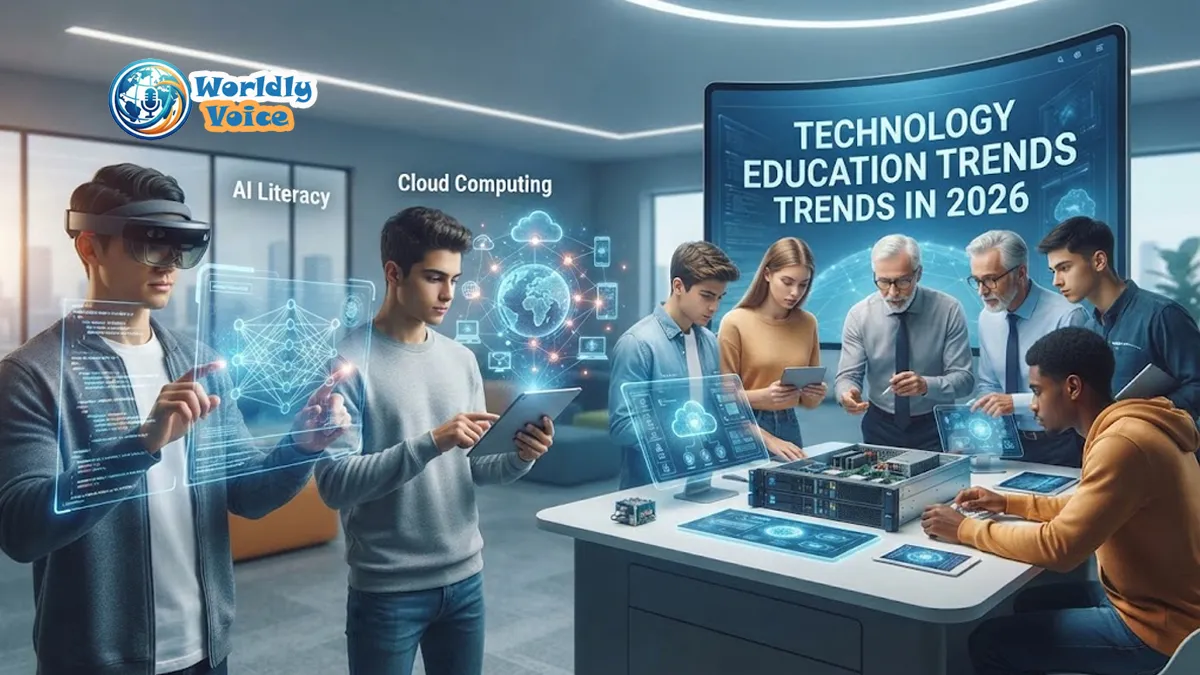
Technology is changing not only what people learn, but also how they learn and which skills employers value. In 2026, technology education is moving toward practical experience, artificial intelligence literacy, cybersecurity awareness, cloud computing, automation, and continuous skill development.
For students, career changers, educators, and working professionals, the traditional idea of learning one set of technical skills and relying on them throughout an entire career is becoming less realistic. The World Economic Forum’s Future of Jobs Report 2025 identifies AI and big data, networks and cybersecurity, and technological literacy among the fastest-growing skill areas through 2030. It also highlights analytical thinking, creative thinking, resilience, flexibility, agility, and lifelong learning as increasingly important.
This does not mean traditional education is becoming irrelevant. Instead, technology education is becoming more practical and continuous. Degrees, certifications, short courses, projects, portfolios, workplace training, and self-directed learning can all contribute to a person’s skill development.
Here are the major technology education trends shaping 2026 and what they mean for learners and educators.
1. Skills-Based Learning Is Becoming More Important
For many years, education was largely organized around completing a course, earning a qualification, and moving into employment. That model still has value, particularly for professions that require formal academic credentials, but technology careers increasingly require demonstrable skills as well.
A technology learner may need to show that they can:
- Build or troubleshoot a software project
- Analyze and interpret data
- Configure a cloud environment
- Understand basic cybersecurity practices
- Use AI tools responsibly
- Automate repetitive tasks
- Explain technical problems clearly
- Work effectively with other people
This makes project-based learning particularly useful.
Instead of simply memorizing how cloud computing works, a learner can create a small cloud project. Instead of studying automation only as a concept, they can build a simple workflow. Instead of learning cybersecurity terminology without practice, they can work through realistic security scenarios.
The result is evidence of capability rather than only evidence of course completion.
Micro-Credentials and University Degrees
Micro-credentials, professional certificates, bootcamps, and short courses can be useful for learning specific skills quickly. University degrees, meanwhile, can provide broader foundations, theoretical knowledge, research experience, and structured academic development.
The choice does not always have to be one or the other.
A computer science graduate might add a cloud certification. A business professional might study data analytics. A support technician might develop skills in Linux, networking, automation, or cybersecurity.
The important question is not simply which credential looks better. It is whether the learning experience provides knowledge and skills that can be demonstrated in practice.
2. Generative AI Is Becoming Part of the Learning Process
Generative AI is one of the most significant technology education trends of 2026.
Students can use AI tools to explain difficult concepts, generate practice questions, explore programming examples, summarize complicated material, brainstorm ideas, or receive feedback on drafts.
However, using AI effectively requires more than knowing how to write prompts.
UNESCO’s AI competency framework for students emphasizes areas including a human-centered mindset, AI ethics, AI techniques and applications, and AI system design. The framework also organizes development around the progression from understanding to applying and creating.
That approach is important because students need to understand what AI can do and where it can fail.
AI Literacy Is More Than Prompt Writing
A useful AI literacy program should teach learners to:
- Check AI-generated information against reliable sources
- Recognize that AI systems can produce incorrect answers
- Protect private and sensitive information
- Understand basic AI limitations
- Identify potential bias
- Use AI without abandoning independent thinking
- Follow institutional rules for AI-assisted work
- Explain when and how AI was used when disclosure is required
UNESCO’s guidance on generative AI in education also emphasizes human-centered use, privacy, ethical considerations, appropriate regulation, and meaningful educational applications.
This suggests that the strongest approach is not “AI versus teachers.” It is a combination in which technology supports learning while educators remain responsible for teaching, judgment, guidance, assessment, and human interaction.
How Students Can Use AI Responsibly
For example, a programming student could ask an AI system to explain why a piece of code produces an error. The student should then test the explanation, read the relevant documentation, modify the code, and understand why the solution works.
That is very different from copying an AI-generated answer without understanding it.
The goal should be AI-assisted learning rather than AI-dependent learning.
3. Cloud Computing Skills Remain Important
Cloud computing has become a fundamental part of modern digital infrastructure.
Web applications, business software, data platforms, artificial intelligence systems, streaming services, and many other digital products depend on cloud infrastructure.
As a result, cloud education is increasingly about understanding a collection of connected skills rather than learning one particular platform.
A useful cloud learning path can include:
| Skill area | What learners can study |
|---|---|
| Cloud fundamentals | Compute, storage, databases, networking |
| Cloud security | Identity, permissions, encryption, monitoring |
| Linux | Command-line administration and troubleshooting |
| Networking | DNS, IP addressing, routing and connectivity |
| DevOps | CI/CD, containers and deployment workflows |
| Infrastructure as code | Automated infrastructure management |
| Monitoring | Logs, metrics and alerts |
| Cost management | Resource usage and cloud optimization |
Learners do not necessarily need to master every cloud provider at once.
A better approach is to understand the underlying concepts first and then gain practical experience with one major cloud platform.
The most useful training also includes hands-on projects. A learner could deploy a simple website, configure access controls, monitor resources, document the architecture, and explain the security decisions.
That creates a portfolio project that demonstrates several skills at once.
4. Automation Is Changing What Entry-Level Technology Skills Mean
Automation and artificial intelligence are changing many routine technology tasks.
That does not mean every entry-level technology job will disappear. Instead, the tasks performed by junior workers are changing.
Routine activities such as basic ticket routing, repetitive data processing, simple system checks, and standardized workflows can increasingly be assisted or automated.
This creates a new educational requirement: learners need to understand how automated systems work and how to monitor them.
Useful skills include:
- Basic scripting
- APIs
- Workflow automation
- Command-line tools
- Log analysis
- Monitoring
- Troubleshooting
- Documentation
- Basic programming logic
- Security awareness
For example, instead of simply learning how to manually check disk space on a server, a student could create a simple script that checks available storage and produces an alert.
The educational value comes from understanding the logic behind the automation, testing it, handling errors, and considering security implications.
This combination of technical knowledge and problem-solving ability is becoming increasingly valuable.
5. Adaptive Learning Can Make Education More Personalized
Traditional courses often present the same material to every learner at approximately the same pace.
Technology makes it possible to create more flexible learning paths.
Adaptive learning systems can use information about a learner’s progress to recommend additional exercises, different explanations, or more advanced material.
For example, two students studying databases may have different weaknesses. One may understand basic SQL but struggle with joins. Another may understand joins but have difficulty designing efficient queries.
A personalized learning system could provide different practice material to each learner.
However, personalization should not come at the expense of privacy.
Education providers using learning analytics should consider:
- What student information is collected
- Why the information is collected
- How long it is retained
- Who can access it
- How automated recommendations are evaluated
- Whether students can challenge automated decisions
- How accessibility and fairness are addressed
Technology should make education more responsive without turning the learning environment into unnecessary surveillance.
6. Human Skills Are Becoming More Valuable Alongside Technical Skills
One of the most important lessons from current workforce research is that technical skills are only part of the picture.
The World Economic Forum identifies analytical thinking as a major core skill while also highlighting creative thinking, resilience, flexibility, agility, leadership, curiosity, and lifelong learning as important skills for the changing workforce.
This matters because technology workers rarely operate in isolation.
A developer may need to explain a technical limitation to a manager. A cybersecurity analyst may need to communicate a security risk to employees. A cloud engineer may need to justify an infrastructure decision to a business team.
Therefore, technology education should include opportunities to practice:
- Communication
- Analytical thinking
- Problem-solving
- Teamwork
- Presentation
- Technical writing
- Decision-making
- Critical thinking
- Adaptability
A learner who can solve a technical problem but cannot explain the solution may struggle in a real workplace.
The strongest programs increasingly combine technical projects with communication and collaboration.
7. Cybersecurity Is Becoming Essential Digital Knowledge
Cybersecurity is no longer only the responsibility of dedicated security professionals.
Students, employees, teachers, developers, business owners, and other technology users interact with digital systems every day.
Basic cybersecurity education can help learners understand:
- Strong passwords and passkeys
- Multi-factor authentication
- Phishing
- Social engineering
- Software updates
- Data privacy
- Secure file sharing
- Access permissions
- Basic threat awareness
- Responsible use of AI tools
The World Economic Forum lists networks and cybersecurity among the fastest-growing skill areas through 2030.
For technology students, cybersecurity should therefore be integrated into other subjects rather than treated only as a separate specialization.
A cloud learner should understand identity and access management. A programmer should learn secure development principles. A data student should understand privacy. A general technology user should know how to recognize common phishing attempts.
8. Hands-On Simulations and Extended Reality Can Improve Practice
Extended reality (XR), including virtual reality and augmented reality, can create simulated environments where learners practice tasks without the cost or danger of using real-world equipment.
Possible applications include:
- Virtual laboratories
- Equipment training
- Medical simulations
- Industrial safety exercises
- Virtual data centers
- Cybersecurity simulations
- Engineering visualization
- Technical maintenance training
The major benefit is practice.
Reading about a process and performing it are different experiences. Simulations can provide learners with opportunities to make mistakes, repeat tasks, and receive feedback in a controlled environment.
However, XR should not be adopted simply because it looks impressive.
Equipment costs, accessibility, motion discomfort, infrastructure requirements, and learning outcomes all need to be considered.
A simulation is valuable when it improves understanding or practice—not merely because it uses new technology.
9. Digital Credentials and Portfolios Are Becoming More Useful
Technology education produces many different types of credentials, including degrees, professional certifications, digital badges, course certificates, and employer training records.
The challenge is determining what those credentials actually demonstrate.
A certificate can show that someone completed a course, but a portfolio can provide evidence of what the learner can actually create or solve.
For technology learners, useful portfolio evidence might include:
- Software projects
- Data analysis reports
- Cloud architecture diagrams
- Automation scripts
- Cybersecurity assessments
- Technical documentation
- Research projects
- Design prototypes
- Case studies
Digital credentials may help verify that a qualification was issued, but the credibility of the issuer and the quality of the assessment still matter.
A strong approach is therefore to combine recognized credentials with practical evidence.
10. Access and Affordability Will Shape the Future of Technology Education
Technology can expand access to education, but it can also create new barriers.
Not every learner has:
- Fast internet
- A modern computer
- A quiet place to study
- Access to paid software
- Money for certification exams
- Flexible working hours
- Reliable electricity
- Accessible learning materials
- A mentor or professional network
These differences can affect who benefits from new technology education opportunities.
For that reason, effective digital education should consider mobile access, flexible schedules, accessible design, low-cost learning resources, scholarships, community support, and offline options where practical.
The goal should not simply be to make technology education more advanced.
It should also be to make it more accessible.
11. What Should Technology Education Look Like in 2026?
The major technology education trends point toward a model that combines several approaches rather than replacing traditional education with one new technology.
Learn Through Real Projects
Students should have opportunities to build things.
Examples include:
- A small website or application
- A cloud-hosted project
- A data analysis report
- An automation workflow
- A cybersecurity exercise
- An AI-assisted research project
- A technical documentation project
Projects give learners something concrete to demonstrate and discuss.
Use AI as a Learning Assistant
AI can help learners explore concepts, generate practice questions, explain difficult material, and provide feedback.
But students should verify important information and develop independent understanding.
Combine Technical and Human Skills
A technology curriculum should not focus entirely on tools.
Learners also need analytical thinking, communication, creativity, collaboration, and adaptability.
Update Learning Paths Regularly
Technology changes quickly.
A curriculum designed around a specific tool can become outdated. Stronger programs teach underlying concepts while periodically updating practical examples and tools.
Connect Education With Real-World Work
Training providers can improve career readiness by using realistic scenarios and assessments.
Instead of asking only whether a student remembers a definition, an assessment might ask them to troubleshoot a problem, explain a decision, document a solution, or present their findings.
That creates a closer connection between education and workplace expectations.
Frequently Asked Questions
What are the biggest technology education trends in 2026?
The major trends include AI literacy, skills-based learning, cloud computing, automation, adaptive learning, cybersecurity education, practical projects, digital credentials, and continuous upskilling. Human skills such as analytical thinking, creativity, adaptability, and communication are also becoming increasingly important.
How is AI changing education in 2026?
AI is becoming a learning and teaching support tool. It can help with explanations, practice, feedback, research assistance, and personalized learning. However, responsible use requires attention to accuracy, privacy, ethics, transparency, and independent thinking. UNESCO recommends a human-centered approach to AI in education.
Will AI replace teachers?
AI is unlikely to replace the full role of teachers. AI can assist with certain educational tasks, but educators provide human judgment, mentoring, motivation, context, classroom management, ethical guidance, and interpersonal support.
What technology skills should students learn in 2026?
Students should consider learning AI literacy, cybersecurity fundamentals, cloud computing, data skills, programming or scripting, automation, digital collaboration, and problem-solving. The best combination depends on the student’s career goals.
Are university degrees still valuable for technology careers?
Yes. Degrees can provide broad theoretical foundations, structured learning, research experience, and qualifications required for some careers. However, practical projects, certifications, portfolios, and continuous skill development can complement a degree and demonstrate current technical ability.
Is cloud computing still worth learning?
Yes. Cloud infrastructure remains an important part of modern technology. Learners can start with fundamentals such as networking, operating systems, security, storage, databases, and virtualization before progressing to a specific cloud provider.
Why is cybersecurity important for students?
Students increasingly use cloud services, AI tools, online learning platforms, social networks, and digital collaboration systems. Basic cybersecurity knowledge helps them protect accounts, recognize phishing, manage data responsibly, and understand common digital risks.
What is the best way to prepare for technology jobs in the future?
Build a combination of technical and human skills. Learn the fundamentals, practice through projects, document your work, develop communication skills, keep learning as tools change, and use AI as an assistant rather than a substitute for understanding.
Conclusion
Technology education in 2026 is moving toward a more practical and continuous model.
Artificial intelligence is changing how people study and work. Cloud computing remains an important technical foundation. Automation is changing routine technology tasks. Cybersecurity is becoming essential digital knowledge. At the same time, analytical thinking, creativity, communication, adaptability, and lifelong learning remain critical.
The goal should not be to chase every new technology.
Instead, learners should develop durable foundations and learn how to apply new tools responsibly. Educators and training providers can support this by combining theory with practical projects, realistic assessments, AI literacy, cybersecurity awareness, and accessible learning opportunities.
The most valuable technology education may ultimately be the education that teaches people how to keep learning.
Sources and Further Reading
- UNESCO — AI Competency Framework for Students: UNESCO AI Competency Framework for Students
- UNESCO — Guidance for Generative AI in Education and Research: UNESCO Guidance for Generative AI in Education and Research
- World Economic Forum — Future of Jobs Report 2025: World Economic Forum Future of Jobs Report 2025
For readers interested in the hardware side of technology-intensive work, WorldlyVoice also covers Best Laptop GPUs for 4K Video Editing in 2026.
