


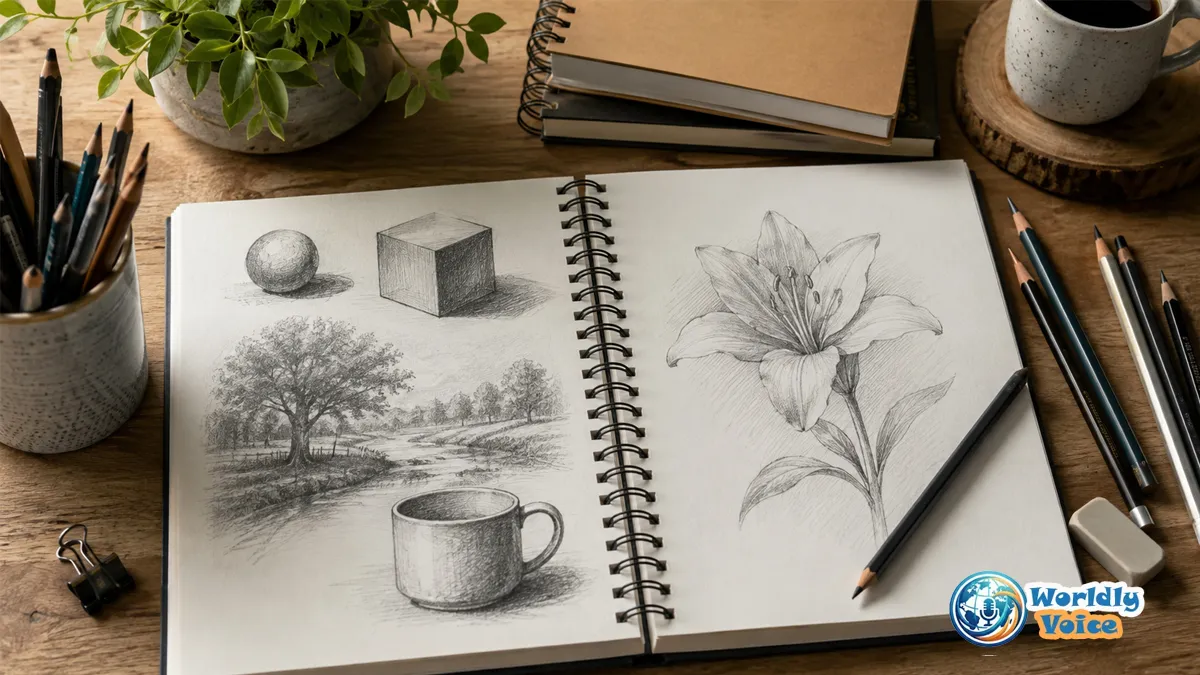
Starting a drawing hobby can feel intimidating when you believe you need natural artistic talent, expensive supplies, or years of training before your sketches can look good. You do not. Drawing is a learnable skill, and you can begin with something as simple as a pencil, a piece of paper, and 5–10 minutes of attention.
The first goal should not be creating realistic portraits or impressive artwork. It should be learning to look carefully, making marks, experimenting with shapes, and becoming comfortable with imperfect results. Over time, regular practice can improve your control, observation, proportions, shading, and confidence.
If you have ever thought, “I can’t draw,” try replacing that thought with a more useful one: “I haven’t practiced drawing yet.”
This guide explains how to begin, what supplies you actually need, easy things to draw for beginners, how to build a daily routine, and practical sketchbook ideas for beginners so you always have something to work on.
Starting a creative hobby can also become a simple way to make more room for creativity in everyday Lifestyle. Whether you spend a few quiet minutes sketching after work or keep a small notebook for ideas and observations, drawing can fit naturally into an existing routine. You do not need a major time commitment; even short, regular creative sessions can give your day a welcome change of pace.
What Is a Drawing Hobby?
A drawing hobby is simply the practice of drawing for enjoyment, creativity, learning, or personal expression rather than because you have to produce professional artwork.
It can involve many different approaches, including:
- Pencil sketching
- Doodling and pattern drawing
- Cartoon and character drawing
- Portraits
- Nature and botanical sketches
- Landscapes
- Urban sketching
- Illustration
- Comics
- Digital drawing
- Visual journaling
You do not have to choose one style when you begin. In fact, experimenting with different subjects can help you discover what you enjoy.
A useful way to think about drawing is as a form of visual observation. Instead of simply looking at an object and deciding what you think it looks like, you begin noticing its proportions, angles, curves, shadows, textures, and relationship to surrounding objects. The Smithsonian describes observational drawing as drawing what you actually see, and its educational resources use exercises involving line, shape, light, shadow, and composition to develop visual perception.
That makes drawing more than putting lines on paper. It is also a way of learning to see.
Why Start Drawing as a Hobby?
Drawing is unusually accessible because you can begin without a studio, complicated equipment, or a large budget. A small sketchbook can fit in a bag, and a basic pencil is enough for many fundamental exercises.
There is also no requirement to decide what your final artistic goal will be. You might eventually become interested in portraits, illustration, comics, botanical drawing, or digital art. At the beginning, exploration is more useful than specialization.
Another advantage is that drawing gives you a visible record of your development. If you date your sketches, you can look back after several weeks or months and compare your line control, proportions, composition, and confidence with your earlier work.
The Smithsonian’s museum resources also encourage sketching as a way of looking more closely at artworks and objects. Their “slow looking” activities specifically suggest making quick sketches without worrying about how they look, emphasizing what sketching can help you notice.
Benefits of Drawing as a Hobby
The benefits of drawing as a hobby are not limited to producing attractive pictures. The activity can develop several useful creative and observational skills.
Encourages Creativity
Drawing gives you a place to experiment with characters, objects, patterns, compositions, and imaginary ideas. You can change a shape, try another perspective, or combine unrelated objects without worrying about getting a single “correct” answer.
Develops Observation Skills
Observational drawing asks you to pay attention to details that are easy to overlook.
You may begin noticing:
- Shape and proportion
- Angles and curves
- Light and shadow
- Texture
- Negative space
- Relative size
- Perspective
This is one reason drawing exercises often begin with simple objects rather than complicated scenes.
Builds Patience and Concentration
A drawing rarely improves simply because you rush through it. Even a basic object requires time to observe, place, adjust, and refine marks. That repeated attention can make drawing a useful focused leisure activity.
Gives You a Record of Progress
A dated sketchbook provides something many hobbies do not: a visual timeline of your development. An awkward early drawing becomes useful later because it gives you something concrete to compare.
Provides a Quiet Creative Activity
For many people, sitting with paper and a pencil is a welcome change from screen-based activities. It can become a relaxing creative routine. However, it is better to describe this as a potentially calming activity rather than claiming that drawing treats stress, anxiety, or other health conditions.
Builds Confidence Through Small Wins
Finishing a simple drawing can make a difficult subject feel less intimidating. A beginner who successfully draws a mug, leaf, or shoe can gradually move toward more complicated subjects.
Supports Other Creative Skills
Basic drawing can also provide a foundation for activities such as painting, illustration, animation, graphic design, comics, crafts, and digital art.
What Do You Need to Start a Drawing Hobby?
You can begin with a very small collection of beginner art supplies.
| Supply | Why you need it | Beginner advice |
|---|---|---|
| Paper or sketchbook | Surface for practice | Ordinary printer paper works at first |
| HB pencil | General-purpose drawing | A reliable starting point |
| 2B pencil | Softer, darker marks | Useful for shading |
| Eraser | Corrections and highlights | Choose a comfortable standard eraser |
| Sharpener | Keeps pencil point usable | A simple sharpener is enough |
| Fineliner | Optional line work | Add later if you enjoy ink |
| Colored pencils | Optional color | Useful for experimenting with color |
| Tablet | Optional digital drawing | Buy only if digital art interests you |
There is no reason to postpone drawing until you own premium paper, professional pencils, or a graphics tablet.
Start with what you already have. As your interests become clearer, you can decide which materials are worth purchasing.
How to Start a Drawing Hobby Step by Step
1. Choose One Simple Tool
Pick a pencil and paper rather than spending your first week researching supplies. The objective is to start drawing.
2. Create a Convenient Drawing Space
You do not need a dedicated art room. A small desk, table, or comfortable place where you can keep your sketchbook nearby is enough.
Convenience matters because a hobby becomes easier to maintain when there are fewer obstacles between you and the activity.
3. Practice Basic Shapes
Before attempting complex subjects, spend some time with:
- Circles
- Ovals
- Squares
- Rectangles
- Triangles
- Cubes
- Cylinders
Many everyday objects can be simplified into combinations of these forms. A cup, for example, can be approached as a cylinder with an oval opening.
4. Draw Familiar Objects
Look around your room instead of searching endlessly for inspiration. Your mug, shoes, phone, keys, lamp, or water bottle can all become drawing subjects.
5. Add Light and Shadow
Once you are comfortable with simple outlines, place an object near a light source and observe where the lighter and darker areas appear.
Do not worry about creating perfectly realistic shading. Begin by identifying broad areas of light, middle tone, and shadow.
6. Keep a Sketchbook
Your sketchbook should not be treated as a gallery where every page must be beautiful. Leave room for rough drawings, failed attempts, experiments, notes, and repeated studies.
UAL’s guidance on sketchbooks describes them as places for visual exploration, experimentation, recording ideas, reviewing development, and revising work.
7. Practice Consistently
A short session you actually complete is more useful for building a routine than an ambitious schedule you repeatedly postpone.
Easy Things to Draw for Beginners
If you are searching for easy things to draw for beginners, start with subjects that have recognizable shapes and manageable details.
Very Easy Subjects
Try:
- Apple
- Leaf
- Cloud
- Star
- Heart
- Simple flower
- Pencil
- Book
- Ball
- Candle
Household Objects
Once you are comfortable with those, move to:
- Mug
- Shoes
- Keys
- Bottle
- Lamp
- Plant pot
- Glass
- Backpack
- Chair
- Headphones
Draw one object several times from different angles. This is often more useful than drawing ten unrelated objects once because you begin to understand how its form changes in space.
Nature Subjects
Nature offers excellent beginner drawing practice:
- Leaves
- Flowers
- Trees
- Mushrooms
- Stones
- Clouds
- Simple mountains
- Birds
- Small landscapes
The Smithsonian’s observational plant-drawing resources specifically encourage looking closely at size, shape, color, and structure while drawing from observation.
Fun Subjects
If realistic drawing feels too serious, try:
- Cartoon animals
- Ice cream
- Cupcakes
- Simple houses
- Rockets
- Hot-air balloons
- Cute imaginary characters
- Fantasy objects
Enjoyment matters. A subject that makes you want to pick up your pencil again is a perfectly good practice subject.
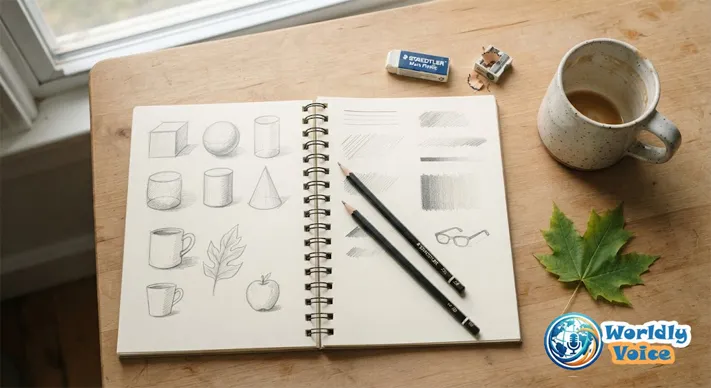
How to Practice Drawing Daily
Learning how to practice drawing daily does not mean spending hours at your desk.
A practical starting point is 10–20 minutes. If you only have five minutes on a busy day, that still counts.
The key is to give each session a purpose rather than drawing randomly every time.
A Simple 15-Minute Drawing Routine
3 minutes — Warm-up
Draw straight lines, curves, circles, ellipses, and light-to-dark strokes.
7 minutes — Skill practice
Choose one skill such as:
- Basic shapes
- Proportion
- Contour drawing
- Perspective
- Shading
- Texture
5 minutes — Free drawing
Finish by drawing something you genuinely enjoy. This keeps practice from becoming a chore.
You can also use observational exercises. Look at an object for a short period before drawing it and consciously identify its major shapes, angles, and proportions. Drawing becomes partly an exercise in noticing rather than simply reproducing a symbol from memory.
How to Build a Daily Drawing Habit
The biggest obstacle is often not artistic ability. It is consistency.
Try these practical approaches:
Keep your sketchbook visible. If it is buried in a drawer, you are less likely to use it.
Set a tiny minimum. Tell yourself you only need to draw for five minutes. Continuing is optional.
Attach drawing to an existing routine. You might draw after breakfast, during a lunch break, or before bed.
Use prompts when inspiration disappears. Pick an object from your room, draw something beginning with a randomly chosen letter, or sketch the nearest plant.
Accept imperfect drawings. A page that teaches you something is not wasted.
Date your work. This makes progress easier to recognize.
A sketchbook can also function as a portable visual notebook. The Metropolitan Museum of Art notes that artist William James Glackens used portable sketchbooks for on-the-spot observations of everyday life, figures, movement, and urban activity.
Sketchbook Ideas for Beginners
When you run out of ideas, divide your sketchbook into small experiments rather than trying to create one impressive drawing on every page.
Everyday Object Studies
Draw your:
- Cup
- Phone
- Shoes
- Keys
- Books
- Glasses
- Backpack
Draw one object from the front, side, and an angled view.
Nature Pages
Collect several small studies on one page. For example, draw five different leaves and compare their shapes, veins, and edges.
Hands and Facial Features
Hands can be challenging, so begin with simple positions rather than attempting a detailed full figure. You can also practice individual features such as eyes, noses, and lips.
Pattern and Doodle Pages
Fill a page with repeating:
- Spirals
- Circles
- Geometric shapes
- Flowers
- Stars
- Abstract marks
Texture Studies
Create small squares showing how you might represent wood, fabric, brick, metal, tree bark, water, or crumpled paper.
These exercises are short enough to complete in a few minutes and can improve your awareness of different marks and surfaces.
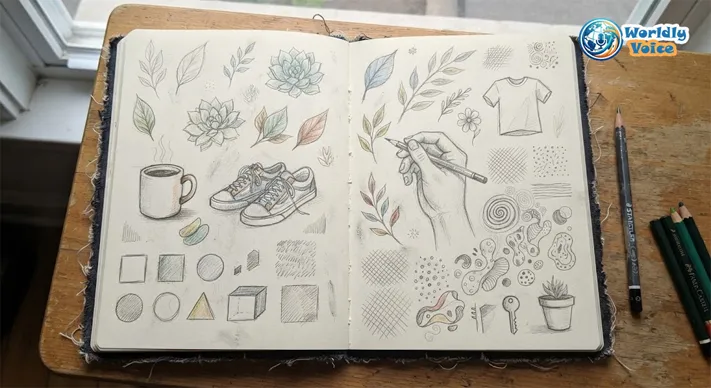
A 7-Day Drawing Challenge for Beginners
If you need structure, try this simple first week.
Day 1: Draw circles, squares, cylinders, cubes, and other basic forms.
Day 2: Choose one household object and draw it from two angles.
Day 3: Draw a leaf, flower, or another natural object.
Day 4: Practice light and shadow using one simple object.
Day 5: Draw your hand in two or three positions.
Day 6: Invent a simple character, creature, or imaginary object.
Day 7: Redraw one subject from earlier in the week and compare the two versions.
The purpose is not to produce seven polished drawings. It is to establish a repeatable practice and discover which types of drawing you enjoy.
Common Drawing Mistakes Beginners Should Avoid
Buying too many supplies: Equipment cannot replace practice.
Starting with extremely difficult subjects: A detailed portrait or complicated cityscape may be frustrating when you are still learning basic forms.
Trying to make every page perfect: A practice sketchbook needs room for mistakes.
Drawing only from memory: Observational drawing gives you opportunities to study real proportions, shapes, and relationships.
Practicing only when inspired: A small routine is more dependable than waiting for motivation.
Comparing yourself with professionals: Compare your current work with your older work instead. Your progress is the more useful measurement.
How Long Does It Take to Get Better at Drawing?
There is no universal timeline for becoming “good” at drawing. Improvement depends on how frequently you practice, what you practice, how you study, and what kind of drawing you want to learn.
A reasonable way to think about progress is:
- First few weeks: greater familiarity with lines, shapes, and basic control
- One to three months: stronger observation and more confident proportions
- Several months: greater ability to handle complex subjects
- Long term: development of specialized skills and an individual artistic approach
These are general expectations, not guarantees. Someone practicing observational drawing several times a week may progress differently from someone who mainly doodles occasionally.
The most useful question is not, “How quickly can I become an artist?” It is, “What can I understand or draw a little better this week?”
Should You Draw Traditionally or Digitally?
Both approaches can work well.
| Traditional drawing | Digital drawing |
| Pencil and paper | Tablet and stylus |
| Simple setup | Requires compatible hardware |
| Easy to start inexpensively | Greater initial equipment cost |
| Physical sketchbook | Digital files and layers |
| Erasing and redrawing by hand | Easy undo and editing |
| Excellent for observational practice | Useful for illustration and design |
There is no rule that says you must choose one permanently. Traditional pencil drawing can teach fundamental observation and mark-making, while digital tools provide convenient editing and experimentation.
Choose the medium that makes you want to practice.
How to Stay Motivated
Motivation becomes easier to maintain when drawing remains enjoyable.
Keep several subjects available so you can switch when one becomes boring. Try drawing prompts, participate in a short challenge, revisit an old sketch, or experiment with a new medium.
You can also create themed sketchbook pages such as “things on my desk,” “plants I see this week,” “five types of cups,” or “faces from imagination.”
Most importantly, allow yourself to make bad drawings. A hobby becomes difficult to sustain when every session feels like an examination.
Universities and art institutions commonly treat sketchbooks as tools for experimentation, reflection, feedback, and sustained practice rather than simply repositories for finished pictures. UAL’s drawing courses, for example, use sketchbook work to develop observation, proportion, gesture, light, structure, and ongoing independent practice.
Frequently Asked Questions About Drawing as a Hobby
Is drawing a good hobby for beginners?
Yes. You can start with very little equipment, choose simple subjects, and increase the difficulty gradually. No formal art education is required to begin practicing.
Can I start drawing if I have no natural talent?
Yes. Drawing involves skills that can be developed through observation, exercises, and repeated practice. You do not need to produce impressive work before you are allowed to call yourself a beginner artist.
What is the easiest thing to draw?
Simple objects such as leaves, apples, mugs, books, clouds, flowers, and geometric shapes are good starting points because their forms are relatively easy to observe and simplify.
How many minutes should I draw every day?
Start with 5–15 minutes if that feels manageable. You can increase the time later. A sustainable routine is generally more useful than setting an unrealistic daily target.
What should I put in my sketchbook?
Try everyday objects, nature studies, patterns, textures, hands, simple characters, landscapes, and observational drawings. You can also include notes about what you learned from each exercise.
How can I improve my drawing skills?
Practice regularly, draw from observation, study basic shapes and proportions, experiment with shading and perspective, and review older sketches. Repeating a subject from different angles can be particularly useful.
Conclusion
A Drawing Hobby does not need to begin with a perfect sketch, an expensive art kit, or a decision to become a professional artist. It can begin with an ordinary pencil and five quiet minutes.
Start by drawing simple shapes and familiar objects. Keep a sketchbook nearby. Practice observation rather than worrying constantly about realism. Try different subjects until you discover what keeps your attention.
Your early sketches may look uneven. That is normal. They are practice, not a final examination.
If you want to begin today, choose one ordinary object in front of you—a cup, shoe, leaf, book, or bottle—and draw it for ten minutes. Date the page, put the pencil down, and come back tomorrow.
Start small. Draw often. Observe carefully. Let imperfect sketches be part of the process.
