


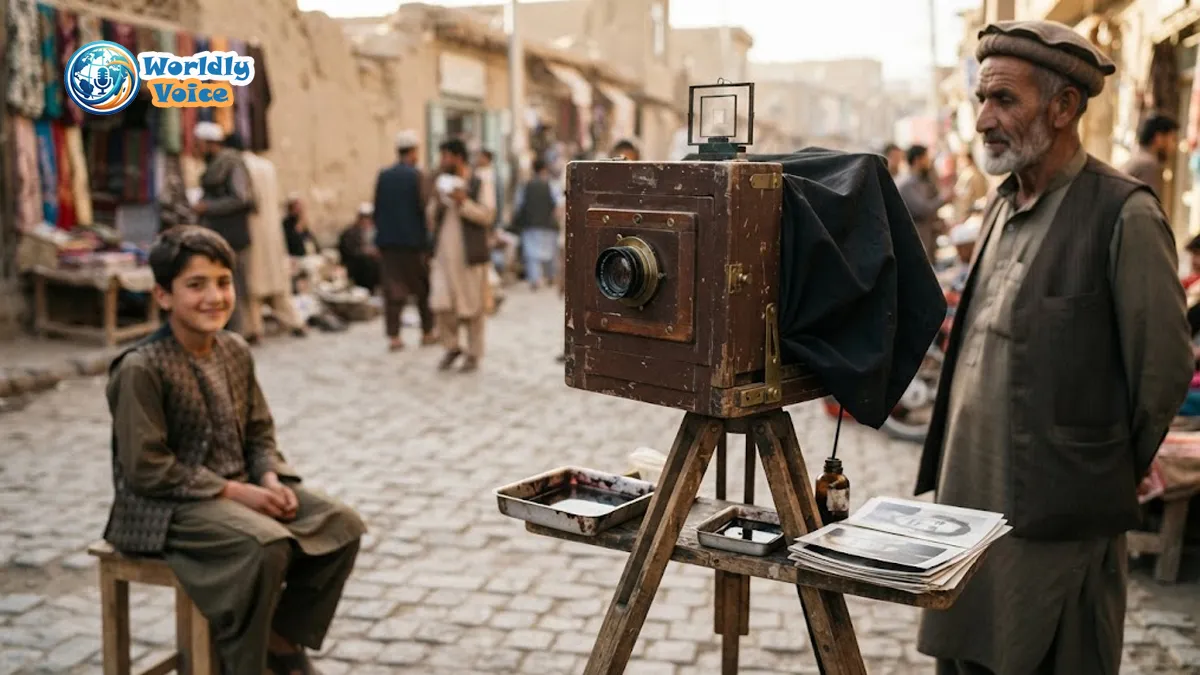
The Afghan Box Camera: A Complete Guide to History, Mechanics, and Legacy begins with a simple wooden box on a busy street. At first glance, it looks handmade, almost humble. But inside that box lives a complete photographic system: camera, darkroom, enlarger, developer tray, fixer tray, and printing station.
Known in Dari as kamra-e-faoree, meaning “instant camera,” and in Pashto as da lastunri kamra, or “sleeve camera,” the Afghan box camera helped generations of Afghans get identity portraits, family images, school photos, and official documents.
I have always found this camera fascinating because it collapses the entire photographic process into one portable object. Compared with a modern Fujifilm X-T5, which captures a crisp digital file in a fraction of a second, the Afghan box camera asks the photographer to slow down. Focus carefully. Touch the materials. Watch the image appear by hand.
This guide explains How the Afghan box camera works, the Kamra-e-faoree history, its role in Street box camera photography, what goes into Making a DIY box camera, and why Preserving the Afghan Box Camera Project matters today.
1. What Is the Afghan Box Camera?
The Afghan box camera is a handmade wooden field camera and portable darkroom combined into one device. It was commonly used by street photographers across Afghanistan, especially in cities such as Kabul, Herat, Mazar-e-Sharif, and Kandahar.
Unlike a conventional camera, it does not simply expose film and send it to a lab. The photographer develops the image inside the box immediately after exposure. That is why many people describe it as a historical portable darkroom.
Most sources agree on a few core facts:
- The device is usually made from wood.
- It uses photographic paper instead of roll film.
- It produces a paper negative first.
- The negative is re-photographed to create a positive print.
- The photographer works through a light-tight cloth sleeve.
- It was widely used for identity photographs.
In my experience studying analog street photography techniques, this is what makes the Afghan box camera so special: it is not just a camera. It is a performance, a trade, and a social service.
For readers who enjoy classic cameras like the Canon AE-1 Program, the Afghan box camera offers something different. It is less about branded engineering and more about local invention.
2. Kamra-e-Faoree History: A Camera Built by Need
The Kamra-e-faoree history is closely tied to Afghanistan’s civic life. These cameras were not luxury objects. They became practical tools for ordinary people who needed affordable portraits.
Similar box-camera traditions appeared in parts of the Middle East, South Asia, and Latin America, but Afghanistan developed its own strong street photography culture around the kamra-e-faoree.
By the early to mid-20th century, these cameras had become visible in Afghan cities. Some accounts credit a Kabul-based civil servant known as Afandi with helping organize and professionalize the trade. Photographers learned from one another, and carpenters made custom boxes suited to each worker’s habits.
The demand grew sharply when official identity papers became more common. National identity cards, known as tazkira, required photographs. For many Afghans, studio photography was too expensive or unavailable. Street photographers filled the gap.
A person could walk up to a photographer, sit on a chair, wait a few minutes, and leave with a small black-and-white portrait. That speed made Kamra-e-faoree instant portraits essential.
Historical Timeline
| Era | What Happened | Impact on the Camera |
|---|---|---|
| 1940s–1950s | Box cameras became common in Afghan urban centers | Street photography became a recognized trade |
| Mid-1950s–1970s | Identity documents increased demand | Photographers became fixtures in public spaces |
| 1979–1990s | Soviet-Afghan War and civil conflict disrupted daily life | Cameras remained useful for documents and relief work |
| 1996–2001 | Taliban restrictions endangered photography | Many photographers hid, buried, or destroyed equipment |
| 2001–Present | Digital photography expanded rapidly | The craft declined but gained archival attention |
This is also where Street photography history in Afghanistan becomes deeply human. These photographers were not only image-makers. They were witnesses to political change, migration, war, bureaucracy, and daily survival.
For a trusted overview of the broader topic, see Afghan box camera.
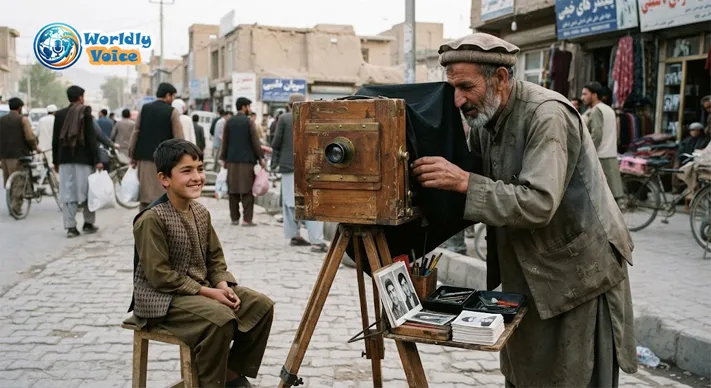
3. How the Afghan Box Camera Works
To understand How the Afghan box camera works, imagine a camera and a darkroom sharing the same wooden body.
The process is simple in theory, but precise in practice.
Step 1: Focusing the Image
The photographer points the lens at the subject. Inside the box, a focusing plate or holder moves forward and backward on a sliding track. The image appears upside down on a ground glass surface.
The photographer checks focus, often by looking through an opening or by using a viewing system built into the box.
This is where vintage box camera mechanics become visible. There are no menus, sensors, autofocus points, or batteries. The photographer uses hands, eyes, distance, and judgment.
Step 2: Loading the Paper
Once the image is focused, the photographer reaches into the camera through a black cloth sleeve. This sleeve blocks outside light.
Inside the box, the photographer places photosensitive paper where the image will fall.
This is one of the defining features of the da lastunri kamra. The sleeve allows the operator to work blind, by touch. I think of it as a tactile darkroom. Every movement must be familiar.
Step 3: Making the Exposure
The lens cap acts like a shutter. The photographer removes it for a few seconds, then replaces it.
Exposure depends on:
- Available daylight
- Lens brightness
- Paper sensitivity
- Subject distance
- Photographer experience
There is no instant preview. The photographer reads the light and trusts the process.
Step 4: Developing Inside the Box
Inside the camera are small trays of developer and fixer. The exposed paper is moved by hand from one tray to another.
The photographer monitors the image through a small light-safe peephole, often fitted with red or amber material.
This is the heart of Instant film street photography, although technically it is not instant film in the Polaroid sense. It is instant paper processing.
Step 5: Creating the Positive Print
The first result is a paper negative. Light areas appear dark, and dark areas appear light.
Here comes the clever part.
The photographer places the paper negative in front of the lens and photographs it again. This second exposure reverses the tones, producing a positive print.
This two-step paper process is one of the most elegant examples of DIY paper negative photography.
4. Why Street Box Camera Photography Mattered
Street box camera photography mattered because it was accessible.
A person did not need to book a studio appointment. They did not need wealth. They did not need to understand photography. They only needed to sit still for a few moments.
These cameras served many purposes:
- National identity cards
- School registration
- Work permits
- Family keepsakes
- Military or relief documentation
- Passport-style portraits
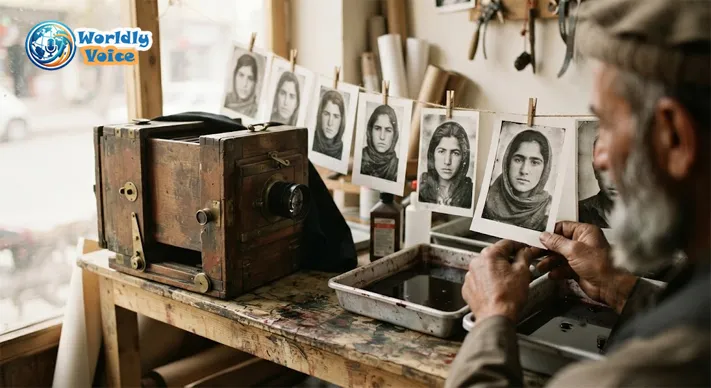
In many cases, the background was plain. The pose was direct. The expression was serious. But the images carried weight. They helped people move through systems of identity, employment, education, and travel.
I noticed that many old kamra-e-faoree portraits share a quiet dignity. They were made quickly, but not carelessly. The photographer’s skill shaped the final image: framing, exposure, contrast, and even retouching.
For anyone interested in travel documentary work, this tradition also connects with stories like Barbados travel, where place, portraiture, and local identity shape how we remember communities.
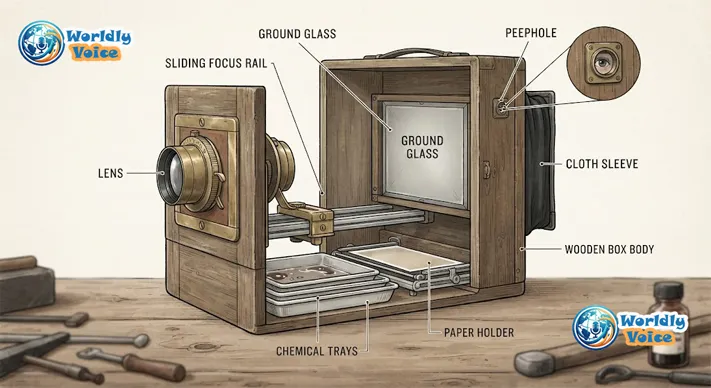
5. Anatomy of a Handmade Wooden Field Camera
A typical Afghan box camera includes several practical parts. Designs vary, because most were locally made. There was no single factory model.
| Component | Purpose | Why It Matters |
|---|---|---|
| Wooden body | Holds the camera and darkroom together | Must be light-tight and durable |
| Lens | Projects the image | Often adapted from older cameras |
| Ground glass | Helps with focusing | Shows the image before exposure |
| Sliding rail | Moves the paper holder | Controls focus distance |
| Cloth sleeve | Allows hands to work inside | Prevents light leaks |
| Chemical trays | Hold developer and fixer | Makes processing possible in the box |
| Peephole | Lets photographer check development | Usually filtered for safe viewing |
| Negative holder | Holds paper negative for re-copying | Creates the final positive print |
These parts explain why the camera survived for so long. It could be repaired locally. A carpenter could replace a panel. A photographer could adapt a lens. A tray could be swapped out.
That flexibility is central to traditional Afghan photography culture. The camera was not precious in the museum sense. It was a working tool.
6. Making a DIY Box Camera: What Enthusiasts Should Know
Making a DIY box camera appeals to photographers who want to understand photography from the inside out. It teaches light, chemistry, exposure, and patience.
I would not recommend starting without basic darkroom safety knowledge. Developer and fixer should be handled carefully, with ventilation and proper disposal. But as a learning project, it is deeply rewarding.
A simple build usually requires:
- A light-tight wooden or plywood box
- A lens with basic focusing ability
- A sliding internal paper holder
- A cloth sleeve fixed securely to the side
- Small chemical trays
- Black paint or light-sealing material
- Photographic paper
- Safe viewing filter or peephole
The hardest part is not woodworking. It is controlling light leaks. Even a thin crack can fog the paper.
If you have used a modern mirrorless camera like the Fujifilm X-T5, this process will feel slow. But that slowness is the lesson. You begin to see how much digital cameras do for us automatically.
Practical Example
A DIY builder might start with a shoebox-sized plywood body, a salvaged enlarger lens, and black-and-white photographic paper. The first prints may look soft or uneven. That is normal. The process improves as the builder learns exposure times and chemical handling.
For detailed preservation and build resources, the best starting point is Preserving the Afghan Box Camera Project.
7. The Afghan Box Camera Project and Cultural Preservation
The Afghan Box Camera Project was founded by Lukas Birk and Sean Foley. Their work is one of the most important documentation efforts connected to this disappearing craft.
They photographed practitioners, collected stories, filmed working methods, and published educational material. Their archive helps preserve not only the cameras but also the human knowledge behind them.
This matters because the Afghan box camera was rarely documented in formal manuals. The knowledge lived in hands, habits, and apprenticeships.
When a photographer retired, a whole set of techniques could disappear.
The project focused on cities such as Kabul, Herat, and Mazar-e-Sharif. It also helped global audiences understand that these cameras were not curiosities. They were part of a living profession.
For more on the work of one of the founders, see Lukas Birk Afghan Box Camera.
8. Why the Camera Declined
The decline of the Afghan box camera was not caused by one event. It came from several pressures.
Digital photography became cheaper. Color identity photographs became required for many official uses. Smartphones changed how people thought about portraits. Printing shops became faster and more standardized.
The kamra-e-faoree could not compete on convenience.
But it still offers something digital tools cannot: a direct connection between subject, photographer, light, paper, and chemistry.
In my view, this is why photographers still care about it. It reminds us that an image is not only data. It can be a physical trace of time, made by hand.
This is similar to why many people still admire the Canon AE-1 Program. Older tools make the process visible. They invite the photographer to participate more consciously.
FAQs About the Afghan Box Camera
1. What is the Afghan box camera used for?
The Afghan box camera was mainly used for quick black-and-white portraits, especially identity photos. It also served school, work, family, and official documentation needs.
2. How the Afghan box camera works in simple terms?
It exposes photographic paper inside a wooden camera, develops it in built-in chemical trays, then re-photographs the paper negative to create a positive print.
3. Is the kamra-e-faoree the same as a Polaroid camera?
No. Both produce quick images, but they work differently. A Polaroid uses instant film chemistry. The kamra-e-faoree uses photographic paper, developer, fixer, and a manual darkroom process.
4. Can I build one at home?
Yes, but Making a DIY box camera requires careful light sealing, safe chemical handling, and patience. It is a useful project for learning analog photography from the ground up.
5. Why is the Afghan box camera disappearing?
Digital cameras, smartphones, and modern printing systems made the process less practical for official photos. Still, preservation projects keep its memory and techniques alive.
6. Is it useful for modern photographers?
Yes. Even if you shoot with a Fujifilm X-T5 or enjoy film cameras like the Canon AE-1 Program, studying the Afghan box camera can sharpen your understanding of exposure, light, and photographic craft.
Conclusion: A Wooden Box That Holds a Nation’s Memory
The Afghan box camera is more than a vintage device. It is a record of public life, handmade engineering, and survival through difficult history.
Through Kamra-e-faoree history, we see how a simple camera became essential for identity and documentation. Through How the Afghan box camera works, we see the elegance of a complete darkroom inside a wooden box. Through Street box camera photography, we see a profession built on trust, speed, and skill.
The Afghan Box Camera: A Complete Guide to History, Mechanics, and Legacy is also a reminder that technology does not need to be complex to be meaningful. Sometimes, a wooden box, a lens, a sleeve, and a few trays can carry an entire culture of image-making.
If you care about analog photography, cultural heritage, or visual storytelling, spend time with this tradition. Study it. Share it. Support archives preserving it. And if you enjoy related stories such as Barbados travel, classic tools like the Canon AE-1 Program, or modern image-making with the Fujifilm X-T5, the Afghan box camera offers a grounding lesson: every photograph begins with attention.
References
- Afghan Box Camera Project: https://www.afghanboxcamera.com/
- Wikipedia overview: https://en.wikipedia.org/wiki/Afghan_box_camera
- Lukas Birk project page: https://www.lukasbirk.com/afghan-box-camera/
