


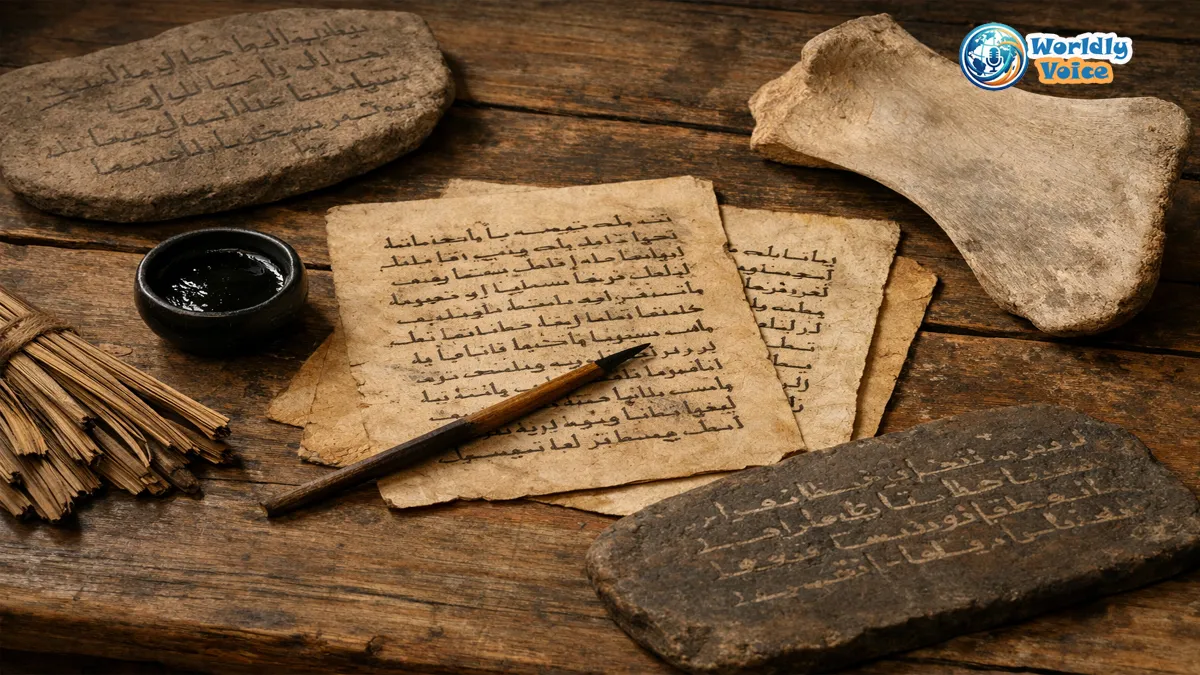
When we study the History of the Quran, one of the first things we notice is how physical and human its early preservation was. Before paper became common in the Muslim world, the Quran was recited, memorized, written, reviewed, and carefully transmitted using the materials available in 7th-century Arabia. That world included parchment, papyrus, palm-leaf ribs, flat stones, wooden boards, and even camel shoulder blades. Understanding these Early Quranic scribal materials gives us a clearer view of the Preservation of the Quranic text, the Ancient Quranic manuscript history, and the Traditional writing tools of the Revelation era.
I have found that many readers imagine early scripture as a bound book from the beginning. But the Quran first lived in voices, memory, and scattered written records. Its earliest custodians were reciters, scribes, and community leaders who understood that revelation was not ordinary speech. It had to be preserved with precision.
This article walks through that story in simple, evidence-based language. We will look at the materials used before paper, the role of oral transmission, the standardization under Caliph Uthman, and the manuscripts that still help scholars study the Quran today.
If you are also exploring related topics, you may later connect this article with Islamic manuscript preservation, Arabic calligraphy history, Quran memorization for beginners, early Islamic history timeline, and even the unrelated technical placeholder How to Fix the Error Llekomiss if your site requires that internal anchor.
1. The Quran Was First Preserved Through Recitation and Writing
The Quran was revealed to Prophet Muhammad between 610 and 632 CE, according to Islamic tradition. Muslims believe the Angel Gabriel delivered the revelation over 23 years in Makkah and Madinah.
In my experience, the easiest way to understand early Quranic preservation is to see it as a dual system:
- Oral memorization
- Written documentation
The oral side was central. Many companions memorized portions of the Quran, and some memorized it fully. These memorizers were known as ḥuffāẓ. The practice continues today across the Muslim world.
The written side was also active during the Prophet’s lifetime. Several companions served as scribes of revelation. Among the most famous was Zayd ibn Thabit, who later played a major role in the first official compilation.
This matters because the History of the Quran is not only a manuscript story. It is also a memory story. The Oral transmission of the Quran worked alongside writing, creating a strong preservation culture.
Most studies agree that early Quranic transmission involved both recitation and written records. Scholars may debate details of dating, orthography, or manuscript development, but the combined oral-written model is widely recognized in both Muslim tradition and modern Early Islamic manuscript studies.
2. What Materials Were Used Before Paper?
Paper did not become widespread in the Islamic world until after the 8th century, especially following contact with Chinese papermaking traditions. Before that, early Muslims used whatever durable writing supports were available.
These Early Quranic scribal materials were practical, regional, and often modest.
Parchment
Parchment was made from prepared animal skin, usually sheep, goat, or calf. It was durable and suitable for important texts. Many early Quranic manuscripts were written on parchment.
Parchment was expensive. Preparing it required skill. The skin had to be cleaned, stretched, scraped, dried, and cut. Because of this, scribes often used space carefully. Some manuscripts show dense writing, limited decoration, and early spelling conventions.
In Quranic codicology and paleography, parchment is important because it helps researchers study manuscript format, script style, ink behavior, and page construction.
Papyrus
Papyrus was made from the papyrus plant, especially in Egypt. It was widely used in the ancient Near East and Mediterranean world.
Papyrus was lighter than parchment but less durable in humid conditions. It was more common for administrative documents, letters, and everyday writing. Some early Islamic documents survive on papyrus, giving us helpful context for writing culture in the 7th and 8th centuries.
Palm-Leaf Ribs
Palm trees were common in Arabia, and their leaves and ribs could be used as writing surfaces. These were not ideal for long-term preservation, but they were available and practical.
For short passages, notes, or temporary recording, palm materials made sense. They remind us that the early written Quran was not first preserved as a single luxury book. It was recorded in fragments and then gathered.
Flat Stones and White Stones
Early reports mention flat stones, including thin white stones, as writing materials. These could hold short passages. They were heavy and not suitable for long books, but they were useful in a resource-limited environment.
Shoulder Blades and Other Bones
Camel shoulder blades and other broad bones are often mentioned in traditional accounts. They offered a smooth enough surface for writing short sections.
To a modern reader, this may sound unusual. But if we think like people living in 7th-century Arabia, it becomes logical. Communities used what they had. A clean, broad bone could serve as a writing tablet.
Wooden Tablets
Wooden boards or tablets could also be used, sometimes with erasable surfaces. In later Islamic learning circles, wooden tablets became familiar tools for Quran education in parts of Africa and beyond.
This long tradition connects the Traditional writing tools of the Revelation era with later Muslim educational practice.
3. Traditional Writing Tools of the Revelation Era
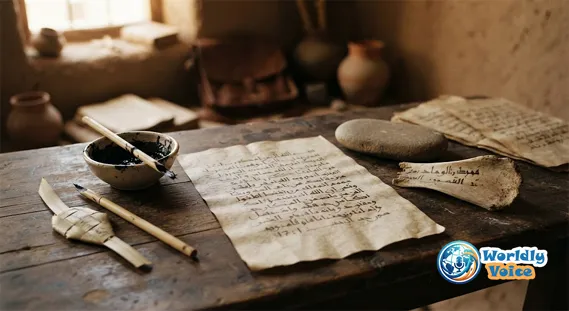
The Traditional writing tools of the Revelation era were simple but effective. A scribe did not need a modern desk or printed notebook. He needed a writing surface, ink, and a pen.
Reed Pens: The Qalam
The main writing instrument was the reed pen, or qalam. It was cut from reed and shaped to create a writing tip. The angle of the cut affected the thickness and style of the letters.
This tool later became central to Islamic calligraphy. If you study Arabic calligraphy history, you will see how the qalam shaped the visual identity of Arabic writing.
Ink
Early ink was often carbon-based. It could be made from soot or lampblack and mixed with binders such as gum arabic. This type of ink was dark, stable, and effective on parchment or papyrus.
Writing Surfaces and Practical Limits
The choice of writing support affected the shape of the text. Parchment allowed more permanent manuscript production. Palm ribs and bones were better for shorter notes. Papyrus was useful but less durable in some climates.
In my experience reviewing manuscript images, one thing stands out: early Quranic writing was not decorative in the way later Qurans became. It was functional, reverent, and focused on preserving the words.
That practical beauty is part of the Historical preservation of the Quran.
4. From Fragments to Compilation Under Abu Bakr
After Prophet Muhammad died in 632 CE, the Muslim community faced new challenges. One of the most important events was the Battle of Yamama, where many Quran memorizers were killed.
According to Islamic tradition, Umar ibn al-Khattab urged Caliph Abu Bakr to commission a written compilation of the Quran. Abu Bakr assigned Zayd ibn Thabit to lead the work.
Zayd reportedly gathered the Quran from:
- Written fragments
- Parchment
- Bones
- Palm materials
- Stones
- The memories of reliable reciters
This was not a casual collection. Reports describe careful verification. The aim was to gather the revealed text into a single compiled record.
This stage is essential in the History of the Quran because it shows how oral and written preservation met in an organized state-backed effort.
5. Uthmanic Codex and Standardization
During the caliphate of Uthman ibn Affan, from 644 to 656 CE, Islam had spread into new regions. Muslims from different tribes and lands recited Arabic with different dialectical habits. Concerns grew that variation in recitation could cause confusion.
Uthman formed a committee, again associated with Zayd ibn Thabit, to prepare a standard written codex. Copies were sent to major Islamic centers, often identified in tradition as places such as Kufa, Basra, Damascus, and Makkah.
This process is known as the Uthmanic codex and standardization.
It did not mean that every pronunciation tradition disappeared. The Quran continued to be recited through authorized modes of recitation. But the written consonantal framework became standardized.
The Preservation of the Quranic text therefore involved both control and continuity. The community preserved recitation while stabilizing the written form.
Most scholars agree that Uthmanic standardization was a decisive moment in the Transmission of the Quran in the 7th century.
6. Early Scripts: Hijazi and Kufic
The Evolution of Arabic script styles is one of the most interesting parts of Quran manuscript history.
Hijazi Script
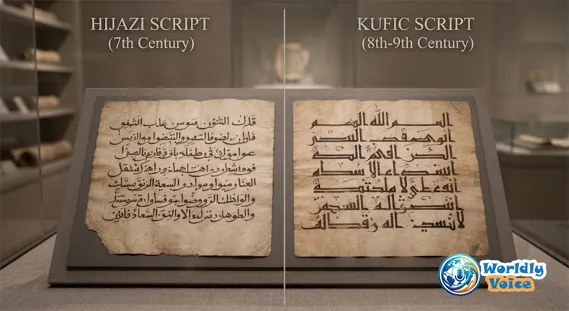
Hijazi script is often associated with some of the earliest Quranic fragments. It is generally sloping, informal, and less visually rigid than later scripts.
The Birmingham leaves and parts of the Sanaa manuscript are often discussed in relation to early Hijazi writing.
Kufic Script
Kufic script became more common in later early Quran manuscripts. It is angular, measured, and geometric. Many large-format Qurans from the 8th and 9th centuries used Kufic or related styles.
When I compare Hijazi and Kufic pages, I notice a shift from urgent documentation to formal manuscript culture. That does not mean one is more sacred than the other. It means Muslim scribal culture was developing.
This is where Ancient Quranic manuscript history becomes especially helpful. Manuscripts show not only text, but also changing writing habits, page layouts, and artistic priorities.
7. Key Ancient Quranic Manuscripts
Several manuscripts and fragments are central to modern research. They do not all have the same status, date, or completeness. But together, they help scholars understand the Ancient Quranic manuscript history of the early Islamic period.
Birmingham Quran Manuscript
The Birmingham Quran manuscript is one of the most discussed early Quranic fragments. Radiocarbon dating of the parchment produced a range of 568–645 CE.
This needs careful explanation. The earlier date, 568 CE, refers to the possible age range of the animal skin used for the parchment, not the date when the Quranic text was written. The writing itself is generally understood within the early Islamic context, and the range overlaps with the Prophet Muhammad’s lifetime and the first decades after his death.
The manuscript contains parts of Surahs 18–20 and is written in an early Arabic script often described as Hijazi.
Sanaa Palimpsest
The Sanaa manuscript, discovered in Yemen, is a palimpsest. That means an earlier text was erased or washed off, and another text was written over it.
The lower text contains Quranic material with some orthographic and textual variations. These variations are important for scholars, but they do not overturn the broad stability of the Quranic text. Rather, they show how early written practices developed before and around standardization.
Topkapi Manuscript
The Topkapi manuscript in Istanbul is a large early Quran copy, often written in Kufic script. It is nearly complete, though modern dating usually places it after the earliest generation.
Samarqand or Tashkent Quran
The Samarqand Quran, kept in Tashkent, is traditionally linked to Uthman. Modern scholarship generally dates it later, often around the 8th or 9th century. It remains historically significant, but its traditional attribution is debated.
Codex Parisino-Petropolitanus
The Codex Parisino-Petropolitanus is a major early Quran manuscript with portions now held in Paris, St. Petersburg, the Vatican, and elsewhere. It is often dated to the late 7th or early 8th century.
Projects such as the Corpus Coranicum project have helped catalog early fragments and compare manuscript evidence. This kind of work supports serious Early Islamic manuscript studies and helps readers move beyond myths, whether apologetic or skeptical.
Comparative Snapshot of Key Quran Manuscripts
| Manuscript | Approximate Date | Script | Completeness | Current Location |
|---|---|---|---|---|
| Birmingham Quran | Parchment dated 568–645 CE | Hijazi | Partial | University of Birmingham |
| Sanaa Palimpsest | 7th century | Hijazi | Fragmentary | Yemen |
| Topkapi Quran | 7th–8th century | Kufic | Nearly complete | Istanbul, Türkiye |
| Samarqand Quran | 8th–9th century | Kufic | Large partial copy | Tashkent, Uzbekistan |
| Codex Parisino-Petropolitanus | Late 7th–early 8th century | Hijazi | Substantial partial | Paris, St. Petersburg, Vatican |
This table is useful because it separates three things readers often confuse:
- Date of parchment or material
- Date of writing
- Traditional attribution
Good Quranic codicology and paleography depends on keeping those categories clear.
8. What Do Manuscripts Tell Us About Preservation?
The manuscript evidence shows minor differences in spelling, layout, verse markers, and orthography. Early Arabic writing often lacked the full system of dots and vowel marks used in later printed Qurans.
That can surprise modern readers. But it should not be alarming.
Arabic writing developed over time. Early readers relied heavily on memorization and oral instruction. The written page supported a living recitation tradition.
This is why the Preservation of the Quranic text cannot be judged by manuscript letters alone. It must be understood through oral recitation, community teaching, written codices, and standardization.
Most studies agree on this balanced point: despite early orthographic variation, the core Quranic text became stable very early and has remained remarkably consistent across Muslim communities.
For a broader museum-based introduction to Islamic manuscript culture, the British Library’s guide to Qur’an manuscripts is a useful reference.
9. Why Paper Changed Quran Manuscript Culture
Paper entered the Islamic world more widely after the 8th century. It was cheaper and easier to produce than parchment. As paper spread, bookmaking expanded.
This changed everything.
Quran copies became easier to produce. Libraries grew. Scholars wrote tafsir, grammar works, legal texts, and hadith collections in larger numbers. Calligraphy also developed into a refined art.
But paper did not create the Quran’s preservation. It amplified it.
The foundations had already been laid through memorization, early writing, compilation under Abu Bakr, and the Uthmanic codex.
This distinction is important for the History of the Quran. Paper belongs to the later manuscript culture, not the earliest recording of revelation.
10. Scholarly Debates: What Is Agreed and What Is Discussed?
A trustworthy article should not pretend there are no debates. There are.
Some Western scholars have argued for later canonization or more complex textual development. Muslim tradition maintains that the Quran was preserved unchanged from the Prophet’s lifetime through the companions and official standardization.
Where is the consensus?
Most contemporary research recognizes:
- The Quran was transmitted very early.
- Oral memorization was central.
- Written materials existed during the Prophet’s lifetime.
- Uthmanic standardization was historically significant.
- Early manuscripts show minor spelling and orthographic variation.
- The received Quranic text is highly stable compared with many ancient textual traditions.
In my view, this is where careful language matters. Saying “there were spelling variations” is not the same as saying “the Quran was rewritten.” Manuscript scholarship works best when we avoid exaggeration in either direction.
That is also the standard I recommend for related content such as Islamic textual criticism explained, history of Arabic scripts, and Quran manuscript dating methods.
FAQs About the History of the Quran and Early Writing Materials
1. Was the Quran written down during Prophet Muhammad’s lifetime?
Yes. Islamic tradition reports that scribes wrote revelation during the Prophet’s lifetime. At the same time, many companions memorized the Quran. This dual method supported the Preservation of the Quranic text.
2. What were the main Early Quranic scribal materials?
The main materials included parchment, papyrus, palm-leaf ribs, flat stones, wooden tablets, and camel shoulder blades. These Early Quranic scribal materials were common before paper became widespread.
3. Why was the Uthmanic codex important?
The Uthmanic codex helped standardize the written Quran as Islam spread into new regions. This reduced confusion and became a major milestone in the History of the Quran.
4. Is the Birmingham Quran from before Islam?
No. The radiocarbon range of 568–645 CE dates the parchment material. The writing belongs to the early Islamic period, and the range overlaps with the Prophet Muhammad’s lifetime and the first generation of Muslims.
5. What is the difference between Hijazi and Kufic script?
Hijazi is an early, sloping Arabic script found in some of the oldest fragments. Kufic is more angular and became common in later early manuscripts. Their study helps explain the Evolution of Arabic script styles.
6. Did early manuscript variations change the Quran’s meaning?
Most variations discussed by scholars involve spelling, orthography, or layout. The broad scholarly consensus is that the Quranic text shows strong early stability. For deeper reading, connect this with Quran manuscript preservation guide and early Islamic manuscript studies.
Conclusion: What Early Materials Teach Us About the History of the Quran
The History of the Quran is not just about ink on parchment. It is about a community that treated revelation as a trust.
Before paper, Quranic passages were written on parchment, papyrus, palm ribs, stones, bones, and wooden tablets. They were also carried in memory by reciters who reviewed and taught the text. Later, compilation under Abu Bakr and standardization under Uthman gave the written Quran a unified codex form.
The surviving manuscripts do not make the story smaller. They make it richer. They show real scribes, real materials, and real historical processes behind the Historical preservation of the Quran.
If you continue exploring this topic, I recommend pairing it with Arabic calligraphy history, Quran memorization for beginners, Islamic manuscript preservation, and early Islamic history timeline for a fuller understanding of how text, memory, and civilization worked together.
