


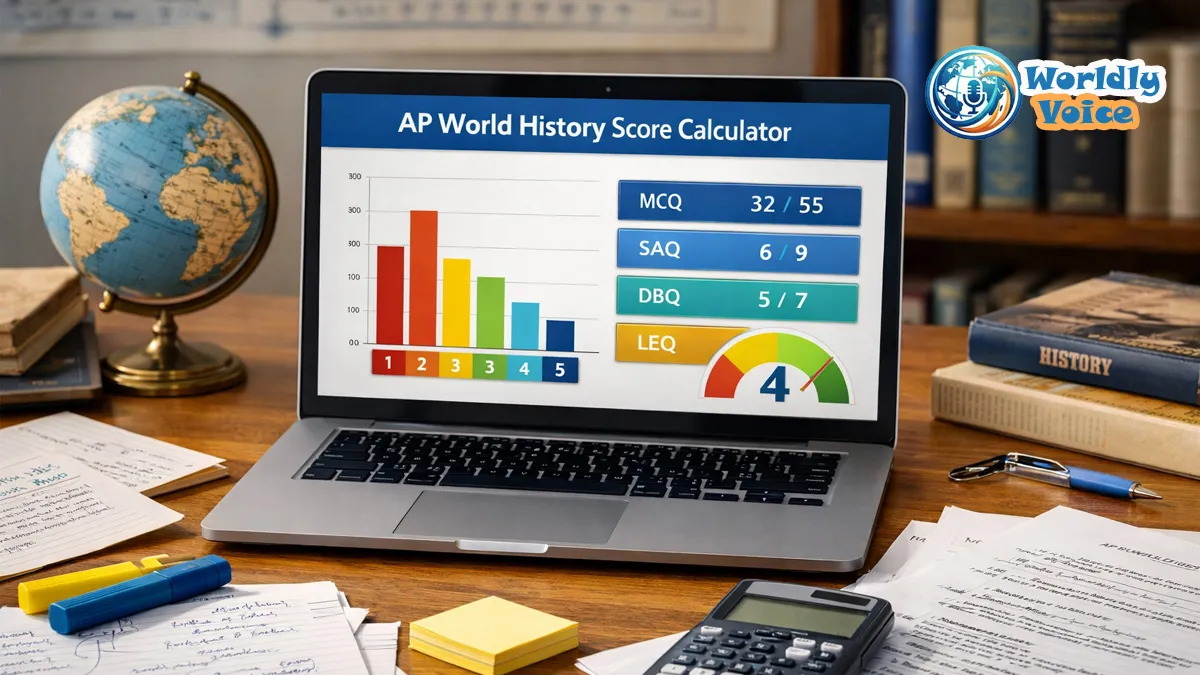
If you are searching for an [ap world score calculator], you are probably trying to answer one urgent question: “Am I on track for a 3, 4, or 5?” I have worked through enough AP practice sets to know that this question can feel bigger than the exam itself. Raw scores look confusing. Rubrics feel subjective. And one practice test can swing your confidence for an entire week. That is exactly why score calculators matter. They turn scattered section scores into a realistic prediction, helping you study smarter instead of guessing.
In my experience, the best calculator is not the one that gives the highest number. It is the one that gives the most honest estimate. For AP World History: Modern, most 2026 projections suggest you need about a 73% composite for a 5, around 58% for a 4, and roughly 42% for a 3. Those numbers can shift slightly when the College Board finalizes scoring, but they are useful benchmarks right now.
If you are balancing AP prep with other priorities, the logic is similar to planning any big goal. The same kind of step-by-step thinking that helps with How to Start a Zero-Waste Lifestyle on a Budget or building a niche business like GrowthScribe Marketing Agency also helps here: measure where you are, identify weak spots, and improve the highest-impact areas first.
1. What an AP World score calculator actually does
An AP World calculator estimates your final 1–5 score using your raw performance in each section:
- Multiple Choice Questions (MCQ)
- Short Answer Questions (SAQ)
- Document-Based Question (DBQ)
- Long Essay Question (LEQ)
Most tools function like an ap exam composite score calculator. You enter how many MCQs you got right, estimate your SAQ points, and grade your DBQ and LEQ using published rubrics. The calculator then applies the official weighting used in the AP World History exam breakdown.
That matters because the exam is not scored by simple percentage alone. A 70% on one section does not mean the same thing as a 70% on another. The multiple-choice section carries more weight than the LEQ, and the DBQ can move your total faster than many students expect.
A reliable [ap world score calculator] usually reflects these four realities:
- MCQ is worth 40% of the final score
- SAQ is worth 20%
- DBQ is worth 25%
- LEQ is worth 15%
I noticed that students often look at the essay sections and panic. But the weighting tells a more balanced story. Essays matter a lot, yes. Still, multiple choice remains the largest share of the exam. If your MCQ performance rises from average to strong, your total can jump quickly.
You can compare estimates with tools like ap world history exam score calculator and ap world exam score calculator. I recommend using calculators as planning tools, not as promises.
2. 2026 estimated score cutoffs you should know
No calculator can guarantee an official result before the College Board releases scores. But historical scoring patterns are stable enough to make useful predictions.
Here is the working estimate many students are using for 2026:
| AP Score | Estimated Composite % | What It Usually Means |
|---|---|---|
| 5 | 73%–100% | Extremely well qualified |
| 4 | 58%–72% | Well qualified |
| 3 | 42%–57% | Qualified / passing |
| 2 | 28%–41% | Possibly qualified |
| 1 | 0%–27% | No recommendation |
These ap exam score cutoffs line up with historical trends seen across reputable prep platforms and public scoring discussions. Most studies and score analyses agree that a 3 is often more reachable than students fear, while a 5 requires consistently strong performance across both objective and writing sections.
A few perspective points help:
- Around 65% of students typically score 3 or higher
- Only a smaller share, often near the low teens, earns a 5
- Small gains in SAQ or DBQ scoring can push a borderline 2 into a 3
In my experience, the biggest emotional mistake students make is treating every missed point like disaster. AP scoring is more forgiving than many classroom grading systems. You do not need perfection. You need enough weighted points in the right places.
This is also where the phrase [how to calculate ap world history score] becomes more than a search query. It becomes a strategy. Once you understand the scoring structure, you stop studying blindly.
3. The official AP World History exam breakdown matters more than most students realize
The AP World History exam breakdown is straightforward on paper but tricky in practice. Here is the official structure used in recent exams and expected for 2026:
Multiple Choice: 55 questions, 40%
This section is the largest part of your score. There is no guessing penalty. That means every question deserves an answer.
Strong multiple choice exam practice pays off because it improves two things at once:
- Content recall
- Source analysis speed
I have seen students obsess over the DBQ while ignoring MCQ. That usually backfires. A weak MCQ score creates a hole that essays alone may not fix.
Short Answer: 3 questions, 20%
SAQs are compact but important. They test direct historical reasoning. Each part is worth a small number of points, but together they make up a meaningful chunk of the exam.
The challenge is precision. Students who write too much often lose time. Students who write too vaguely lose points.
DBQ: 1 essay, 25%
The DBQ is where rubric discipline matters most. When students ask about dbq and leq grading, this is usually the section that worries them first.
A DBQ is scored using specific ap world history rubric points such as:
- Thesis
- Contextualization
- Evidence from documents
- Evidence beyond the documents
- Sourcing and analysis
- Complexity
The DBQ rewards structure more than flair. A clear argument with targeted evidence usually beats a long essay that rambles.
LEQ: 1 essay, 15%
The LEQ is smaller in weight than the DBQ, but it still matters. It tests your ability to build a historical argument without documents.
If I had to give one simple LEQ rule, it would be this: answer the prompt early and directly. Too many students save their real argument for the middle.

4. How to calculate your AP World History score step by step
If you want to know [how to calculate ap world history score] without relying entirely on an online tool, here is the simple version.
Step 1: Count your correct MCQ answers
You get 1 raw point per correct answer. No penalty for wrong answers.
Example:
- 39 correct out of 55
That gives you a raw MCQ score of 39.
Step 2: Estimate your SAQ points honestly
Most SAQs are scored point by point. Be strict.
Example:
- SAQ 1: 2/3
- SAQ 2: 3/3
- SAQ 3: 2/3
Total SAQ raw points = 7
Step 3: Grade your DBQ with the official rubric
The DBQ is usually scored out of 7.
Example:
- Thesis: 1
- Contextualization: 1
- Evidence from docs: 2
- Evidence beyond docs: 1
- Analysis/sourcing: 1
- Complexity: 0
Total DBQ raw points = 6/7
Step 4: Grade your LEQ with the rubric
The LEQ is usually scored out of 6.
Example:
- Thesis: 1
- Contextualization: 1
- Evidence: 2
- Analysis: 1
- Complexity: 0
Total LEQ raw points = 5/6
Step 5: Convert using exam weights
This is where an ap world history score calculator saves time. Still, the logic is simple:
- MCQ contributes 40%
- SAQ contributes 20%
- DBQ contributes 25%
- LEQ contributes 15%
Using the example above, that student would likely land in strong 4 or low 5 territory depending on the conversion scale used by the calculator.
This is why I encourage students to use more than one [ap world score calculator]. If two or three reputable tools cluster around the same result, your estimate is probably solid.
You can also review official scoring guidance from the College Board AP World History: Modern page to confirm the section format and expectations.
5. Where students lose points when self-scoring
This is the part many calculators cannot fix. They depend on the quality of your inputs. If you overgrade yourself, the prediction becomes inflated.
In my experience, students most often miscalculate in three places.
They overestimate DBQ and LEQ performance
This is the biggest issue. A student may feel an essay was “pretty strong,” then discover it missed contextualization or failed to earn a complexity point.
With ap world history rubric points, one missing requirement can matter. Use released sample responses when possible. Compare line by line.
They underestimate the weight of MCQ
Because MCQ feels less dramatic than an essay, students sometimes neglect it. But the college board exam weighting makes this section your largest scoring opportunity.
A modest gain in MCQ can outperform a dramatic but inconsistent essay improvement.
They forget score cutoffs shift slightly
An [ap world exam score calculator] is based on estimates, not final scoring decisions. Year-to-year variation is usually small, but it exists. Treat projected cutoffs as ranges, not rigid laws.
They rely on one practice test only
One test is a snapshot, not a pattern. I prefer using calculators after three or four timed practice sets. The average is more useful than your best or worst day.
This kind of pattern tracking applies outside academics too. Whether someone is researching How to Become a Disney Travel Agent or building a content brand like GrowthScribe Marketing Agency, one result never tells the whole story. Trends do.
6. How to use a score calculator to raise your score, not just predict it
The smartest use of an ap world history score calculator is diagnostic. It tells you where extra effort has the highest return.
Here is how I would use it over a 4–6 week study stretch.
Focus first on the highest-weight section
If your MCQ score is weak, start there. Use multiple choice exam practice three or four times a week.
Aim to identify patterns:
- Are you missing chronology questions?
- Are you rushing source-based questions?
- Are comparison prompts slowing you down?
Use SAQ drills for fast gains
SAQs improve quickly when you practice concise answers. Many students can gain 1–2 raw points here with focused work.
Try this:
- Set a 12-minute timer
- Answer one SAQ fully
- Check each part against the rubric
- Rewrite weak sentences
Build repeatable DBQ habits
For DBQ prep, I tell students to stop chasing “beautiful essays” and start chasing points.
Your checklist should include:
- A direct thesis
- Brief context before the argument
- Specific document use
- Outside evidence
- Sourcing language tied to the argument
That is how you improve dbq and leq grading outcomes.
Treat the LEQ like a controlled argument
The LEQ rewards clarity. Pick a defensible claim and support it with accurate evidence. A simple, well-organized essay beats an ambitious but scattered one.

7. A practical example of score improvement
Let’s imagine a student named Maya.
Her first practice test looks like this:
- MCQ: 28/55
- SAQ: 5/9
- DBQ: 4/7
- LEQ: 3/6
Most calculators would place her near the 2/3 borderline.
Instead of panicking, Maya studies by weight:
- She raises MCQ from 28 to 36 through timed drills
- She improves SAQ by practicing direct evidence-based responses
- She increases DBQ from 4 to 5 by adding contextualization and outside evidence
- She keeps LEQ stable at 3 or 4
That pattern alone can move her into likely 3 or possible 4 territory.
I have seen this happen often. Students imagine they need a complete transformation. Usually they need targeted gains. A few extra points in the right sections can change the outcome.
FAQs
What is a passing AP World History score?
A passing ap world history passing score is generally a 3 or higher. For 2026 estimates, that usually starts around a 42% composite, though official cutoffs can shift slightly.
Is the AP World History exam hard to score accurately at home?
Yes, especially the essays. MCQ is easy to count, but DBQ and LEQ require careful use of the rubric. Self-scoring tends to be too generous unless you compare your work with official examples.
Which section matters most on the AP World exam?
Multiple choice matters most by weight because it counts for 40% of the score. That is why multiple choice exam practice often gives the fastest return.
Can an ap world history score calculator guarantee my final score?
No. It gives an estimate based on historical scoring and current weighting. It is useful, but it is not official.
How often should I use an ap world history exam score calculator?
I recommend using one after each full timed practice exam, not after every small quiz. You want trend data, not random noise.
Can studying unrelated planning skills help with AP prep?
Surprisingly, yes. Articles like How to Start a Zero-Waste Lifestyle on a Budget teach structured decision-making, and How to Become a Disney Travel Agent shows how large goals become manageable through repeatable steps. That same mindset works well for AP review.
Conclusion
An [ap world score calculator] is most useful when it turns anxiety into action. It helps you see the exam clearly: what each section is worth, where you are gaining points, and where you are leaving them behind. For 2026, the big benchmarks are simple enough to remember—about 73% for a 5, 58% for a 4, and 42% for a 3. Those numbers are not magic. They are planning tools.
If you use an ap world history score calculator honestly, grade your essays strictly, and study by section weight, you give yourself a far better chance of improving before test day. I would not use it as a crystal ball. I would use it as a dashboard.
That is the real value of an ap world exam score calculator. It shows where to push next. And if you are building disciplined study habits now, that same skill will help in other long-term goals too, whether you are exploring GrowthScribe Marketing Agency, mapping a career shift, or simply learning how to handle pressure with more confidence. 📚
References:
