



If you’re searching for h2 history a level questions, you’re probably facing the same challenge many students do: the syllabus feels broad, the essays look intimidating, and the source-based case study section can seem unpredictable. I’ve worked through history exam prep with students who knew their content well but still lost marks because they did not understand how questions were framed. That gap matters. In my experience, strong H2 History performance is not just about memorizing facts. It is about reading the question with precision, selecting evidence fast, and building arguments under pressure.
This guide breaks down how to use past papers, sharpen essay technique, and improve Source-based case study (SBQ) skills for the Singapore GCE A-Level syllabus 9752. I’ll focus on practical methods that reflect how the Singapore-Cambridge GCE A-Level H2 History exam actually works, especially across H2 History Paper 1 and Paper 2. If you also enjoy structured exam strategy guides, you might like content such as AP World Score Calculator for comparing how different history assessments reward analysis over narrative recall.
1. Start With the Exam Structure Before You Start Memorizing
One of the biggest mistakes I see is students revising topics without a clear map of the exam. That usually leads to notes that are long, passive, and hard to use in timed conditions.
Under the Singapore GCE A-Level syllabus 9752, H2 History is generally divided into:
Paper 1: International History
This paper often centers on:
- The Cold War
- The United Nations
- The global economy
- Major international developments after 1945
It also includes the all-important Source-based case study section, where Historical concepts and evidence evaluation become just as important as factual recall.
Paper 2: Southeast Asian History
This paper usually focuses on:
- Decolonization
- Nation-building
- Political stability
- Regional cooperation
- Economic development, including ASEAN
I always tell students this: treat Paper 1 and Paper 2 as related, but not identical, skill sets. Paper 1 often rewards flexible international comparisons. Paper 2 requires sharper regional specificity.
2. Why Past Year Papers Matter More Than Extra Notes
The best revision tool is often not another summary sheet. It is the paper itself. Reviewing singapore cambridge gce a level h2 history past year papers helps you see how examiners recycle themes, alter phrasing, and test depth rather than breadth.
In my experience, past papers do three things at once:
- They reveal patterns.
- They train time management.
- They expose weak spots quickly.
For example, a student may “know” the Cold War, but a timed essay on whether ideology mattered more than leadership can expose shallow argument balance. That is useful. Painful, but useful.
What to look for in past papers
When using singapore cambridge gce a level h2 history past year papers, don’t just read the questions. Categorize them.
Create a sheet with these columns:
| Topic | Common Question Style | Recurring Debate | Evidence Needed | My Confidence Level |
|---|---|---|---|---|
| End of Cold War | “To what extent” | Economics vs leadership | Gorbachev, Reagan, arms race, Soviet decline | Medium |
| UN Effectiveness | “How far was” | Structure vs political will | Security Council, peacekeeping, Cold War vetoes | Low |
| Southeast Asia nation-building | “How important” | Leadership vs institutions | Lee Kuan Yew, Sukarno, ethnic policy, governance | Medium |
| ASEAN/economic growth | “Assess the view” | Internal policy vs global trends | Trade, industrialization, regional cooperation | High |
This method turns revision into diagnosis. It also helps you avoid the false confidence that comes from rereading notes.
3. How to Use Essay Questions the Right Way
A lot of students search for cambridge a level history essay questions and model answers hoping to find the perfect structure. That can help, but only if used carefully.
I’ve noticed that weaker students read model essays like finished products. Stronger students read them like blueprints.
What examiners usually want
Most H2 prompts are not asking for a story. They are asking for judgment.
Common command styles include:
- To what extent do you agree
- How far was X responsible
- Was X the most important factor
- Assess the reasons for
- Evaluate the effectiveness of
Each one demands argument, not summary.
A practical essay framework
When I teach the A-Level essay writing framework, I use a simple 5-part model:
1. Define the issue
Clarify what the question is actually testing.
2. Set a line of argument
Give a direct answer early.
3. Group factors logically
Do not list random points. Group them by theme.
4. Compare significance
Show why one factor mattered more, less, or only in combination.
5. Conclude with judgment
Return to the wording of the question.
Example prompt
“Economic problems between 1980 and 1991 were the most significant reason for the end of the Cold War.” To what extent do you agree?
A weak response lists:
- Soviet economy was bad
- Gorbachev introduced reforms
- Reagan increased pressure
A stronger response does this:
- Argues that economic decline created the conditions for retreat
- Shows that leadership choices turned crisis into transformation
- Explains that international pressure accelerated an already unstable system
- Weighs long-term structural weakness against short-term political agency
That difference is where marks are won.
If you are reviewing cambridge a level history essay questions and model answers, pay attention to how topic sentences answer the question directly. That habit alone can lift essay quality fast.

4. A Better Way to Practice Source-Based Questions
For many students, the hardest part of h2 history a level questions is the SBQ section. The challenge is not just comprehension. It is controlled evaluation.
Good SBQ answers are built on three moves:
- Understand the source
- Compare it with others
- Test it against contextual knowledge
That is why h2 history source based case study practice questions are essential. You need repetition, not just theory.
What strong SBQ answers usually include
Provenance
Who wrote the source? When? Why? For whom?
Message
What is the source actually saying?
Cross-reference
Does another source support or contradict it?
Context
What do you know from outside the sources?
Judgment
How useful, reliable, or convincing is it?
I often tell students to stop using provenance as a ritual. Saying “this source may be biased” is not enough. Every source has perspective. The real question is whether that perspective limits or enhances the source for the specific inquiry.
Sample SBQ practice approach
Suppose the case study asks whether tensions in the Grand Alliance were mainly caused by ideological conflict.
A smart answer would:
- Quote Source A’s claim about capitalist-communist distrust
- Compare it to Source B’s emphasis on wartime security concerns
- Bring in contextual knowledge about Eastern Europe, Yalta, and postwar planning
- Conclude that ideology mattered, but strategic insecurity also played a major role
This is why regular h2 history source based case study practice questions matter. They teach you to move beyond paraphrasing into analysis.
A quick SBQ checklist
Before handing in any response, ask:
- Did I answer the exact question?
- Did I quote or reference source content directly?
- Did I compare sources clearly?
- Did I use contextual knowledge accurately?
- Did I reach a reasoned judgment?
That checklist sounds simple. Under exam pressure, it is not. But practice makes it automatic.
5. Cold War Prep: Build by Theme, Not Just by Timeline
For Paper 1, many students need focused cold war and international relations a level history exam prep because the topic appears huge. The trick is to revise both chronologically and thematically.
Use a chronological map
Break the Cold War into manageable phases:
- 1943–1949: Breakdown of the Grand Alliance
- 1950s–1960s: Expansion and confrontation
- 1970s: Détente
- 1980s–1991: Second Cold War and end of the conflict
Then revise by theme
This is where revision gets sharper. Build notes around:
- Ideology
- Leadership
- Economics
- Security fears
- Miscalculation and perception
This approach improves Cold War international relations themes because it lets you adapt to many essay wordings.
For example:
- If the question asks about the Cuban Missile Crisis, leadership and security become central.
- If the question asks about the end of the Cold War, economics and reform become more useful.
- If the question asks about the origins of conflict, ideology and mutual distrust matter more.
In my experience, students who revise only by event often panic when a question is phrased by theme. Students who revise by both event and theme are far more flexible.
6. Paper 2 Needs a Different Kind of Precision
Many students spend more time on international history because it feels familiar. That can be risky. H2 History Paper 1 and Paper 2 demand different evidence styles.
Paper 2 often rewards:
- Specific Southeast Asian examples
- Clear comparison between countries
- Understanding of local political and social conditions
- Careful use of regional context rather than generic theory
For instance, a question on nation-building cannot be answered with broad statements about “strong governments.” You need precise evidence:
- Singapore under Lee Kuan Yew
- Indonesia under Sukarno or Suharto
- Malaysia’s ethnic and political balancing
- ASEAN’s role in regional cooperation
This is where SEAB history assessment objectives become useful in practice. The exam is not only checking whether you know names and dates. It is assessing explanation, selection, analysis, and judgment.
Students interested in admissions planning often compare academic pathways through resources like Loyola University Chicago Acceptance Rate 2026, but exam performance still depends on subject-specific technique. H2 History rewards method as much as memory.
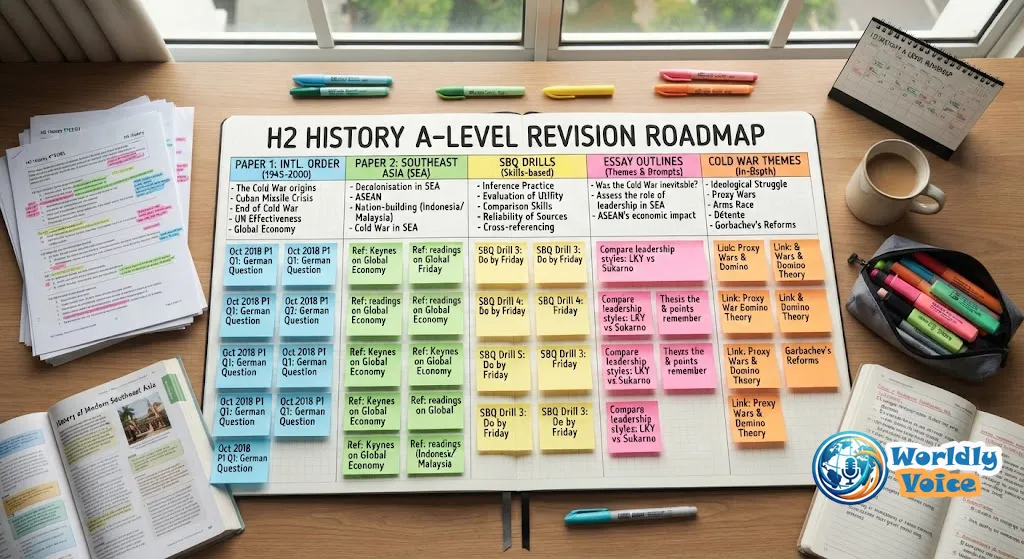
7. How I Would Build a 4-Week Revision Plan
When students ask me how to prepare efficiently, I suggest a compact but disciplined plan.
Week 1: Diagnose
- Review singapore cambridge gce a level h2 history past year papers
- List weak topics
- Sort questions by theme and command word
- Write one untimed essay plan per major topic
Week 2: Strengthen essays
- Review cambridge a level history essay questions and model answers
- Practice introductions and thesis statements
- Write 2 timed essay outlines
- Memorize flexible evidence clusters, not full essays
Week 3: Drill SBQ
- Complete 3 sets of h2 history source based case study practice questions
- Focus on cross-referencing and evaluation
- Use short timed paragraphs instead of full scripts if stamina is low
Week 4: Simulate exam conditions
- Do one full Paper 1 practice
- Do one full Paper 2 practice
- Review errors honestly
- Tighten weak examples and argument phrasing
This plan is not glamorous. It works because it matches the exam.
8. Common Mistakes Students Make
I’ve seen these patterns repeatedly:
Mistake 1: Writing everything you know
Examiners reward relevance, not volume.
Mistake 2: Treating essays like narratives
History at this level requires judgment.
Mistake 3: Using sources passively
SBQ is about interrogation, not copying.
Mistake 4: Ignoring command words
“How far” is not the same as “why” or “assess.”
Mistake 5: Revising content without practicing timed writing
Knowledge that cannot be deployed quickly is not exam-ready.
Most studies agree that timed retrieval and active practice are more effective than passive rereading. That principle applies directly to h2 history a level questions.
FAQs
1. What are the most common types of h2 history a level questions?
The most common h2 history a level questions fall into two broad types: essay questions and Source-based case study (SBQ) questions. Essays usually ask you to evaluate causes, compare factors, or judge significance. SBQs test source interpretation, cross-referencing, and evidence evaluation.
2. Where can I find singapore cambridge gce a level h2 history past year papers?
You can usually find singapore cambridge gce a level h2 history past year papers through school departments, teachers, academic resource platforms, and official exam-prep collections. I recommend starting with materials your school has already vetted, then organizing questions by theme rather than by year.
3. How should I use cambridge a level history essay questions and model answers?
Use cambridge a level history essay questions and model answers as frameworks, not scripts to memorize. Focus on how the thesis is built, how each paragraph answers the question, and how the conclusion weighs competing arguments. In my experience, this is much more effective than copying full essays.
4. How can I improve h2 history source based case study practice questions?
To improve with h2 history source based case study practice questions, practice five core skills:
- identifying message
- analyzing provenance
- cross-referencing sources
- applying contextual knowledge
- reaching a supported judgment
Timed drills help a lot. Even 15-minute source comparisons can sharpen your response speed.
5. What is the best way to do cold war and international relations a level history exam prep?
The best cold war and international relations a level history exam prep combines chronology with themes. Revise key phases of the Cold War first, then group evidence under themes like ideology, economics, leadership, and security. That makes it easier to adapt to unfamiliar essay wording.
6. How important are SEAB history assessment objectives in revision?
Very important. SEAB history assessment objectives help explain what examiners are rewarding: not just content knowledge, but analysis, argument, and source handling. If your revision only builds memory and not writing skill, your marks may stall.
7. How do I balance H2 History Paper 1 and Paper 2 revision?
A simple way is to give each paper its own weekly slot. For H2 History Paper 1 and Paper 2, I suggest alternating between international history essays, SBQ drills, and Southeast Asia topic reviews. This prevents one paper from dominating your schedule.
8. Are there any related study resources I should explore?
Yes. If you are building a wider exam strategy system, it can help to compare how other academic tools present performance benchmarks and planning methods. Related site content like AP World Score Calculator and Loyola University Chicago Acceptance Rate 2026 can support broader academic planning habits, even if they are not specific to H2 History.
9. Trusted Resources Worth Using
Here are a few reliable references for syllabus and assessment context:
Use official documents first. They
