



If you have ever wondered how old is Google, the answer depends slightly on which date you use. Google Inc. was incorporated on September 4, 1998, which means that as of September 1, 2026, Google has completed 27 years and will turn 28 on September 4, 2026. However, Google’s story began earlier, in 1995, when Larry Page and Sergey Brin met at Stanford University and began developing the research project that eventually became Google Search.
That distinction matters because September 4 is the company’s incorporation date, while September 27 became Google’s traditional birthday. Google has also described September 27, 2023, as the 25th birthday of Google Search.
So, in simple terms:
Google will be 28 years old on September 4, 2026. Its roots, however, go back to 1995, making the broader Google story about 31 years old in 2026.
How Old Is Google in 2026?
As of September 1, 2026, Google is 27 years old based on its September 4, 1998 incorporation date. It will officially complete 28 years on September 4.
The easiest way to understand Google’s age is to separate three milestones:
| Milestone | Date | What it means |
|---|---|---|
| Google’s origins | 1995 | Larry Page and Sergey Brin meet at Stanford |
| Early search project | 1996 | The project develops into BackRub |
| Google Inc. incorporated | September 4, 1998 | The company is officially incorporated |
| Traditional Google birthday | September 27 | Google’s long-running birthday celebration |
| Google turns 28 | September 4, 2026 | 28 years since incorporation |
Google itself has acknowledged that the exact date can be confusing. Its 2018 anniversary explanation says Google Inc. was incorporated on September 4, while the company had celebrated its birthday on September 27 for more than a decade.
This is why an article that simply says “Google was founded on September 27, 1998” misses an important part of the story.
When Was Google Founded? The Exact Date Explained
The question “when was Google founded exact date” has two reasonable answers depending on what someone means by “founded.”
If the question refers to the legal creation of the company, the answer is September 4, 1998, when Google Inc. was incorporated. Google confirms this date in its own historical account.
If the question refers to the beginning of the technology and research behind Google Search, the story starts in 1995 at Stanford University.
Google’s official company history says Larry Page was considering Stanford for graduate school in 1995, while Sergey Brin was assigned to show him around. The two subsequently became collaborators and built a search engine that used links to determine the importance of webpages. They initially called it BackRub.
So the most accurate wording is:
Google’s company was incorporated on September 4, 1998, but its origins trace back to 1995.
That distinction also explains why different websites sometimes give different answers for Google’s age.
Who Created Google Search Engine?
Google was created by Larry Page and Sergey Brin, two Stanford graduate students who began working together on the problem of organizing information on the rapidly expanding World Wide Web.
Larry Page and Sergey Brin approached search differently from many early search engines.
Instead of relying primarily on matching words on a webpage, their research examined the relationships created by hyperlinks. A link from one webpage to another could provide a useful signal about the importance or relevance of the destination.
This idea led to PageRank, an algorithmic approach associated with Google’s early search technology. The National Science Foundation’s history of the project explains that Page and Brin developed a system that mapped relationships among webpages and used those relationships to calculate rankings.
The innovation was not that Google invented web search. Search engines already existed. Google’s early advantage was its approach to ranking information and finding useful pages within an increasingly enormous web.
How Google Started at Stanford
1995 — Larry Page Meets Sergey Brin
The Google story begins at Stanford University in 1995.
Page was considering Stanford for graduate study, and Brin was assigned to show him around. Their early interaction eventually developed into a research partnership.
At the time, the World Wide Web was growing rapidly, creating a difficult information problem: how could people find the most useful pages among an expanding collection of websites?
1996 — The BackRub Search Engine
Page and Brin began building a search engine from their Stanford environment. The project became known as BackRub.
Its distinctive idea was to analyze links between webpages. Rather than treating every page as an isolated document, the system considered the web’s structure itself.
The National Science Foundation describes how the prototype mapped relationships between webpages and how PageRank used those relationships to calculate rankings.
This was an important conceptual step toward modern search.
1998 — Google Inc. Is Born
The BackRub project was renamed Google, and outside interest in the technology began to grow.
In August 1998, Sun Microsystems co-founder Andy Bechtolsheim provided Page and Brin with a $100,000 check. Google says the newly incorporated company then moved from its dorm-room beginnings into its first office, a garage in Menlo Park, California.
That garage became one of the most recognizable locations in Google’s history, but the company’s real foundation was the search technology developed during its Stanford research period.
Google Search History Timeline
The history of Google search timeline is really a story of search becoming progressively broader and more capable. It moved from finding webpages to helping people search images, news, locations, entities, voices, cameras and, increasingly, complex questions with AI.
1995 — Google’s origins
Larry Page and Sergey Brin meet at Stanford, beginning the story that eventually leads to Google.
1996 — BackRub
Page and Brin develop their early search engine research project, using links between webpages as an important ranking signal.
1998 — Google Search and Google Inc.
Google emerges from the BackRub project, and Google Inc. is incorporated on September 4.
2001 — Google Images
Google launched Google Images in July 2001 after users’ interest in finding visual information exposed the limitations of a search page containing mainly text links. Google says the enormous interest in Jennifer Lopez’s 2000 Grammy Awards dress helped inspire the service.
2002 — Google News
Google News launched in 2002, giving users access to news stories from multiple sources. Google says the need for timely information following the events of September 11, 2001, helped inspire the service.
2004 — Google Goes Public
Google’s initial public offering became an important corporate milestone. Its Class A shares began trading on Nasdaq under the ticker GOOG on August 19, 2004.
2005 — Google Maps
Google Maps launched for desktop in February 2005, extending Google’s information mission into geography and location-based information.
Google’s expansion into products such as Maps also showed that the company was becoming more than a traditional search engine.
2007 — Universal Search
Universal Search brought different information formats together, including webpages, images, videos and local results. Rather than keeping each type of information completely separate, Google redesigned Search to blend relevant formats into one results experience.
2008 — Voice Search and Mobile Search
Google expanded Search beyond desktop typing. Voice Search arrived through the Google Mobile App in 2008, allowing people to speak queries rather than enter every word on a keyboard.
2012 — Knowledge Graph
The Knowledge Graph marked another major change. Google began moving beyond simple keyword matching toward understanding real-world entities and their relationships.
For example, a search for a person, place or landmark could be understood as a query about a specific entity rather than merely a sequence of words. Google introduced the Knowledge Graph in 2012.
2015 — Alphabet Becomes Google’s Parent Company
Google’s corporate structure changed significantly in 2015 when Alphabet was created as the parent company. Google became the largest company within the new structure, while other businesses and long-term projects were organized separately.
2022 — Multisearch
Google introduced Multisearch, allowing users to combine images and text in the same search. For example, someone could photograph an object and add words to refine what they were looking for.
2023 — Generative AI Enters Search
Google introduced Search Labs and its Search Generative Experience, beginning a more visible transition toward generative AI within Search.
2024 — Circle to Search and AI-Powered Search
Google introduced Circle to Search, allowing users on supported Android devices to select something on their screen and search for it without leaving the current app. Google also expanded AI-powered capabilities in multimodal search.
2025 — AI Mode and Search Live
Google expanded AI in Search with AI Mode, designed for longer, more complex and multimodal questions. It also introduced capabilities such as Deep Search and Search Live, which combines voice interaction with camera input for real-time visual assistance.
2026 — Search Becomes More Multimodal
By 2026, Google continued pushing Search toward visual and conversational experiences. Google’s March 2026 update says Search Live had expanded to more than 200 countries and territories where AI Mode was available, enabling interactive conversations using voice and camera input.
The same year, Google highlighted 25 years of Google Images and described newer visual-search capabilities, including more sophisticated image understanding and multiple-object recognition in Circle to Search.
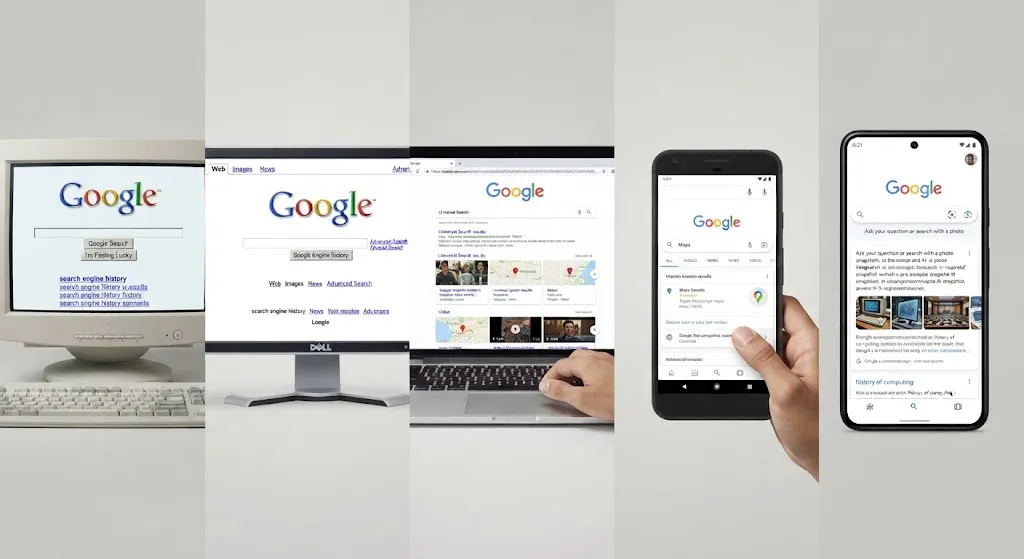
How Google Evolved From a Search Engine to a Technology Giant
Google’s growth was not based on Search alone. Search became the foundation for a much broader technology ecosystem.
Over time, Google expanded into advertising, email, maps, browsers, mobile operating systems, video, cloud services and artificial intelligence. Products such as Chrome, Android, YouTube and Maps helped Google become part of everyday digital life rather than remaining simply a website people visited when they needed to find something.
That wider ecosystem also created connections between Google’s products. A person might use Search to discover a location, Maps to navigate there, Chrome to browse the web, Android to access services from a phone, and YouTube to watch related content.
For people interested in how Google’s cloud-based services fit into modern work, Google Workspace is another useful example of how the company expanded beyond search into productivity and collaboration. cloud-based productivity apps and Google Workspace
This diversification helps explain the Google company age and history more fully. Google did not remain frozen in the form it had in 1998; its business and products changed repeatedly as the internet itself changed.
Google Company Age and History
A simple way to visualize Google’s development is:
1995: Stanford research begins
↓
1996: BackRub develops
↓
1998: Google Inc. incorporated
↓
2000s: Search, advertising and major consumer services expand
↓
2010s: Mobile, Maps, YouTube, Chrome and other products become central to Google’s ecosystem
↓
2015: Alphabet becomes the parent company
↓
2020s: Artificial intelligence becomes increasingly important to Search and other products
↓
2026: Google approaches its 28th anniversary as an incorporated company
The company’s transformation is remarkable because the original problem—helping people find useful information—remains connected to the modern product, even though the technology used to solve that problem has changed dramatically.
Google’s own history describes the journey from dorm rooms and a Menlo Park garage to a company operating hundreds of products used around the world.
Google in the AI Era
Modern Google Search is increasingly different from the “10 blue links” experience associated with the company’s early years.
AI has changed how Google can interpret complicated questions, images and follow-up requests. In 2025, Google described AI Mode as an experience designed for more advanced reasoning and multimodal searches, including questions that may require several related searches rather than one simple keyword lookup.
Visual search has also become much more important. Google Images, Lens, Multisearch, Circle to Search and Search Live all move Search away from the assumption that every query begins with typed words. Google’s 2026 review of Google Images describes this progression as a move from text-based search toward visual exploration and AI-assisted understanding.
That evolution is significant when considering Google’s age. A 28-year-old company can still be operating in a technology environment that looks completely different from the one in which it was founded.
How Old Is Google Compared With Other Search Engines?
Google was not the first search engine.
Before Google became dominant, the web already had services such as Yahoo!, Lycos and WebCrawler. The National Science Foundation notes that early search tools emerged in the mid-1990s and used different approaches to organizing and ranking webpages.
Google’s distinction was its approach to ranking the web’s interconnected pages. PageRank helped make links part of the ranking equation, providing a way to estimate the importance of a page based partly on the pages linking to it.
This helps explain why Google’s history is not simply a story about being first. It is a story about improving an existing category and then continually expanding what “search” could mean.
Google Age Calculation by Year
If Google’s age is calculated from its September 4, 1998 incorporation date, the completed-year ages look like this:
| Year | Completed age on September 4 |
|---|---|
| 1998 | 0 |
| 2000 | 2 |
| 2005 | 7 |
| 2010 | 12 |
| 2015 | 17 |
| 2020 | 22 |
| 2023 | 25 |
| 2024 | 26 |
| 2025 | 27 |
| 2026 | 28 |
There is one important detail: on September 1, 2026, Google has not yet completed 28 years. Its 28th anniversary arrives on September 4.
So if you are publishing this article on September 1, the most technically accurate wording is:
Google is 27 years old and will turn 28 on September 4, 2026.
After September 4, the answer becomes simply 28 years old.
Frequently Asked Questions About Google’s Age and History
How old is Google in 2026?
Google is 27 years old as of September 1, 2026, based on its September 4, 1998 incorporation date. It will turn 28 on September 4, 2026.
When was Google founded?
Google Inc. was incorporated on September 4, 1998. However, the technology behind Google began with Larry Page and Sergey Brin’s Stanford research in 1995.
Who created Google?
Larry Page and Sergey Brin created the search technology that became Google while they were graduate students at Stanford University. Their early project was called BackRub.
What was Google’s original name?
The early search engine was called BackRub. It was later renamed Google. The name “Google” is a play on “googol,” the mathematical term for 1 followed by 100 zeros.
When did Google Search first launch?
Google Search’s public history dates to 1998, and Google celebrated the 25th anniversary of Search on September 27, 2023.
Why does Google celebrate September 27 as its birthday?
Google Inc. was incorporated on September 4, 1998, but Google says it has traditionally celebrated its birthday on September 27. The company has used that date for birthday celebrations and Doodles for many years.
Final Thoughts
The simplest answer to how old is Google needs one small qualification. Google was incorporated on September 4, 1998, so it will turn 28 years old on September 4, 2026. But Google’s roots reach back to 1995, when Larry Page and Sergey Brin began the Stanford research that eventually produced BackRub and then Google Search.
That history helps put Google’s age into perspective. The company started with a research idea about using links to understand the importance of webpages. It grew into a search engine, expanded into images, news, maps and mobile services, became part of Alphabet, and is now moving toward increasingly multimodal and AI-powered search.
The most useful way to remember the dates is therefore simple: 1995 marks Google’s origins, September 4, 1998 marks the incorporation of Google Inc., and September 27 became its traditional birthday. By September 4, 2026, Google will have completed 28 years as an incorporated company.
