



Choosing a cloud platform in 2026 is no longer just a question of where to host virtual machines. When I look at an aws vs azure comparison today, I see a much bigger decision involving AI, data residency, security, hybrid infrastructure, licensing, developer skills, networking, sustainability, and long-term operating costs.
For a startup, the wrong choice can create unnecessary engineering work. For an enterprise, it can affect licensing, compliance, migration budgets, and years of infrastructure planning.
So which is better: Amazon Web Services or Microsoft Azure?
My answer is simple: there is no universal winner. AWS often makes more sense when flexibility, cloud-native development, infrastructure control, and service breadth are priorities. Azure can be the better fit when Microsoft technologies, enterprise identity, hybrid infrastructure, and existing licensing dominate the environment.
This amazon web services vs microsoft azure 2026 guide uses a practical Droven.io perspective to help business owners, CTOs, developers, DevOps teams, and IT leaders make that decision based on workload rather than popularity.
If your team is also researching Tech Ideas That Made the Web Move Quicker, the same principle applies here: technology decisions become easier when we evaluate what the system actually needs instead of chasing the most popular option.
What Is the Droven.io AWS vs Azure Comparison?
I see the droven. io aws vs azure comparison as a decision framework rather than a scoreboard.
Instead of asking, “Which cloud is best?” I would start with six questions:
- What technology stack does the organization already operate?
- Which cloud services does the workload actually require?
- Where are the application’s users and regulated data located?
- What will the complete workload cost—not just the virtual machines?
- Which platform can the existing engineering team operate confidently?
- Could specific workloads benefit from different cloud environments?
That last question matters more than it once did. Some organizations may find that a single-cloud strategy is simplest, while others have legitimate reasons to use both AWS and Azure.
A sensible droven cloud infrastructure evaluation therefore begins with architecture, people, contracts, and business requirements—not a generic “AWS wins” or “Azure wins” statement.
1. AWS vs Azure at a Glance
AWS global infrastructure gives AWS a substantial worldwide footprint. AWS currently lists 39 geographic Regions and 123 Availability Zones, with additional infrastructure announced.
AWS is particularly attractive when I need:
- Broad cloud service selection
- Highly configurable infrastructure
- Cloud-native application architecture
- Serverless and container workloads
- Extensive open-source support
- Flexible database and storage choices
- Large-scale SaaS or e-commerce infrastructure
- Strong developer and DevOps tooling
The trade-off is complexity. AWS gives engineers enormous freedom, but that freedom can mean more architectural decisions and more opportunities for cost leakage.
Azure approaches the market differently. Microsoft’s platform is deeply connected to its wider enterprise ecosystem. Azure global infrastructure currently advertises 70+ Azure regions and 400+ datacenters.
Azure is especially compelling for organizations using:
- Windows Server
- SQL Server
- .NET
- Microsoft Entra
- Microsoft 365
- Power Platform
- Microsoft-oriented identity and governance
- Existing Microsoft enterprise agreements
- Hybrid infrastructure
That makes Azure particularly interesting in an AWS vs Azure for enterprise evaluation.
2. AWS vs Azure Comparison: Quick Decision Table
| Factor | AWS | Azure |
|---|---|---|
| Core strength | Flexibility and cloud-native infrastructure | Microsoft integration and enterprise hybrid cloud |
| Compute | EC2, Lambda, containers and specialized compute | Azure VMs, Functions and containers |
| Storage | S3, EBS, EFS and related services | Blob Storage, Azure Files and managed storage |
| Databases | RDS, Aurora, DynamoDB and analytics services | Azure SQL, Cosmos DB and managed databases |
| AI | Bedrock, SageMaker and broad model ecosystem | Azure AI and Microsoft’s enterprise AI ecosystem |
| Hybrid cloud | Extensive capabilities | Particularly compelling for Microsoft-heavy environments |
| Developer fit | Strong for cloud-native and open-source workloads | Strong for .NET, Microsoft and enterprise workflows |
| Global footprint | 39 Regions / 123 Availability Zones | 70+ regions / 400+ datacenters advertised |
| Pricing | Flexible but can be complex | Flexible, with Microsoft licensing potentially influential |
| Best starting point | Customized cloud-native workloads | Microsoft-centric enterprise workloads |
These are starting points, not absolute rankings. A particular region, service, contract, architecture, or licensing position can completely change the result.
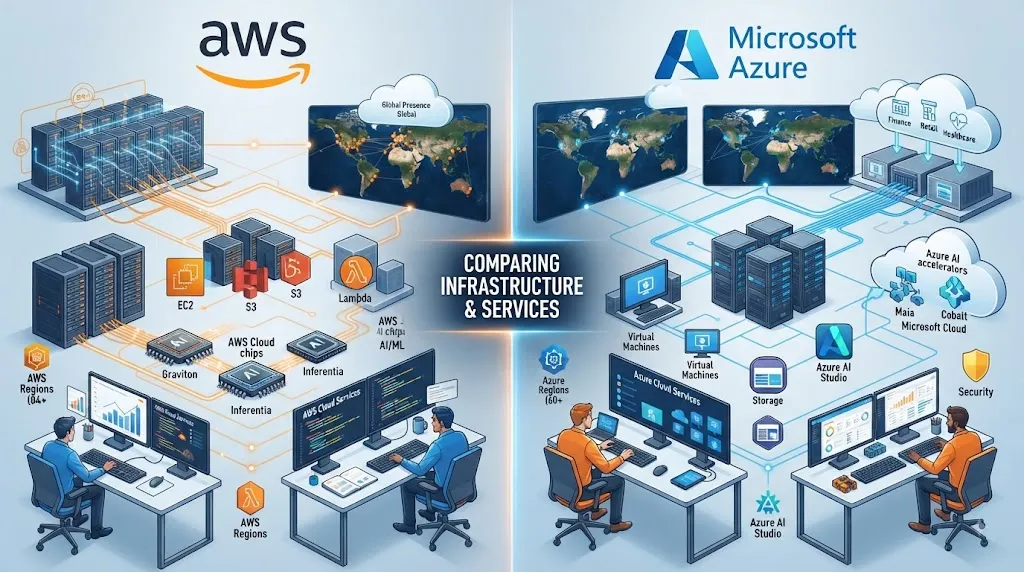
3. AWS vs Azure Service Comparison
Compute
AWS EC2 and Azure Virtual Machines both provide flexible virtual computing. AWS also offers Lambda for serverless workloads, while Azure provides Azure Functions.
For containers, both platforms provide managed orchestration and container services.
I would not choose between them based on CPU specifications alone. Application performance depends on instance family, memory, storage, network configuration, region, database design, autoscaling, and application architecture.
A well-designed application on either platform can outperform a poorly designed application on the other.
Storage
The familiar comparison is Amazon S3 versus Azure Blob Storage.
Both support scalable object storage, but the real cost calculation should include:
- Storage capacity
- API requests
- Retrieval charges
- Replication
- Backup
- Data transfer
- Lifecycle policies
- Operational overhead
That is why a simple “price per GB” comparison can be misleading.
Databases
AWS offers services such as RDS, Aurora, DynamoDB, and Redshift. Azure offers Azure SQL, Cosmos DB, managed PostgreSQL and MySQL options, and its wider data platform.
The important question is not which provider has the longest database list.
It is: Which managed database best matches the application’s consistency model, query pattern, scalability requirements, operational skills, and existing data architecture?
Networking
Networking deserves more attention than it usually receives in an enterprise cloud platform comparison aws azure.
Both platforms provide virtual networking, DNS, load balancing, private connectivity, CDN capabilities, and inter-region networking.
But data transfer can become a major bill.
If an application constantly moves large amounts of data between regions, databases, cloud services, or external systems, network architecture may matter more financially than the compute bill.
🗺️ Architectural Decision Flow: AWS vs. Azure
☁️ Choose AWS If You Need:
- Cloud-Native Flexibility: Highly custom microservices, serverless frameworks, and complex architectures.
- Broad Service Breadth: Massive selection of bleeding-edge managed databases and specialized tools.
- Open-Source Stack: Heavy reliance on Linux, containers, and modern CI/CD DevOps workflows.
- Multi-Model AI: Extensive infrastructure choices via Bedrock across diverse foundation models.
🏢 Choose Azure If You Need:
- Enterprise Microsoft Stack: Deep integration with Windows Server, SQL Server, and .NET.
- Unified Identity & Security: Seamless governance through Microsoft Entra (formerly Azure AD).
- Hybrid Infrastructure: Superior bridge capabilities for pre-existing on-premise enterprise datacenters.
- Existing Agreements: Leveraging pre-negotiated Microsoft Enterprise Agreements (EAs).
4. AWS vs Azure Performance Comparison
The most useful aws vs azure performance comparison does not begin with a benchmark chart.
It begins with the application.
There is no credible universal rule saying AWS is always faster or Azure is always faster. Performance changes according to:
- Region
- Instance family
- CPU/GPU requirements
- Memory
- Storage IOPS
- Network latency
- Database architecture
- Autoscaling configuration
- CDN strategy
- Container design
- Application code
For a serious procurement decision, I recommend benchmarking the actual workload on both platforms.
Measure:
- Average latency
- P95 and P99 latency
- Throughput
- CPU and memory utilization
- Database response time
- Network transfer performance
- Autoscaling speed
- Recovery time
- Estimated monthly cost
This approach is much more useful than trusting a generic cloud ranking.
A web application serving customers in Asia, for example, may behave differently depending on where its database, API, CDN, and compute resources are deployed. The “faster cloud” can change when the architecture changes.
5. AWS vs Azure Pricing: Which Is Cheaper?
I would be cautious whenever someone claims that AWS or Azure is universally the cheapest.
AWS vs Azure pricing depends on workload shape.
Consider:
- Pay-as-you-go rates
- Reserved or committed-use discounts
- Spot/preemptible capacity
- Storage
- Databases
- Egress
- Monitoring
- Support
- Licensing
- Backup
- Idle resources
- Engineering time
AWS can be highly cost-effective when resources are right-sized and properly governed. Azure can become particularly attractive for organizations that already have Microsoft licensing and enterprise agreements.
This is why cloud cost optimization should be treated as an ongoing FinOps discipline.
The cheapest virtual machine is not necessarily the cheapest architecture.
Migration costs matter, too. Moving an application can require database migration, network redesign, identity changes, monitoring changes, testing, staff training, and downtime planning.

6. AWS vs Azure Security and Compliance
Both platforms provide mature security services, but the cloud provider is not the same thing as the security architecture.
That distinction is critical.
Both AWS and Azure support identity management, encryption, key management, network controls, logging, monitoring, threat detection, governance, and compliance programs.
Yet a badly configured cloud environment can still be vulnerable.
Common problems include:
- Excessive permissions
- Publicly exposed storage
- Weak credentials
- Poor secrets management
- Unsecured APIs
- Misconfigured network rules
- Inadequate logging
The shared-responsibility model means customers still have significant responsibility for protecting workloads.
So in an AWS vs Azure security evaluation, I would examine the organization’s actual security architecture rather than simply comparing provider checklists.
For regulated workloads, I would also verify the exact compliance requirements, service availability, data residency rules, and region-specific capabilities before deployment.
7. AWS vs Azure AI Capabilities in 2026
AI has changed the cloud decision considerably.
AWS has expanded Amazon Bedrock into a broader multi-model proposition. In June 2026, AWS announced general availability of OpenAI GPT-5.5, GPT-5.4, and Codex through Amazon Bedrock, giving organizations access to those models with AWS security, governance, and operational controls.
That matters for teams building AI applications that want model choice without redesigning their entire infrastructure around one model provider.
Azure remains highly compelling for businesses already invested in Microsoft’s enterprise ecosystem and AI tooling.
For an AWS vs Azure AI capabilities evaluation, I would compare:
- Foundation-model availability
- Model portability
- Inference pricing
- Regional availability
- GPU capacity
- Data governance
- Identity
- Enterprise integration
- Agentic workload support
- Monitoring
- AI application development tools
Neither provider should automatically be declared the AI winner.
The best platform depends on the models, data, users, latency requirements, governance rules, and existing enterprise environment.
8. AWS vs Azure Hybrid Cloud
Hybrid cloud remains one of Azure’s most recognizable strengths, particularly for Microsoft-heavy organizations.
A company running Windows Server, SQL Server, Microsoft identity, Microsoft 365, and existing datacenters may find Azure’s ecosystem integration highly practical.
Historically, this was one of Azure’s clearest differentiators.
But I would avoid the outdated claim that AWS lacks hybrid capabilities. AWS also provides extensive hybrid and edge services.
The more accurate comparison is about which hybrid approach fits the existing environment.
For example, a Microsoft-heavy enterprise may reduce operational friction by extending familiar identity, management, and application patterns into Azure.
A cloud-native organization with a different infrastructure strategy may find AWS’s hybrid and edge options more appropriate.
9. AWS vs Azure for Developers and Startups
AWS can be an excellent starting point when a startup values cloud-native flexibility, broad services, serverless computing, containers, open-source technologies, and highly customized architecture.
Azure can be a natural choice when the team already works heavily with .NET, Microsoft identity, GitHub, Microsoft 365, or enterprise Microsoft systems.
The old idea that Azure is only for Windows developers is no longer accurate. Microsoft has embraced open-source development extensively.
The better question is: Where does your team already have expertise?
A platform that costs slightly less on paper may become more expensive if developers spend weeks learning unfamiliar infrastructure.
For teams exploring adjacent technical subjects, even something like How to Configure OpenVPN Client Config Dir can reinforce an important lesson: operational familiarity matters. Infrastructure decisions are ultimately implemented by people.
10. AWS vs Azure Global Regions and Data Residency
AWS currently lists 39 geographic Regions and 123 Availability Zones. Microsoft advertises 70+ Azure regions and 400+ datacenters.
But I would never select a cloud merely because one provider has a larger region count.
Check whether the specific service you need is available where you need it.
Evaluate:
- Customer location
- Data residency
- Regulatory requirements
- Availability Zones
- Disaster recovery
- Cross-region replication
- Network latency
- Service-specific regional availability
- AI model availability
AWS itself advises customers to select regions based on service requirements, latency, and legal or operational considerations.
This is one of the most important practical lessons in the droven. io aws vs azure comparison: provider-wide infrastructure numbers can look impressive while hiding the regional limitations of a particular service.
11. Sustainability Is Becoming a Cloud Procurement Factor
Sustainability is increasingly part of enterprise technology planning.
AWS launched its Sustainability console in March 2026. It provides environmental-impact information by region, service, and account, including carbon emissions across Scopes 1, 2, and 3. AWS has also added water-withdrawal information and programmatic access for reporting workflows.
I would not interpret that as proof that AWS is “greener” than Azure.
Instead, sustainability should be evaluated through measurable workload efficiency, reporting requirements, data-center location, resource utilization, and the transparency of the tools available to the organization.
For large enterprises, these factors can increasingly affect procurement and reporting.
12. AWS vs Azure Pros and Cons
AWS advantages
- Extensive service ecosystem
- Strong cloud-native flexibility
- Broad infrastructure customization
- Mature developer ecosystem
- Strong serverless and container options
- Broad AI and model choices
- Large global footprint
AWS disadvantages
- Service breadth can create complexity
- Pricing can require careful analysis
- Governance is essential
- Flexibility creates more architectural responsibility
Azure advantages
- Excellent Microsoft integration
- Strong enterprise positioning
- Hybrid-cloud strengths
- Familiar environment for Microsoft teams
- Broad governance and compliance capabilities
- Strong enterprise AI integration
Azure disadvantages
- Less compelling when Microsoft dependency is low
- Pricing can also become complex
- Large enterprise feature sets require governance
- Regional service availability varies
When Should You Choose AWS?
I would start with AWS when the organization needs:
- Maximum infrastructure flexibility
- Cloud-native development
- Highly customized architecture
- Extensive service choice
- Open-source workloads
- Serverless applications
- Large-scale SaaS
- Broad AI model options
- Strong AWS engineering expertise
For a startup building a globally scalable SaaS platform from scratch, AWS is often a strong starting candidate.
When Should You Choose Azure?
I would start with Azure when the organization already depends heavily on:
- Microsoft 365
- Windows Server
- SQL Server
- Microsoft Entra
- .NET
- Enterprise Microsoft licensing
- Existing datacenters
- Microsoft-oriented governance
- Hybrid infrastructure
The more deeply Microsoft is embedded in the organization, the more Azure’s integration can influence the total economics.
AWS vs Azure: Which Cloud Platform Is Best in 2026?
Here is my practical verdict:
| Requirement | Starting recommendation |
|---|---|
| Maximum flexibility | AWS |
| Cloud-native customization | AWS |
| Microsoft-heavy enterprise | Azure |
| Windows Server environment | Azure |
| Microsoft-centric hybrid cloud | Azure |
| Open-source/cloud-native workloads | AWS |
| Multi-model AI experimentation | AWS |
| Microsoft-connected enterprise AI | Azure |
| Existing AWS expertise | AWS |
| Existing Microsoft expertise and licensing | Azure |
| Highly variable workload | Benchmark both |
| Complex multi-cloud requirements | Evaluate both |
For AWS vs Azure scalability, I would again avoid declaring a universal winner. Both platforms can support very large workloads. Architecture, quotas, region selection, database design, traffic patterns, and engineering discipline determine the real outcome.
And if the organization has unusual requirements, using both clouds may be reasonable. The downside is duplicated skills, tooling, governance, monitoring, and operational complexity.
That is why multi-cloud should be an intentional architecture decision—not a badge of sophistication.
Final Verdict: AWS or Azure?
The most useful droven. io aws vs azure comparison does not end with a single provider winning every category.
AWS is generally the stronger starting point when flexibility, cloud-native development, infrastructure customization, broad service selection, and model choice matter most.
Azure is generally the stronger starting point when Microsoft integration, hybrid enterprise infrastructure, Windows workloads, identity, licensing, and existing Microsoft investments dominate.
Performance depends on workload and region.
Price depends on architecture, usage, contracts, licensing, and operations.
Security depends on implementation as much as the provider.
AI depends on models, governance, latency, cost, and ecosystem fit.
So I recommend treating cloud selection like an engineering investment. Define the workload. Model the five-year operating picture. Identify regional and compliance requirements. Then benchmark the important components.
And do not ignore the people operating the platform.
That is the real lesson behind a practical droven cloud infrastructure evaluation: the best cloud is not necessarily the one with the longest feature list. It is the one that gives your business the right combination of technical capability, financial predictability, security, operational fit, and room to grow.
If your team is evaluating infrastructure alongside topics such as Error Code 211 Marvel Rivals or AnonVault Explained, keep the same editorial principle in mind: understand the underlying technology first, then make the decision.
FAQs
Is AWS better than Azure in 2026?
AWS is generally a strong choice for flexibility, cloud-native infrastructure, and broad service selection. Azure can be better for Microsoft-centric enterprises and hybrid environments. The workload determines the outcome.
Which is cheaper, AWS or Azure?
Neither is universally cheaper. AWS vs Azure pricing depends on compute, storage, databases, networking, licensing, commitments, region, and usage patterns.
Which has better performance, AWS or Azure?
Neither has a universal performance advantage. The AWS vs Azure performance comparison should use the actual application, region, database, networking, and workload configuration.
Is Azure better for Microsoft businesses?
Generally, yes. Organizations deeply invested in Microsoft 365, Windows Server, SQL Server, Microsoft identity, and related enterprise technologies may benefit significantly from Azure integration.
Is AWS better for startups?
AWS can be an excellent startup platform, especially for cloud-native, open-source, serverless, SaaS, and highly customized applications. But startup teams should also consider their existing skills and expected architecture.
Can a company use both AWS and Azure?
Yes. Multi-cloud can make sense for resilience, workload specialization, contractual requirements, or existing investments. However, it also increases operational complexity, so it should have a clear business or technical justification.
References
For current infrastructure information, readers should verify the latest figures directly with the providers:
