


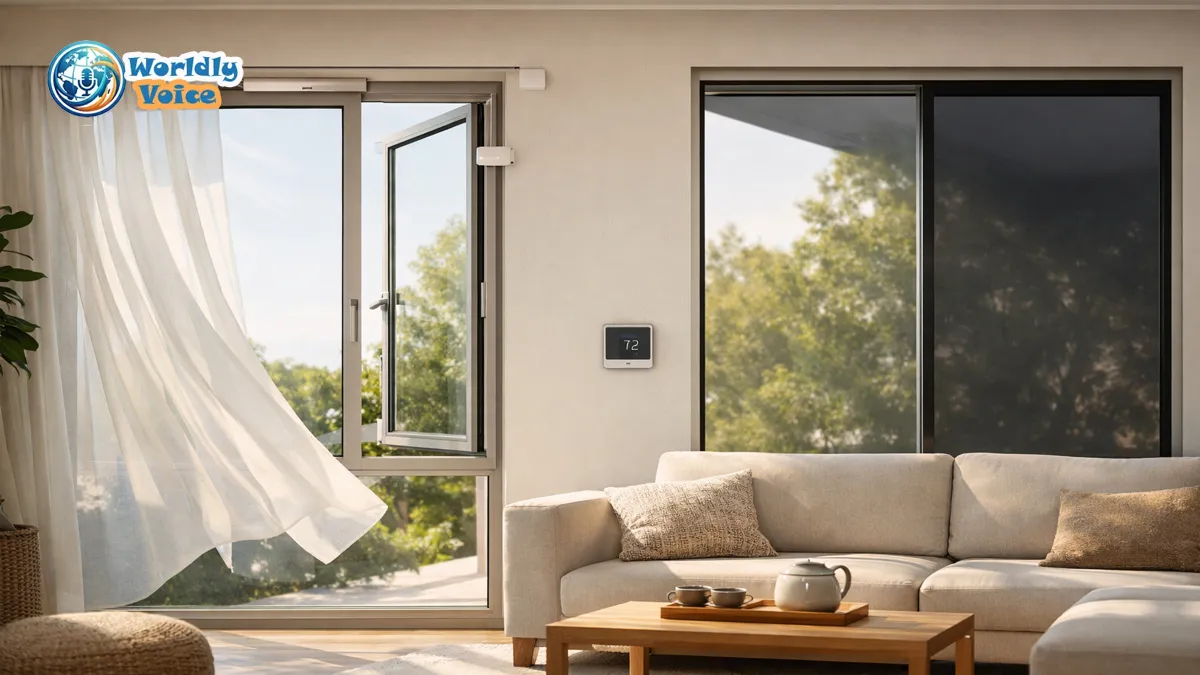
On a hot afternoon, most of us reach for the thermostat before thinking about the windows. Yet windows can be one of the most overlooked parts of a home’s cooling strategy. An intelligent window system combines sensors, motors, control software, and sometimes smart glass to manage heat, airflow, and ventilation automatically. Instead of relying entirely on manual decisions, the windows respond to indoor and outdoor conditions.
I have seen this technology work best when it is treated as part of the whole building—not as an isolated gadget. When windows coordinate with a thermostat, blinds, HVAC equipment, and weather sensors, they can reduce unnecessary cooling while making rooms feel fresher.
Some installations report HVAC energy reductions of 20–30%, particularly in larger buildings with favorable outdoor conditions. Actual results vary by climate, window orientation, insulation, occupancy, and system design. Still, the principle is straightforward: use natural ventilation when it helps, block solar heat when it does not, and avoid cooling an already comfortable room.
What is an intelligent window system?
An intelligent window system is a connected window-control solution that opens, closes, shades, or changes glass transparency based on programmed conditions.
A typical system may respond to:
- Indoor temperature
- Relative humidity
- Carbon dioxide, or CO₂, levels
- Outdoor temperature
- Rain and wind
- Sunlight intensity
- Room occupancy
- Smoke or fire signals
- Heating and cooling schedules
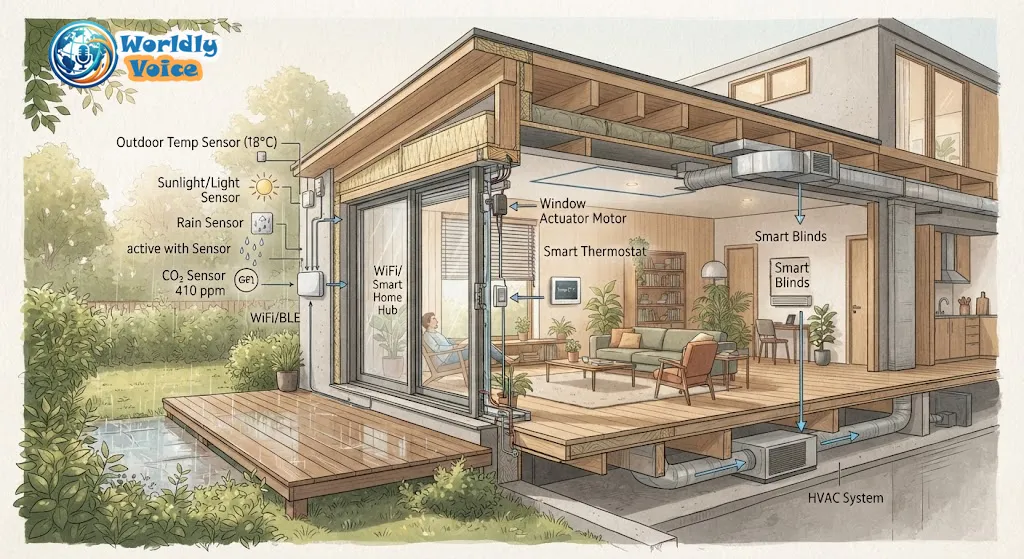
The system usually includes a window actuator motor, one or more sensors, a control unit, and a communication interface. The control logic determines whether the window should open, close, or remain unchanged.
For example, if a bedroom becomes warm at night while the outdoor air is cooler, automatic window ventilation can release indoor heat. In the morning, the system may close the window before outdoor temperatures rise. If a rain sensor detects showers, the window closes without waiting for someone to notice.
This is different from a simple timer. A timer opens a window at a set hour. An intelligent controller considers current conditions and adjusts its decision accordingly.
Quick Fix Summary
If you are researching intelligent window systems to lower your energy costs, the core benefit is automated climate management. By integrating sensors and motors, these systems reduce AC dependency in two ways:
- Smart Ventilation: The system automatically opens windows when outdoor air is cooler than your indoor setpoint, replacing mechanical cooling with natural cross-ventilation.
- Solar Heat Blocking: Automated blinds or smart glass tinting prevent solar heat gain during peak afternoon hours, significantly reducing the “heat load” on your HVAC system.
Best results occur when you:
- Coordinate windows with your smart thermostat to prevent conflicting commands.
- Prioritize rooms with the most afternoon sun exposure.
- Install humidity and CO₂ sensors to ensure ventilation only occurs when conditions are truly optimal.
Automation is a tool for efficiency, not a replacement for proper building insulation or exterior shading.
1. It automates ventilation when outdoor air can replace AC
Cooling a home with air conditioning is not always necessary. During cool mornings, evenings, and mild seasons, outdoor air may provide enough relief through cross-ventilation.
Smart window automation makes this process more consistent. Rather than asking residents to monitor temperature and humidity, the system can compare indoor and outdoor readings and create a ventilation routine.
A basic sequence might look like this:
- Indoor temperature rises above a chosen comfort level.
- Outdoor temperature is lower than indoor temperature.
- The control unit checks for rain and strong wind.
- Automatic window openers open selected windows.
- The windows close when the room reaches the target temperature or conditions change.
I noticed this benefit most clearly in rooms that heat up quickly, such as south-facing offices and upper-floor bedrooms. A few degrees of passive cooling before the AC starts can reduce how long the compressor needs to run.
However, ventilation should not be automatic in every situation. On a hot, humid afternoon, opening windows may increase the cooling load. A properly configured system should understand that outdoor temperature and humidity matter as much as indoor temperature.
Why CO₂ sensors matter
Temperature is only part of comfort. A room can feel acceptable while CO₂ levels rise because of occupancy and limited fresh-air exchange. Smart home window sensors can monitor CO₂ and trigger ventilation when air quality declines.
This does not replace a complete mechanical ventilation system, air purifier, or professional indoor-air-quality assessment. It does provide a useful response to a common problem: rooms becoming stuffy because windows remain closed all day.
The U.S. Department of Energy window technologies guidance also emphasizes that window performance depends on climate, glazing, shading, and installation—not just the presence of automation.
2. It reduces solar heat before the AC has to remove it
Sunlight entering through glass can create a significant cooling load. This is especially true for large west-facing windows, where low afternoon sun can heat a room just before occupants need the most cooling.
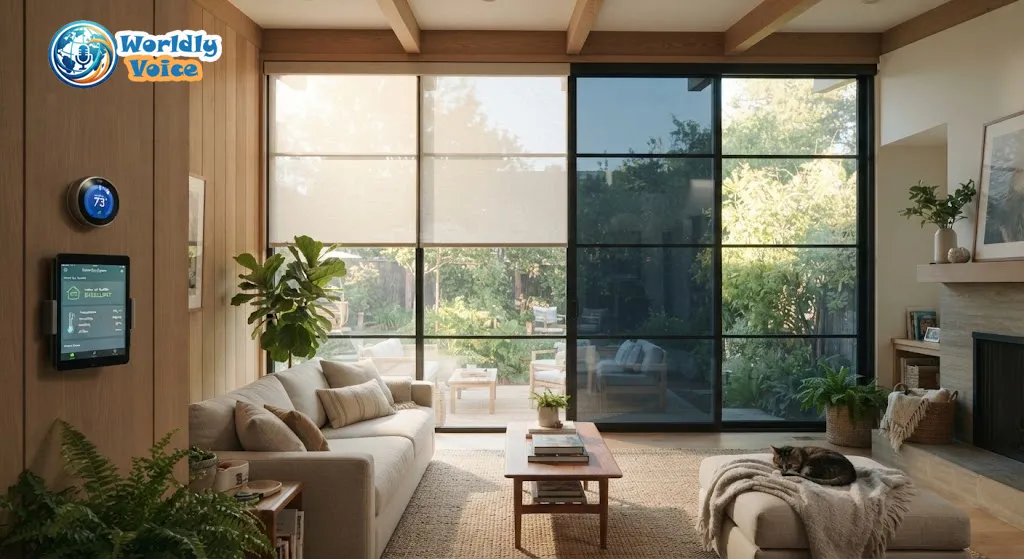
Some intelligent window systems use electrochromic or thermochromic glass. Electrochromic glass changes its tint when a small electrical current is applied. It can become darker during intense sunlight and clearer when daylight is more useful.
This is where smart glass energy savings can become valuable. By reducing solar heat gain, the glass limits how much heat enters the room. The air conditioner then has less work to do.
Smart glass is not magic, and it is not always the most economical option. High-performance low-emissivity glass, exterior shades, properly sized overhangs, and smart blinds automation may deliver better value in some homes. The best choice depends on the building’s orientation and local climate.
A useful design approach is to combine technologies:
- Low-emissivity glazing for baseline efficiency
- Motorized blinds for flexible shading
- Exterior shading for strong solar control
- Automated opening for cool-weather ventilation
- HVAC coordination for stable comfort
Smart glass versus motorized shades
Smart glass changes the window itself. Motorized shades control how much sunlight reaches the glass. Both approaches can reduce glare and heat, but they behave differently.
Smart glass preserves the view and avoids moving hardware across the window. Shades are often less expensive to replace or repair. A large commercial building may use electrochromic glass, while a typical home may achieve similar practical results with efficient glazing and automated shades.
In my experience, solar control should be planned room by room. A shaded north-facing window has different needs from an unprotected west-facing window.
3. It coordinates windows with smart home systems
A window that operates independently is useful. A window that communicates with other building systems is more effective.
Many products can connect through platforms and protocols such as Tuya, KNX, RS-485, Wi-Fi, Zigbee, or Z-Wave. Compatibility varies, so buyers should confirm whether the window controller can communicate with their existing ecosystem.
Smart thermostat integration is particularly valuable. Consider this example:
- The thermostat detects that cooling is active.
- An outdoor sensor reports that the air is hotter than indoors.
- The controller keeps the windows closed.
- Smart blinds lower on the sun-facing side of the home.
- The HVAC system continues cooling efficiently.
Later that evening:
- Outdoor air becomes cooler than indoor air.
- The thermostat enters a ventilation mode.
- The system pauses compressor cooling.
- Selected windows open for a limited period.
- Windows close before morning heat returns.
This type of coordination prevents contradictory commands. Without integration, a thermostat might cool a room while an open window allows expensive conditioned air to escape.
Protocols and interoperability
KNX is widely used in building automation, especially in commercial and high-end residential projects. RS-485 is a wired communication standard often used for reliable device communication over longer distances. Tuya supports many consumer smart-home products, although device compatibility and cloud dependence should be reviewed carefully.
Apple Home, Google Home, and Amazon Alexa may provide convenient user interfaces, but they are not necessarily the same as the underlying building-control system. A window installer should explain which functions continue working if the internet connection fails.
Look for:
- Local control during internet outages
- Manual override switches
- Clear safety interlocks
- Replaceable sensors
- Manufacturer support
- Compatibility with your thermostat and alarm system
4. It improves safety, not just comfort
Automated windows can provide useful safety responses. A rain sensor can close windows during a storm. A wind sensor can prevent motorized units from opening in unsafe conditions. A security system can confirm whether windows are closed when the home is armed.
In commercial buildings, smoke-control windows may assist with smoke ventilation during a fire event. These systems are subject to local building codes, fire regulations, and professional engineering requirements. A residential ventilation product should never be assumed to provide certified smoke-control performance.
Safety features may include:
- Obstacle detection
- Pinch protection
- Wind limits
- Rain closure
- Lock-status monitoring
- Emergency manual operation
- Battery backup
- Fire-alarm integration
Automatic window openers are not all alike. Chain actuators can suit lighter top-hung windows, while screw or linear actuators may be selected for heavier units. The actuator must match the window’s weight, opening angle, friction, and installation geometry.
An undersized motor may overheat or fail. An oversized motor may place unnecessary stress on hinges and frames. Professional sizing matters.
For broader indoor-air guidance, the EPA indoor air quality resources explain how ventilation, pollutants, moisture, and occupant behavior interact.
5. It can lower AC bills—but only under the right conditions
The most important question is practical: how much can an intelligent window system save?
There is no universal percentage. Savings depend on:
- Local climate
- Length of the cooling season
- Window area and orientation
- Building insulation
- Air leakage
- HVAC efficiency
- Occupancy patterns
- Sensor placement
- Automation settings
- Whether the system uses natural ventilation or smart glass
A system may provide modest savings in a tightly sealed home that already has excellent shading. It may deliver more value in a large building with warm perimeter rooms, fluctuating occupancy, and cool nighttime temperatures.
Most studies and building-efficiency programs agree on a central point: reducing solar heat gain and avoiding unnecessary HVAC operation lowers cooling demand. Automation helps because it applies those strategies consistently.
A simple payback calculation should include:
- Equipment and installation cost
- Expected annual energy reduction
- Maintenance and battery replacement
- Electricity rates
- Window lifespan
- Comfort and air-quality benefits
Do not base the purchase decision on a best-case claim alone. Ask the installer for a climate-specific estimate and request details about how the estimate was calculated.
| Feature | Intelligent window system | Traditional windows |
|---|---|---|
| Operation | Automated through sensors and actuators | Manual |
| Ventilation | Responds to temperature, humidity, or CO₂ | Depends on occupant action |
| Solar control | Can coordinate glass or shades with sunlight | Usually fixed |
| HVAC integration | Can work with thermostats and building controls | Generally none |
| Weather response | Can close during rain or high wind | Manual intervention |
| Safety monitoring | May report open, closed, or locked status | Usually unavailable |
| Energy impact | Potentially lower cooling demand | Depends on user behavior and window design |
| Upfront cost | Higher | Lower |
How to choose the right system
Start with the building, not the product. A window specialist or energy professional should review the room’s orientation, frame condition, glazing, ventilation needs, and electrical access.
Check the actuator
Ask about the window actuator motor’s force rating, stroke length, noise level, power requirements, and expected cycle life. Confirm that the actuator can support the window at the intended opening angle.
Check sensor placement
A temperature sensor placed beside a sunny window may read much warmer than the center of the room. A CO₂ sensor hidden behind furniture may not represent the occupied zone. Sensor location affects every automation decision.
Check fail-safe behavior
Find out what happens when:
- Wi-Fi stops working
- The power fails
- A sensor battery runs out
- A rain sensor becomes dirty
- The actuator encounters resistance
- The fire alarm activates
A good system should fail safely and allow manual operation.
Check maintenance
Window tracks, hinges, seals, sensors, and actuators need occasional inspection. Dust and moisture can affect sensors. Batteries require replacement. Software may need updates.
Automation reduces daily effort, but it does not eliminate maintenance.
Start with a pilot
For a larger home or office, I recommend testing one or two rooms first. Track indoor temperature, humidity, CO₂, window status, and HVAC runtime for several weeks. Compare similar weather periods before expanding.
This approach often reveals problems that are invisible during a sales demonstration. For example, a room may need better exterior shading rather than more sophisticated controls.
Common challenges and limitations
The upfront cost is the most obvious barrier. Retrofitting motors and wiring into existing windows can be more complicated than installing a new smart thermostat.
Other concerns include:
- Limited compatibility with older window frames
- Noise from low-cost actuators
- Poor sensor calibration
- Dependence on cloud services
- Network security risks
- Conflicts between user commands and automation
- Moisture entering during poorly timed ventilation
- Insufficient maintenance access
Cybersecurity also deserves attention. Connected controllers should use strong passwords, updated firmware, and secure networks. Choose manufacturers that document support and update policies.
Privacy is another consideration when occupancy sensors or cloud dashboards are involved. Ask what data is collected and whether it is stored locally or remotely.
For people researching connected devices generally, AnonVault Explained offers a useful adjacent topic when evaluating privacy and online data practices. It does not replace product-specific security documentation, but it can help frame the questions to ask.
FAQs
Is an intelligent window system worth it for a normal home?
It can be worthwhile if the home has overheating rooms, high cooling costs, large windows, or cool nighttime conditions. The return is less certain in a small, well-shaded, highly efficient home. Start with the windows that create the greatest comfort problem.
Can automatic window openers work with existing windows?
Often, yes, but compatibility depends on window type, weight, hinge design, opening direction, and available power. A professional should measure the window and confirm actuator requirements before purchase.
Does smart glass always reduce energy bills?
No. Smart glass can reduce solar heat gain, but savings depend on climate, window orientation, control settings, and the rest of the building envelope. Efficient glazing and external shading may be more cost-effective in some projects.
Will the system open windows when the AC is running?
A well-designed controller should prevent that conflict. It can close windows when mechanical cooling is active or use ventilation only when outdoor conditions are favorable. The exact behavior depends on smart thermostat integration and configuration.
Can these systems improve indoor air quality?
They may improve ventilation when outdoor air is clean and suitable. They do not remove every pollutant, and opening windows may worsen indoor air quality near traffic, wildfire smoke, or high outdoor humidity. The ASHRAE Standard 62.1 framework is a useful professional reference for ventilation planning in applicable buildings.
Are smart windows safe during bad weather?
Systems with rain and wind sensors can close windows automatically, but no sensor is perfect. Manual overrides, appropriate wind limits, and regular maintenance remain important.

Final takeaway
An intelligent window system is more than a motor attached to a frame. It is a coordinated approach to ventilation, shading, comfort, safety, and energy management. Sensors identify conditions, actuators move the window, control units apply the logic, and smart-home connections coordinate the result.
The strongest results usually come from combining several modest improvements: efficient glazing, external shading, automatic window ventilation, careful sensor placement, and a properly sized HVAC system. Smart glass energy savings can be useful, but they should be evaluated alongside simpler options.
If you are planning a retrofit, begin with an energy audit and a room-by-room review. Measure where heat enters, when rooms overheat, and how often the HVAC system runs. Then test a small installation before committing to the entire property.
For readers comparing technology investments, Best Laptop GPUs for 4K Video and Error Code 211 Marvel Rivals are unrelated topics, but they illustrate an important buying principle: specifications matter only when they match the real use case. The same is true for connected windows.
With realistic expectations and professional installation, an intelligent window system can support lower AC use, cleaner-feeling indoor air, and more comfortable rooms without requiring constant manual attention.
