


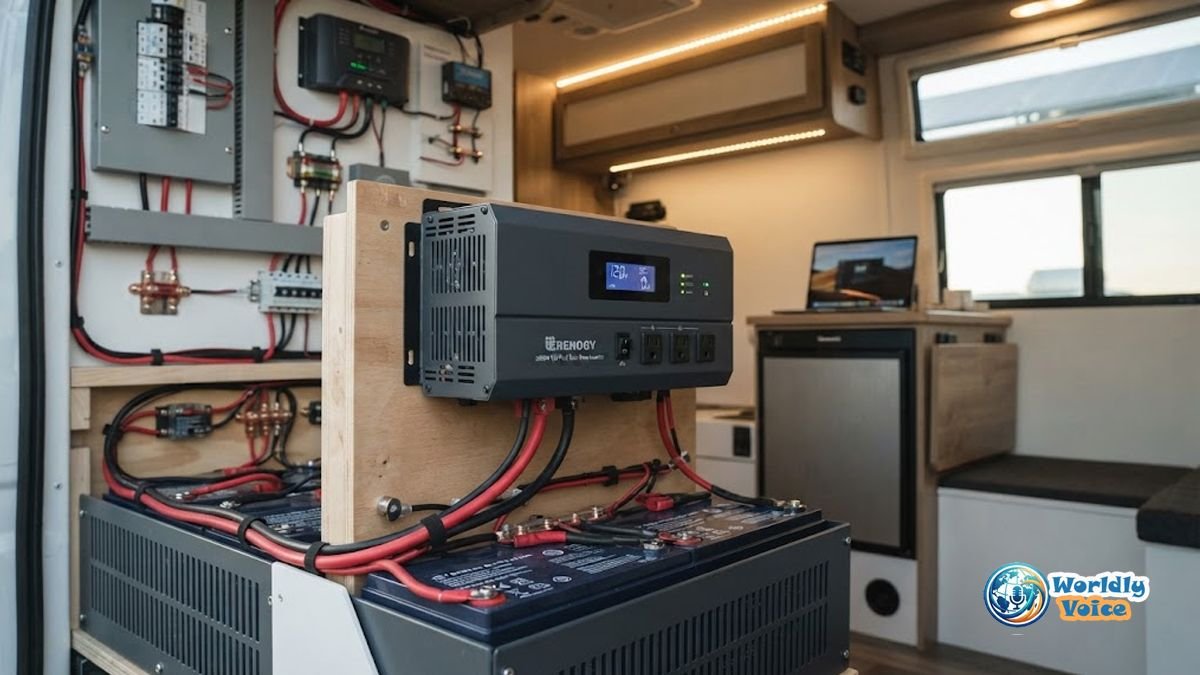
If you need more AC power than a typical 1,000W or 2,000W inverter can provide, the Renogy 3000 watt inverter is designed for larger off-grid electrical loads. The U.S. P2 model is a 12V DC-to-120V AC pure sine wave inverter rated for 3,000W of continuous output and 6,000W of surge power. Renogy positions it for applications including RVs, vans, boats, cabins, semi-trucks and other off-grid installations.
The important qualification is that a 3,000W label does not mean you can connect any collection of appliances totaling 3,000W and expect unlimited runtime. A 12V inverter at this power level can draw hundreds of amps from the battery, so battery capacity, discharge capability, cabling, fusing and installation quality are just as important as the inverter itself.
There is also a model-generation issue worth knowing. Renogy currently sells several 3,000W 12V configurations, including the older P2, newer Bluetooth/UPS-equipped versions and a P2 Pro model. Their specifications are not identical, so this article uses the U.S. Renogy P2 3000W 12V pure sine wave inverter as the primary reference and identifies newer versions where the differences matter.
Renogy 3000 Watt Inverter Overview
The P2 is essentially a bridge between a 12V battery bank and conventional 120V AC equipment. The battery supplies DC electricity, while the inverter converts that energy into household-style AC electricity.
Its headline specifications are straightforward:
| Specification | Renogy P2 3000W |
|---|---|
| Continuous output | 3,000W |
| Peak/surge output | 6,000W |
| Input voltage | 12V DC |
| AC output | 120V |
| Frequency | 60Hz ±0.1% |
| Waveform | Pure sine wave |
| Nominal efficiency | >90% |
| THD | <3% linear / <5% nonlinear load |
| AC outlets | 3 |
| AC terminal block | Yes |
| USB output | 5V/2.1A |
| Remote control | Wired remote included |
| Cooling | Thermally controlled fan |
| Dimensions | 18.9 × 9 × 4 inches |
| Weight | 12.5 lb |
| Battery terminals | M8 |
| Warranty | 1 year |
These figures come from Renogy’s product documentation for SKU RNG-INVT-3000-12V-P2-US.
The inverter also has low- and high-voltage protection features. On the P2, Renogy specifies a low-battery alarm at 11.0V ±0.3V and shutdown at 10.0V ±0.3V, while over-voltage protection is specified at 16.5V ±0.5V.
Pure sine wave output
One of the main reasons to choose the Renogy 3000 watt pure sine wave inverter rather than a basic modified-sine model is the quality of its AC output.
A pure sine wave waveform is closer to the electricity supplied by a conventional utility grid. That makes this type of inverter suitable for a broad range of electronics and appliances, including computers, televisions, refrigerators, fans, pumps, audio equipment and many motor-driven loads.
Renogy specifies total harmonic distortion below 3% for linear loads and below 5% for nonlinear loads on the P2.
That does not eliminate every compatibility problem. An appliance can still exceed the inverter’s power rating, demand excessive startup current, or behave poorly because of a battery or wiring problem. Pure sine wave describes the output waveform; it does not increase the available battery energy.
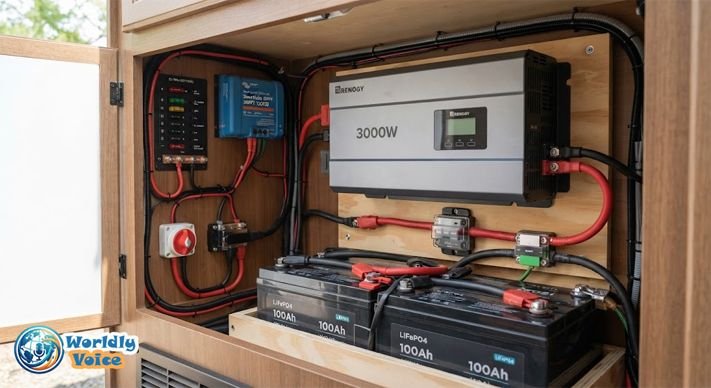
Renogy Inverter Specifications and Features
The combination of power capacity, pure sine wave output and built-in protection makes the P2 reasonably versatile.
3,000W continuous and 6,000W surge
The 3,000W rating is the amount of power the inverter is designed to supply continuously under its specified conditions. The 6,000W figure is a temporary surge rating rather than an additional 3,000W of usable continuous capacity.
That distinction matters with appliances containing motors or compressors. A refrigerator, pump or air conditioner may require considerably more power for a short period when its compressor or motor starts.
Renogy’s P2 documentation specifies a 6,000W surge rating for one second.
Multiple AC connections
The P2 provides three AC outlets plus an AC terminal block, along with a 5V/2.1A USB port. A wired remote control is included, which can be useful when the inverter is mounted somewhere inconvenient to reach.
Protection and cooling
Electronic protection features and GFCI are part of the P2’s design, while a thermally controlled fan manages heat during operation. Renogy lists the operating temperature range as -4°F to 104°F (-20°C to 40°C).
Renogy 3000W Pure Sine Wave Inverter Review: Real-World Performance
On paper, the P2 has the specifications expected from a serious 3,000W off-grid inverter. Its strongest advantage is not simply the 3,000W number; it is the combination of substantial continuous capacity, pure sine wave output and a 6,000W surge rating.
For an RV owner, that can mean operating several ordinary AC devices without immediately approaching the inverter’s limit. For a cabin or backup system, it provides enough capacity for selected household circuits and appliances, provided the battery bank is appropriately sized.
The main weakness is inherent in the 12V architecture.
At 3,000W, the DC side has to deliver a very large current. Using the basic relationship between power and voltage:
3,000W ÷ 12V = 250A
That’s a theoretical figure before accounting for inverter losses. At 90% efficiency:
3,000W ÷ 12V ÷ 0.90 ≈ 278A
In practice, battery voltage varies under load, so actual current can differ. The newer Renogy 3000W Bluetooth/UPS model, for example, specifies a maximum continuous battery current of 310A and greater than 92% inverter efficiency, illustrating how substantial the DC current requirement can be.
This is why a 3,000W inverter should not be treated like a small plug-in accessory.
What Can a 3000 Watt Inverter Run?
The question “what can a 3000 watt inverter run” cannot be answered by simply listing appliances below 3,000W. You need to consider both running wattage and startup or surge requirements.
A 3,000W inverter can potentially operate combinations of equipment such as:
- Refrigerators and freezers
- Televisions
- Computers and monitors
- Wi-Fi equipment
- LED lighting
- Fans
- Microwaves
- Coffee makers
- Toasters
- Air fryers
- Vacuum cleaners
- Power tools
- Small pumps
- Other household electronics
The key is the combined load.
Imagine a system running a refrigerator at approximately 200W, lighting at 100W, a television at 100W and a 1,000W microwave. The approximate running load would be 1,400W. That leaves substantial headroom below the 3,000W continuous rating.
But the refrigerator may briefly demand extra current when its compressor starts. That is where the inverter’s surge capability becomes relevant.
You should also check the actual wattage label on your appliance rather than relying on a generic online estimate. Appliance power consumption varies considerably between models.
Appliances that require more caution
Some loads can quickly consume most of the inverter’s capacity:
- Electric space heaters
- Electric water heaters
- Large ovens
- Electric ranges
- Large air conditioners
- High-power pumps
- Multiple heating appliances operating together
A 2,000W space heater, for example, leaves only about 1,000W of continuous inverter capacity for everything else.
The same principle applies to a microwave, kettle, toaster or air fryer. A 3,000W inverter can run one or more of these devices depending on their actual ratings, but simultaneously operating several high-wattage heating appliances can push the system close to its limit.
How Much Battery Power Does a 3000W Inverter Need?
This is arguably the most overlooked part of choosing a Renogy inverter 12V 3000W system.
The inverter’s power rating tells you how much AC power it can deliver. It does not tell you how long your battery can supply that power.
Consider a nominal 12V 200Ah battery:
12V × 200Ah = 2,400Wh
That is approximately 2.4kWh of nominal stored energy. It is not the same as 2.4kWh of guaranteed usable AC energy because you have to account for battery chemistry, usable depth of discharge, inverter losses, temperature and the actual battery voltage.
At a 1,000W AC load, the theoretical calculation suggests roughly 2.4 hours before losses and other limitations. At a 3,000W load, the same nominal energy represents less than an hour of theoretical operation.
Real runtime will be lower or otherwise different depending on the battery and operating conditions.
For high-power applications, also pay attention to the battery’s continuous discharge rating. A battery can have plenty of amp-hours but still be unsuitable for a sustained 250–300A load if its BMS or cells are not designed for that current.
Cable size matters too
Renogy’s June 2025 manual for its 12V 3000W inverter with transfer switch recommends preparing 2/0 AWG battery cables for the 3,000W model and notes that cables are not included with that particular configuration.
The exact cable specification should always follow the manual for the particular inverter version and installation. Short, appropriately sized cables, secure connections and correctly rated overcurrent protection are essential when hundreds of amps may flow through the DC side.
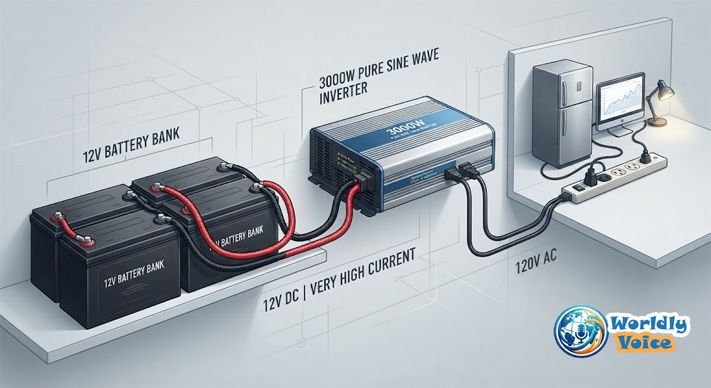
Is a Renogy 3000W Inverter Good for RVs and Off-Grid Solar?
For an RV, van, cabin or similar off-grid installation, the P2’s combination of 3,000W continuous output and pure sine wave power is well suited to running a selection of conventional AC equipment.
It can also work in a 3000W inverter for off-grid solar system, but remember that the inverter is only one component. A complete system may include:
- Solar panels
- MPPT or PWM charge controller
- 12V battery bank
- Battery monitoring
- Properly rated DC protection
- AC distribution and protection
- Inverter
The solar panels do not necessarily power the appliance directly through the inverter at every moment. Energy may first be stored in the battery, depending on the system architecture and operating conditions.
For RV and cabin installations, the biggest design question is often whether 12V is the right system voltage at all. At 3,000W, a 12V system has to move extremely high current. A higher-voltage battery architecture can reduce current for the same power, although it requires equipment designed for that voltage.
Newer Renogy 3000W Models You Should Know About
The original P2 is no longer the only 3,000W Renogy option.
Renogy currently lists a 12V 3000W pure sine wave inverter with built-in Bluetooth and a UPS transfer switch. It retains 3,000W continuous output and 6,000W surge capability, while Renogy lists efficiency above 92%, 50/60Hz output and a maximum continuous battery current of 310A.
There is also a newer 3000W Pro model with EcoSleep functionality, Bluetooth and RV-C support. Renogy states that its EcoSleep mode can reduce idle consumption to under 10W.
That means shoppers should check the exact model number before comparing prices or specifications. “Renogy 3000W inverter” is now a family of products rather than one completely interchangeable specification sheet.
Pros and Cons
Pros
- 3,000W continuous AC output
- 6,000W surge capability
- Pure sine wave output
- More than 90% nominal efficiency on the P2
- Three AC outlets plus terminal block
- Wired remote control
- Electronic protection features and GFCI
- Suitable for RV, marine and off-grid applications
- Established product documentation and replacement-model options
Cons
- A 12V 3,000W system requires extremely high battery current
- Proper battery cables and overcurrent protection are essential
- Full-load operation can drain a modest battery quickly
- It is not a complete battery backup system by itself
- Different Renogy 3,000W models have different features and specifications
- The standard P2 warranty is one year according to Renogy’s warranty documentation.
Is the Renogy 3000 Watt Inverter Worth It?
The Renogy 3000 watt inverter makes sense when you genuinely need around 3,000W of AC capacity and already have, or are prepared to build, a battery system capable of supplying it.
Its pure sine wave output, 3,000W continuous rating, 6,000W surge capability and practical RV/off-grid features make it considerably more versatile than a small inverter. The P2’s published specifications are also clear enough to evaluate the product without relying solely on marketing claims.
The catch is the battery system. At 12V, 3,000W represents an enormous DC current. If your typical loads are only 500–1,000W, a smaller inverter may be more appropriate. Conversely, if you regularly need several high-power appliances, the 3,000W class can provide useful headroom.
For buyers comparing current Renogy models, I would pay particular attention to the exact model number, whether Bluetooth or UPS functionality is included, the surge-duration specification, battery-current requirements and warranty terms.
Frequently Asked Questions
How many watts can the Renogy 3000W inverter handle?
The P2 is rated for 3,000W continuous output and up to 6,000W of surge power. The surge rating is temporary and should not be interpreted as 6,000W continuous capacity.
Can a Renogy 3000W inverter run an air conditioner?
It can potentially run an air conditioner if the unit’s running and startup requirements remain within the inverter’s capabilities. Compressor startup can require substantially more power than normal operation, so the actual air-conditioner specifications matter.
How many batteries do I need for a 3000W inverter?
There is no single answer. Battery count depends on battery voltage, amp-hour capacity, chemistry, maximum continuous discharge current and the runtime you want. A 12V 200Ah battery contains about 2,400Wh nominal energy, but that does not mean all 2,400Wh will be available as AC output.
Can a 3000W Renogy inverter run a refrigerator?
Yes, a refrigerator can be a reasonable load for a pure sine wave inverter, but compressor startup must be considered. An appliance’s actual nameplate specifications are more useful than a generic wattage estimate.
Is the Renogy 3000W inverter pure sine wave?
Yes. The U.S. P2 3000W model uses a pure sine wave output and Renogy specifies less than 3% THD for linear loads and less than 5% for nonlinear loads.
How many amps does a 3000W inverter draw from a 12V battery?
At an ideal 12V and 100% efficiency, 3,000W would require 250A. At 90% efficiency, the calculation rises to about 278A. Actual current varies with battery voltage, inverter efficiency and load conditions. Renogy’s newer 3000W Bluetooth/UPS model lists a maximum continuous battery current of 310A.
Conclusion
A 3,000W inverter is a substantial piece of off-grid equipment, and the Renogy P2 demonstrates both the advantages and challenges of this power class. It offers pure sine wave AC, 3,000W continuous output and 6,000W surge capacity in a relatively compact package.
The most important lesson is not simply how many appliances it can run. It is understanding the complete electrical system behind the inverter. A suitable battery, high-current cabling, protection devices and correct installation are essential, particularly when approaching the 3,000W limit.
For RVs, cabins, boats and selected backup loads, the Renogy 3000W inverter can be a sensible choice. Just make sure you compare the exact Renogy model you are buying, because newer versions now add features such as Bluetooth, UPS transfer switching and EcoSleep that are not part of the original P2 specification.
