



If you have ever wondered, “is secondary school high school?”, the answer depends on the country and on whether you mean a broad stage of education or the name of a particular school. The terms are related, but they are not always interchangeable.
In the United States, high school is generally part of secondary education, while middle school or junior high may also fall within the broader secondary-education category. A typical U.S. high school covers Grades 9–12, whereas middle school commonly covers Grades 6–8. U.S. school structures can vary by state and district, however.
In England, the terminology works differently. Secondary school generally begins around age 11, starting with Year 7, and can continue through Year 11 or through Year 13 when sixth-form education is provided at the same school.
That difference in terminology is why a student moving between countries may find that the same age group is described using different school names.
Is Secondary School High School?
Not always. The simplest way to understand the distinction is to separate an educational stage from a specific school level.
In the United States:
- Secondary education is the broader category.
- Middle school or junior high generally serves younger secondary-age students.
- High school serves older secondary-age students.
- A common school arrangement places middle school at Grades 6–8 and high school at Grades 9–12.
- Grade 9 is normally the first year of high school.
NCES materials distinguish middle/junior high and senior high school in this general grade pattern, although the exact organization of schools varies across the country.
So, a useful way to visualize the U.S. structure is:
Secondary education → lower secondary + upper secondary
In everyday American school terminology, those stages often correspond broadly to middle school/junior high and high school.
There is one important nuance. International education classifications do not always divide U.S. grades in exactly the same way that American schools are organized. For example, an NCES international-comparison framework has used Grades 7–9 as lower secondary and Grades 10–12 as upper secondary for statistical comparison. That classification is designed for international comparability rather than to tell parents which physical school a child should attend.
This is why it is better to say that high school is part of secondary education rather than claiming that the two terms always mean exactly the same thing.
What Is Secondary School?
Secondary school or secondary education generally refers to the stage of education that follows primary or elementary education and comes before higher education.
International education systems often divide secondary education into two broad stages:
- Lower secondary education: the earlier part of secondary schooling.
- Upper secondary education: the later part, often leading toward graduation, qualifications, employment, or further study.
The terminology varies considerably. One country may call a school “secondary school,” while another may use terms such as middle school, junior high, senior high school, or high school.
This distinction also explains why searching for secondary school grades can produce different answers depending on the country being discussed.
For American readers, it is useful to think of elementary school as the foundation, middle school as the transition into adolescence and more specialized study, and high school as the stage leading toward graduation and post-secondary options.
For British readers, particularly in England, the word “secondary” covers a considerably broader period than the American everyday meaning of “high school.”
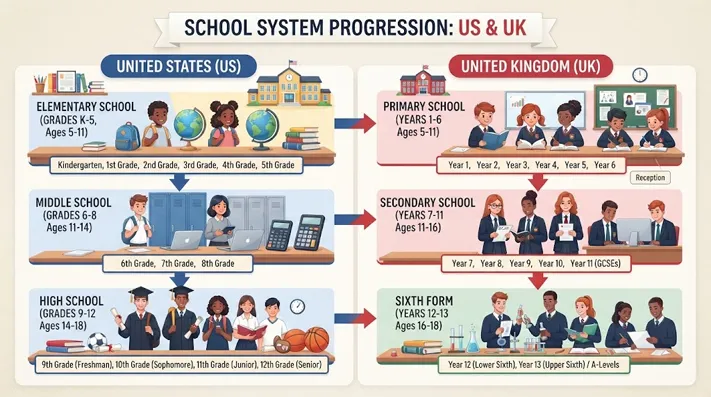
What Grades Are Secondary School in the U.S.?
There is no single school-building arrangement used by every American district. Some schools combine grades, while others separate them into elementary, middle, junior high, and high school buildings.
A common arrangement looks like this:
| School stage | Typical grades | Approximate age |
|---|---|---|
| Elementary school | K–5 | 5–11 |
| Middle school | 6–8 | 11–14 |
| High school | 9–12 | 14–18 |
| Broader secondary education | Approximately 6–12 | Approximately 11–18 |
The last row should be treated as a broad educational classification, not a universal rule for how schools must be organized.
For example, some districts have junior high schools covering Grades 7–8 or 7–9. Others operate combined junior-senior high schools. NCES school data also show that actual school grade spans can vary considerably.
This distinction between educational classification and school building is one of the most useful ideas to remember.
A student can be receiving secondary education without attending a school whose sign literally says “Secondary School.”
Difference Between Middle School and High School
The difference between middle school and high school is more than simply the number attached to the student’s grade.
| Feature | Middle School | High School |
| Common U.S. grades | 6–8 | 9–12 |
| Typical age | 11–14 | 14–18 |
| Broad stage | Lower secondary | Upper secondary |
| Common student terms | Middle school student | Freshman, sophomore, junior, senior |
| Graduation | Usually no | Usually yes |
| Academic direction | Increasingly specialized | More specialized and graduation-focused |
| Postsecondary planning | Introduced | Major focus |
Middle school generally serves as a bridge between elementary education and high school. Students encounter more subject-specific teachers, greater academic independence, and new expectations for organization and responsibility.
High school builds on that foundation. Courses can become more specialized, and students may choose academic, vocational, technical, Advanced Placement, or other pathways depending on the school and state.
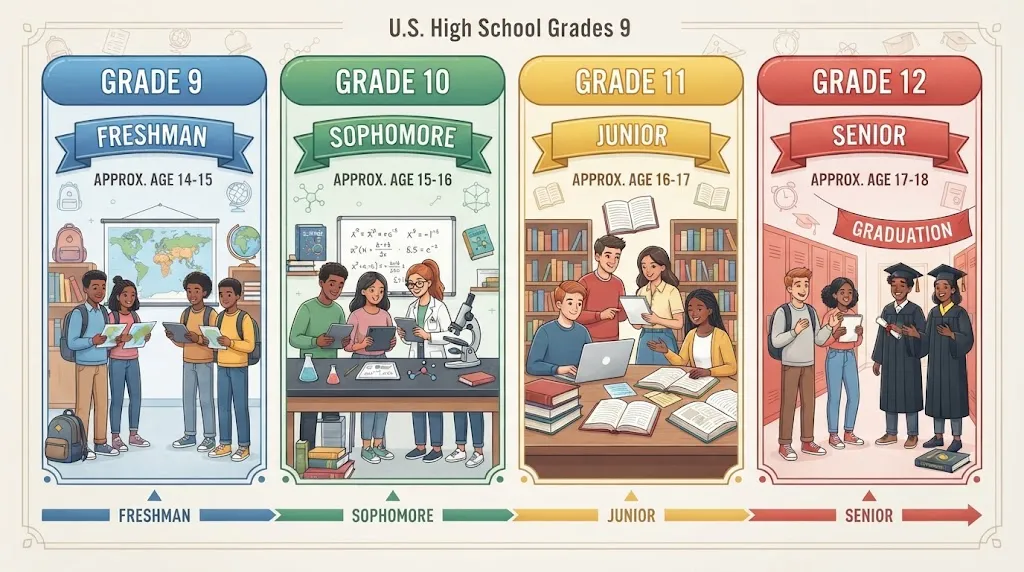
American high school students are traditionally identified by these names:
- Grade 9 — Freshman
- Grade 10 — Sophomore
- Grade 11 — Junior
- Grade 12 — Senior
These labels are especially useful when interpreting American school information because “junior” and “senior” can otherwise be confusing to readers from other education systems.
High School Grade Levels by Age
When comparing high school grade levels by age, remember that ages are approximate. Birthday cutoffs, school-entry rules, grade acceleration, repeating a grade, and individual circumstances can all affect a student’s age.
| U.S. Grade | Common Name | Typical Age |
| Grade 9 | Freshman | 14–15 |
| Grade 10 | Sophomore | 15–16 |
| Grade 11 | Junior | 16–17 |
| Grade 12 | Senior | 17–18 |
These ranges should not be treated as strict age requirements.
For example, two students in Grade 10 may have different ages because their birthdays fall at different points in the school year. That does not necessarily indicate that either student is in the wrong grade.
The same principle applies when comparing countries. A British Year 10 student and an American Grade 9 student may be around the same age, but their curricula, qualifications, and school structures are not identical.
What Age Is Secondary School?
The secondary school age range depends on the education system.
United States
Secondary education commonly covers the adolescent years, beginning around ages 11–12 and continuing through high school graduation at roughly 17–18. The exact starting point depends on the classification being used and how a particular district organizes its schools.
England
In England, children generally enter secondary school at around age 11, beginning Year 7. Key Stage 3 covers Years 7–9, while Key Stage 4 covers Years 10–11. Students who continue into Years 12–13 may study in sixth form at a secondary school or attend a college.
Consequently, there is no single worldwide answer to the question “What age is secondary school?” The answer has to be tied to a particular country’s education system.
U.S. vs UK School System Grades
The U.S. vs UK school system grades comparison is one of the clearest examples of why the word “secondary” can cause confusion.
A simplified comparison for England looks like this:
| Approx. age | U.S. | England |
| 5–6 | Kindergarten | Year 1 |
| 6–7 | Grade 1 | Year 2 |
| 7–8 | Grade 2 | Year 3 |
| 8–9 | Grade 3 | Year 4 |
| 9–10 | Grade 4 | Year 5 |
| 10–11 | Grade 5 | Year 6 |
| 11–12 | Grade 6 | Year 7 |
| 12–13 | Grade 7 | Year 8 |
| 13–14 | Grade 8 | Year 9 |
| 14–15 | Grade 9 | Year 10 |
| 15–16 | Grade 10 | Year 11 |
| 16–17 | Grade 11 | Year 12 |
| 17–18 | Grade 12 | Year 13 |
These are approximate U.S. vs UK grade equivalents, not exact academic equivalencies.
England uses “Years,” while the United States generally uses numbered “Grades.” England also organizes the curriculum into Key Stages. Key Stage 3 covers Years 7–9, Key Stage 4 covers Years 10–11, and Key Stage 5 generally covers Years 12–13.
The qualification system is also different. Students in England commonly work toward GCSE qualifications during Years 10 and 11, followed by A levels or other qualifications in the post-16 stage.
For readers comparing British qualifications with American courses, a separate resource such as H2 History A-Level Questions can be useful when the focus shifts from grade equivalency to subject-level preparation.
Why the U.K. term can be confusing
In England, “secondary school” is not simply another name for American high school.
A student entering Year 7 at about age 11 is already entering secondary school. That age corresponds roughly to the period when an American student might enter middle school.
The same English secondary school may then continue through the years that correspond more closely to American high school.
This means that a British secondary school can cover a much wider age range than what an American reader might imagine from the phrase “high school.”
Scotland also uses a different structure and terminology, including S1–S6, so “UK school system” should not be treated as though every part of the United Kingdom follows exactly the same grade naming system.
Is Secondary School Called High School in the UK?
Not usually in exactly the same sense as in the United States.
In England, secondary school is the standard broad term for the school stage beginning around age 11. Some British schools use “high school” in their names, but that does not mean the term has the same standardized meaning as American “high school.”
In the U.S., saying that a student is “in high school” normally points to Grades 9–12.
In England, saying that a student is “in secondary school” can refer to a student in Year 7, Year 9, Year 11, or, in some settings, Years 12–13.
That is why translating school names word-for-word between the two countries can create misleading comparisons.
Is Grade 9 Middle School or High School?
In the typical U.S. system, Grade 9 is high school.
It is normally called freshman year and is the first of the four traditional high school grades.
However, the school building a Grade 9 student attends can vary. Some districts have a combined junior-senior high school or other grade configuration. The educational grade and the physical name of the school are therefore not always identical.
For most U.S. readers, though, the practical answer is straightforward:
Grade 9 = first year of high school.
Is Grade 6 Middle School or Secondary School?
Grade 6 is a good example of why educational terminology can be confusing.
In many U.S. districts, Grade 6 is part of middle school. NCES materials commonly distinguish Grades 6–8 as middle school/junior high in relevant survey classifications.
At the same time, some broader educational frameworks describe secondary education as including students in the middle-school and high-school years. A recent NCES-supported toolkit, for example, describes secondary schools in the U.S. as serving students in Grades 6–12.
So Grade 6 can reasonably be described as:
Middle school in the everyday U.S. school sense, and part of secondary education in a broader classification.
This is precisely why “secondary school” should not automatically be treated as a synonym for “high school.”
Secondary School vs High School: Quick Comparison
| Question | Answer |
| Is high school part of secondary education? | Yes |
| Is middle school part of secondary education? | Generally yes in broad U.S. classifications |
| Is secondary school always high school? | No |
| What are typical U.S. high school grades? | Grades 9–12 |
| What are typical U.S. middle school grades? | Grades 6–8 |
| Does the U.K. use “secondary school” differently? | Yes |
| Does every country organize grades the same way? | No |
| Is Grade 9 normally high school in the U.S.? | Yes |
The easiest rule to remember is that “secondary education” is usually a broader educational category, while “high school” is generally a specific school level or stage.
Understanding secondary and high school education is also useful when looking at what comes next in a student’s academic journey. After completing high school, students may consider colleges and universities based on their academic interests, location, and admission requirements. For example, students researching U.S. higher education can explore information about Loyola University Chicago’s acceptance rate to better understand the competitiveness of university admissions. Looking at both school-level education and college admissions can provide a clearer picture of the broader U.S. education pathway.
Frequently Asked Questions
Is secondary school the same as high school?
No, not necessarily. In the U.S., high school is part of secondary education, while the broader secondary category can also include middle school. In England, secondary school generally begins around age 11 and covers a broader span of years.
Is Grade 9 secondary school?
Yes. In the U.S., Grade 9 is normally the first year of high school and is part of upper-secondary education in broad international classifications.
What grades are secondary school in America?
There is no single building-level arrangement nationwide. Broadly, Grades 6–12 are often discussed as the secondary-school years, with Grades 6–8 generally associated with middle school and Grades 9–12 with high school. The exact classification can vary depending on the context.
What is Grade 10 called in high school?
Grade 10 is usually called sophomore year in the United States.
What is Grade 12 called?
Grade 12 is usually called senior year. It is generally the final year of a traditional four-year American high school.
Is secondary school high school in the UK?
Not exactly. In England, secondary school is a broader stage that starts around age 11 and can continue through the later teenage years. It therefore covers years broadly corresponding to both U.S. middle school and high school.
Conclusion
So, is secondary school high school? The most accurate answer is not always.
In the United States, high school is generally one part of secondary education, with middle school or junior high representing an earlier part of the secondary years. A typical American high school covers Grades 9–12, although individual districts can organize grades differently.
In England, “secondary school” has a broader everyday meaning. Students generally enter secondary school around age 11 in Year 7, progressing through Years 7–11 and, where sixth form is included, Years 12–13.
The key lesson is to look at the country, grade/year, age, and educational classification together. That approach prevents common mistakes when comparing American school grade levels with British school years.
If you are comparing schools, transferring between countries, or interpreting an overseas education record, do not rely on the school name alone. Check the actual grade or year, age range, curriculum stage, and qualification level. That provides a much more accurate picture of where a student fits in the education system.
References
- National Center for Education Statistics (NCES) — National Household Education Surveys: Middle School/Junior High School and Senior High School Grade Classifications. NCES education data
- GOV.UK, Department for Education — Age groups you could teach: Secondary (ages 11 to 18). GOV.UK secondary education guidance
- GOV.UK, Department for Education — National curriculum in England: secondary curriculum. GOV.UK secondary curriculum
