


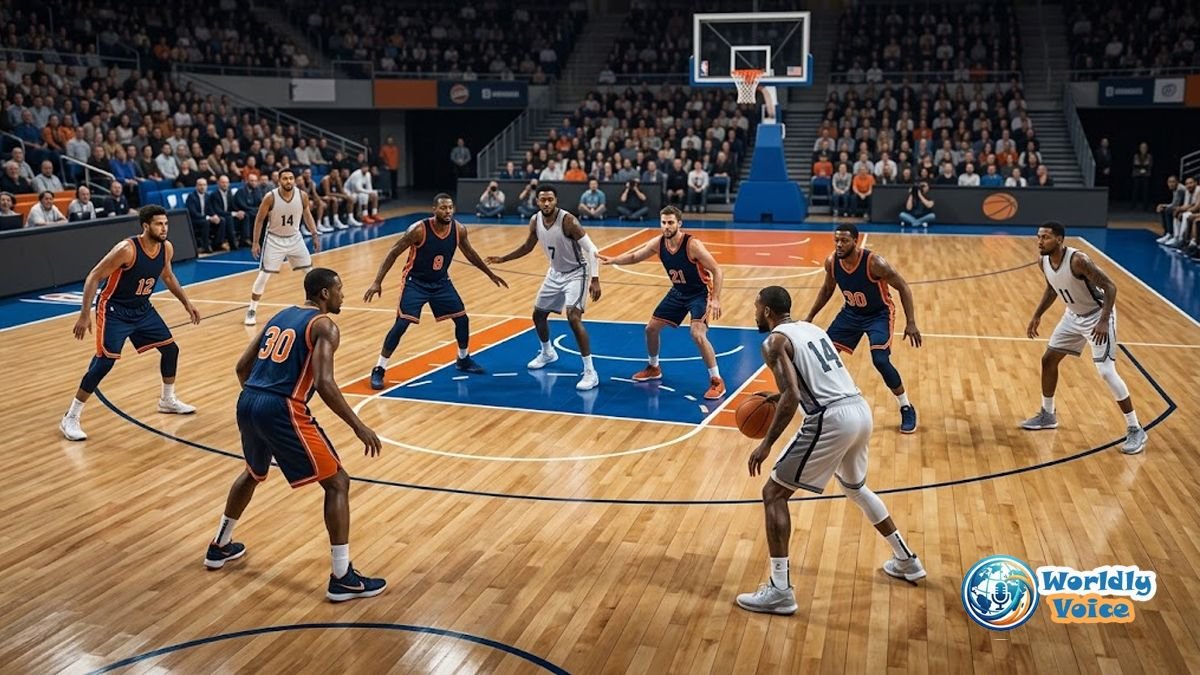
If you are wondering how many players are in the basketball court, the answer is straightforward: in standard 5-on-5 basketball, 10 players are on the court at one time—five from each team. The same basic five-player setup applies in major 5-on-5 competitions such as the NBA, FIBA basketball, and NCAA basketball.
That does not mean a basketball team has only five players available for an entire game. Teams can have substitutes on the bench, and coaches can replace players during legal substitution opportunities. The five players actually participating can therefore change many times during a game.
There are also different versions of basketball. For example, FIBA 3×3 uses three players per team on a half-court, so only six players are on the court.
Understanding the difference between players on the court, starters, substitutes, positions, and team rosters makes the answer much clearer.
How Many Players Are on a Basketball Court at Once?
In standard 5-on-5 basketball, there are:
- 5 players from Team A
- 5 players from Team B
- 10 players total on the court
So, if someone asks, “How many players on the court at once?”, the standard answer is 10.
The five players representing each team form that team’s on-court unit. Other eligible players remain on the bench until a substitution is made.
FIBA’s official rules require each team to have five players ready to play at the beginning of a standard game. Its rules also explain that a team may continue with fewer than five later in unusual circumstances, such as injuries or disqualifications.
| Basketball format | Players per team on court | Total players on court |
|---|---|---|
| NBA | 5 | 10 |
| FIBA 5-on-5 | 5 | 10 |
| NCAA | 5 | 10 |
| FIBA 3×3 | 3 | 6 |
The important distinction is that five players are on the floor for each team, not that a complete basketball team necessarily contains only five players.
How Many Players Does a Basketball Team Have?
The number of players associated with a basketball team can vary depending on the competition and the specific roster rules.
It helps to think about a team in four layers:
Basketball team roster → eligible/active players → starting five → players currently on court
The basketball team roster can contain more players than the five currently playing. Those additional players provide substitutions throughout the game.
In FIBA basketball, the official rules distinguish the five players who start the game from substitutes. The coach identifies the five starters before the game begins, while substitutes can enter during the game according to the applicable substitution rules.
The NBA also distinguishes its starting lineup from the broader group of eligible players and has specific rules governing substitutes.
This is why saying “a basketball team has five players” can be misleading. Five is the number of players from each team normally on the court, not necessarily the total number of players associated with the team.
What Is the NBA Team Player Limit on Court?
The NBA team player limit on court is five players for each team during normal play. That means a standard NBA game has 10 players on the court—five wearing each team’s uniform. The NBA’s official Rule No. 3 states that each team consists of five players and contains specific provisions for unusual situations involving disqualified or injured players.
The NBA also requires teams to provide the names and numbers of their starting players before the game. A starter does not have to remain on the floor for the entire contest, however. Coaches can make substitutions under the league’s rules.
There are rare situations in which the normal five-player arrangement becomes complicated. For example, the NBA rulebook contains provisions for situations in which all available substitutes have been disqualified. These rules are designed to prevent a team from being reduced below the permitted number simply because of accumulated fouls or other unusual circumstances.
For readers interested in NBA basketball rules, this is an important distinction: the normal on-court number is five per team, but the rulebook also accounts for exceptional game situations.
What Are the Five Basketball Team Positions?
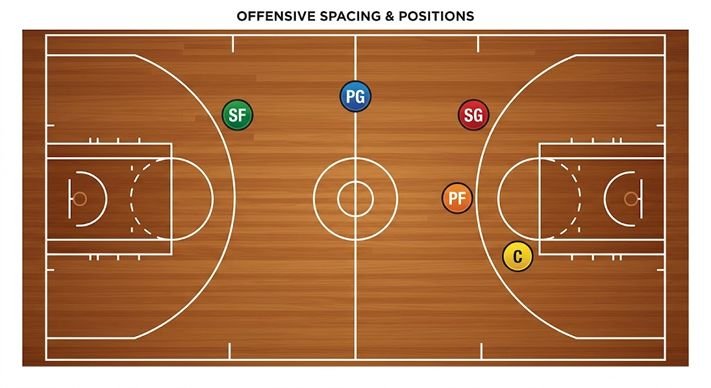
Traditional basketball player positions divide the five players into different roles:
- Point Guard (PG)
- Shooting Guard (SG)
- Small Forward (SF)
- Power Forward (PF)
- Center (C)
These labels are useful for understanding traditional team structure, although modern basketball is much more flexible than the old position-by-position model.
Point Guard
The point guard traditionally acts as a primary ball handler and helps organize the offense. This player often brings the ball up the court, starts offensive actions, passes to teammates, and creates scoring opportunities.
A point guard does not necessarily have to be the team’s best scorer. Court vision, decision-making, ball control, and passing are often central responsibilities.
Shooting Guard
The shooting guard is traditionally associated with perimeter scoring and shooting. A shooting guard may also handle the ball, defend opposing guards, cut without the ball, and create shots for teammates.
The distinction between point guard and shooting guard can become less obvious in modern offenses because many guards perform both roles.
Small Forward
The small forward is traditionally a versatile player who can contribute both around the perimeter and closer to the basket.
Depending on the team’s strategy, a small forward might score, rebound, defend multiple positions, pass, or help create space for other players.
Power Forward
The power forward traditionally operates closer to the basket than the guards and contributes to rebounding, interior defense, and scoring.
Modern power forwards may also shoot three-pointers and spend significant time outside the paint, making the position more versatile than its traditional description suggests.
Center
The center is traditionally the team’s main interior player. Centers commonly contribute through rebounding, rim protection, screening, and scoring near the basket.
However, many modern centers can also pass and shoot from outside, so the position should not be viewed as a rigid job description.
What Is a Starting Lineup in Basketball?
The starting lineup basketball rules are relatively easy to understand: each team begins a standard 5-on-5 game with five designated starters.
These five players are commonly called the basketball starting five.
Being named a starter does not mean a player must stay on the court for the whole game. A coach can substitute another eligible player, and the original starter can generally return later according to the competition’s substitution rules.
The starting lineup therefore represents the players selected to begin the game, not a permanent group of five.
For example, a coach might begin with:
- Point guard
- Shooting guard
- Small forward
- Power forward
- Center
After several minutes, the coach could replace two starters with bench players. The team still has five players on the court; only the identity of those five has changed.
Can Basketball Players Be Substituted During the Game?
Yes. Basketball substitutions are a normal part of the sport.
A substitution occurs when an eligible player on the bench replaces a player who is currently participating. The precise procedure varies between competitions, so NBA procedures should not automatically be applied to FIBA or NCAA games.
Substitutions can be used for several practical reasons:
- Giving a tired player a rest
- Replacing a player in foul trouble
- Changing the team’s defensive matchup
- Adding shooting or ball-handling
- Responding to an opponent’s strategy
- Replacing an injured player
The key point is that substitutions normally change which five players are on the court, not the normal number of players per team.
How to Play Basketball
For someone learning how to play Basketball, the basic objective is simple: two teams attempt to score more points than their opponent while defending their own basket.
Players advance the ball primarily through dribbling and passing. They can then attempt field goals or free throws.
Scoring generally works like this in standard basketball:
- Free throw: 1 point
- Field goal inside the three-point area: 2 points
- Three-point field goal: 3 points
The defending team tries to prevent scoring by contesting shots, defending passing lanes, forcing turnovers, and securing rebounds.
Basketball also depends heavily on teamwork. A player may give up an open shot to pass to a teammate, set a screen to create space, or move without the ball to make an offensive play possible.
That is one reason the five-player structure works strategically: the team must balance ball handling, scoring, passing, defense, rebounding, and spacing.
If you’re exploring broader Education topics, basketball also offers a useful example of how rules, roles, and strategy work together in organized competition.
What Are the Basic Basketball Rules?
The core basketball rules are designed to keep the game organized and prevent players from gaining an unfair advantage.
At a beginner level, some of the most important principles are:
- Two teams compete against each other.
- Standard basketball uses five players per team on the court.
- The objective is to score more points than the opposing team.
- Players can pass and dribble the ball.
- A player cannot illegally travel while controlling the ball.
- The ball must remain within the boundaries according to the applicable rules.
- Certain physical contact is considered a foul.
- Teams must comply with possession and timing rules, including the shot clock where applicable.
Rules are not identical across every basketball competition. FIBA specifically notes that its rules differ in some respects from NBA, WNBA, and NCAA rules.
That distinction matters if you are comparing international basketball with professional or college basketball.
Common Basketball Rules Violations
New players often confuse a violation with a foul. A violation generally concerns breaking a procedural or gameplay rule, while a foul typically involves illegal physical contact or certain prohibited conduct.
Here are several common basketball rules violations.
Traveling
Traveling occurs when a player moves illegally while controlling the ball instead of maintaining a legal dribble or complying with the applicable pivot-foot rules.
Double Dribble
A double dribble generally occurs when a player ends a dribble and then starts another dribble without a qualifying intervening action.
Carrying or Palming
This involves illegally placing the hand underneath or otherwise controlling the ball in a manner that violates the dribbling rules.
Out of Bounds
The ball becomes out of bounds when it touches a boundary area or a player who is out of bounds, subject to the exact rules of the competition.
Backcourt Violation
In general, once a team has established control in the frontcourt, it cannot illegally return the ball to the backcourt.
Three-Second Violation
Certain competitions restrict how long an offensive player may remain in the restricted area near the basket. The precise rule and interpretation depend on the governing rules.
Shot-Clock Violation
A team must attempt a shot within the applicable shot-clock period. If it fails to do so, possession is awarded to the opponent.
Goaltending and Basket Interference
These are specialized rules concerning attempts to interfere illegally with a shot or the ball around the basket. The detailed definitions vary according to the governing rulebook.
For competitive play, the official rulebook is the appropriate source for exact interpretations rather than relying on simplified descriptions.
What Is the Difference Between a Violation and a Foul?
A violation and a foul are not the same thing.
A violation commonly involves an action such as:
- Traveling
- Double dribbling
- Going out of bounds
- Violating the shot clock
- Committing an illegal backcourt action
A foul, by contrast, generally involves illegal physical contact or certain types of prohibited behavior.
The NBA defines a common personal foul in terms of illegal physical contact after the ball becomes live.
The distinction is useful for beginners because not every time a player breaks a rule does the referee call a foul.
How Many Players Are on the Court in Different Basketball Formats?
The answer depends on the format.
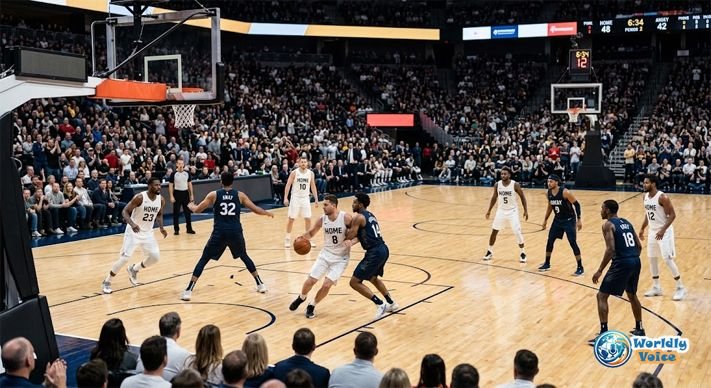
5-on-5 basketball uses five players from each team, producing 10 players on the court. This is the format associated with the NBA, FIBA’s standard game, and NCAA basketball.
FIBA 3×3 is different. It is played on a half-court with three players from each team, so there are six players on the court. FIBA describes each 3×3 team as three players plus one substitute in its official format.
| Format | Players per team | Total on court |
|---|---|---|
| NBA 5-on-5 | 5 | 10 |
| FIBA 5-on-5 | 5 | 10 |
| NCAA basketball | 5 | 10 |
| FIBA 3×3 | 3 | 6 |
The NCAA maintains separate official men’s and women’s basketball playing rules, while FIBA publishes its own international rules.
Why Are There Five Players on a Basketball Court?
Five-player basketball provides enough players for teams to distribute responsibilities while still leaving meaningful space on the court.
The traditional five positions allow a team to combine:
- Ball handling
- Playmaking
- Perimeter shooting
- Interior scoring
- Rebounding
- Individual defense
- Team defense
- Offensive spacing
The positions are not rigid requirements. A modern team might have five players who can all pass, shoot, defend, or handle the ball to varying degrees.
That flexibility is one reason the traditional labels—point guard, shooting guard, small forward, power forward, and center—are still useful for describing players even though modern offenses often operate without fixed positions.
Frequently Asked Questions
How many players are in the basketball court?
In standard 5-on-5 basketball, 10 players are on the court—five from each team. Players on the bench do not count toward the number currently on the court.
How many players can be on the court at once in basketball?
Normally, five players per team, or 10 players total, can be on the court in standard 5-on-5 basketball.
How many players can an NBA team have on the court?
An NBA team normally has five players on the court at one time. The NBA rulebook also includes special provisions for unusual situations involving disqualified or injured players.
What are the five positions in basketball?
The traditional positions are point guard, shooting guard, small forward, power forward, and center. Modern players often perform responsibilities associated with multiple positions.
How many players are in a basketball starting lineup?
A standard basketball starting lineup contains five players per team. These are the five players selected to begin the game.
How many players are on the court in 3×3 basketball?
FIBA 3×3 has three players from each team on the court, making six players in total. Each official 3×3 team also has one possible substitute.
Conclusion
So, how many players are in the basketball court during a normal game? The answer is 10 players in standard 5-on-5 basketball: five players from each team.
Those five players form the team’s on-court unit and traditionally occupy the point guard, shooting guard, small forward, power forward, and center roles. Substitutions can change which players are participating, but the normal number remains five per team.
The answer changes in alternative formats. FIBA 3×3, for example, has three players per team on a half-court.
For beginners, the easiest way to remember the rule is 5 + 5 = 10. From there, understanding the starting five, substitutes, positions, violations, and competition-specific rules provides a much clearer picture of how basketball is actually played.
